
The Shortlived Luxury German Sedan With A Hypercar Engine
The global financial crisis of 2008 permanently reshaped corporate product strategy across the automotive industry. Before the economic crash, manufacturers routinely approved expensive halo projects to demonstrate technical authority regardless of bottom-line profitability. The market collapse forced executive boards to cancel low-margin programs, eliminate bespoke low-volume engines, and consolidate vehicle architectures.

Automakers redirected capital away from prestige sedans toward high-volume SUVs, downsized turbocharged engines, and shared modular platforms. Modern manufacturing relies heavily on component sharing to protect profit margins. The crisis effectively ended the era of building over-engineered, money-losing flagship cars solely to claim industry dominance.
The 2008 Financial Crisis Changed Automotive Direction
The global financial crisis of 2008 permanently reshaped corporate product strategy across the entire automotive industry. Prior to the market crash, global automakers routinely approved expensive, low-volume halo programs to demonstrate technical authority, regardless of direct profitability. The credit collapse forced executive boards to cancel unviable niche platforms, phase out bespoke engines, and consolidate engineering operations.

Automakers redirected development capital away from heavy luxury sedans toward high-volume crossover SUVs, downsized turbocharged engines, and shared modular platforms. Modern car manufacturing now relies heavily on global component sharing and scalable architectures to protect corporate profit margins against economic volatility. The recession effectively ended the era of building over-engineered, money-losing flagship vehicles solely to claim technological dominance.
The Volkswagen W12 Phaeton Is An Underloved Luxury Sedan

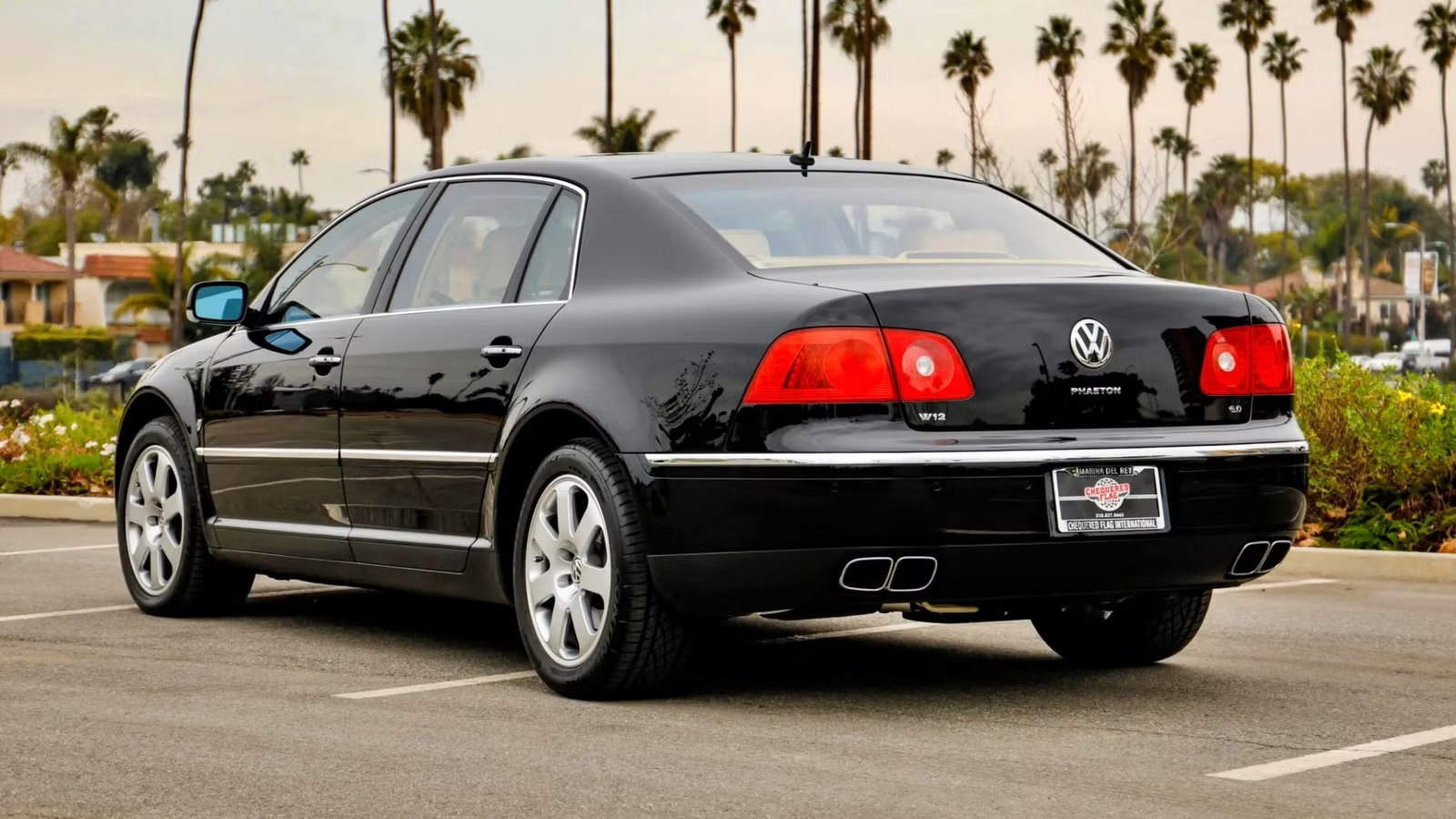
Volkswagen introduced the Phaeton W12 to North America for the 2004 model year as the absolute summit of its brand lineup. Positioned far above the midsize Passat sedan, the Phaeton entered dealership showrooms alongside budget hatchbacks and economical family cars. Volkswagen assigned the 2004 Phaeton W12 a starting base MSRP of $94,600, which pushed past $100,000 when buyers selected optional four-seat executive seating packages. Volkswagen sold approximately 3,350 total Phaeton units in North America across its entire multi-year run, with the exclusive W-12 variant accounting for roughly 500 total deliveries.
The model failed commercially in North America primarily because of badge prestige. Buyers spending six figures demanded luxury status symbols and social recognition. Consumers flatly refused to pay Mercedes-Benz S-Class or BMW 7 Series money for an automobile carrying a mass-market Volkswagen emblem. Additionally, Volkswagen dealerships lacked the high-end customer service infrastructure needed to cater to ultra-wealthy luxury buyers.
Despite its poor sales performance, the Phaeton gets a lot of love. Edmunds consumer reviews currently hold the model at a 4.9/5 average score, with its comfort and performance being standout strengths.
VW’s Outrageous Hypercar W-12 Engine

The 2004 Volkswagen Phaeton W-12 pairs impressive output numbers with rapid acceleration metrics. Power transfers through a five-speed ZF automatic transmission featuring Tiptronic manual gear control. Volkswagen linked this transmission to its permanent 4Motion all-wheel-drive system using a mechanical Torsen center differential to optimize traction across all four wheels.
The naturally aspirated 6.0-liter W12 engine generates 420 horsepower at 6,000 RPM and 406 pound-feet of torque at 3,250 RPM. Despite a massive curb weight of 5,399 pounds, the engine propels the large luxury sedan from 0 to 60 MPH in 5.5 seconds. It completes the quarter-mile sprint in 13.9 seconds at a trap speed of 100 MPH.
Volkswagen electronically restricted the top speed to 130 MPH in North America due to factory tire ratings, whereas European variants reached an electronically governed top speed of 155 MPH. Unrestricted models can achieve top speeds near 186 MPH.
Joining Two VR6 Engines Into One

The naturally aspirated 6.0-liter W-12 engine remains a remarkable achievement in modern powertrain packaging. Volkswagen created the dense twelve-cylinder block by pairing two narrow-angle 15-degree VR6 cylinder banks together onto a shared crankshaft at a 72-degree V-angle. This unique engineering solution yielded an exceptionally compact powerplant measuring shorter in overall physical length than a standard inline-four engine.
This compact footprint was essential because it allowed engineers to fit a twelve-cylinder engine into the front bay alongside heavy 4Motion all-wheel-drive differential components. The 48-valve cylinder heads feature double overhead camshafts per bank with continuous variable valve timing to optimize intake and exhaust gas flow across the entire operating range. Beyond its compact dimensions, the W-12 engine delivers remarkable operational balance.
A Suspension Fit For A Luxury Sedan

Volkswagen built the Phaeton on the D1 steel platform, a heavy platform shared directly with the Bentley Continental GT. Volkswagen Chairman Ferdinand Piëch mandated extreme torsional rigidity for the underlying structure. Piëch required the chassis to handle continuous speeds of 186 mph in 122-degree Fahrenheit ambient heat while maintaining a steady 72-degree cabin temperature. The suspension layout utilizes a complex multi-link configuration at all four corners, supported by fully adaptive electronic air springs with continuous damping control.
The air suspension continuously monitors vehicle height, automatically lowering the body at elevated speeds to reduce aerodynamic drag, optimize highway stability, and lower the center of gravity. Stopping power comes from large four-wheel disc brakes clamped by multi-piston calipers, working alongside Hydraulic Brake Assist and electronic brake-force distribution. This setup brings the heavy luxury sedan to a complete stop rapidly without inducing brake fade, even at high speeds. The sophisticated platform architecture allows the vehicle to absorb harsh road imperfections seamlessly while maintaining flat body control and precise handling during hard cornering.
Owning A Phaeton Is An Expensive Feat

Operating a used Phaeton W12 demands significant financial commitment and access to specialized mechanical expertise. Routine oil services require nearly thirteen quarts of high-grade synthetic oil alongside specialized filters, increasing basic upkeep expenses. The engine bay is exceptionally tight, meaning routine repair procedures frequently require mechanics to pull the entire engine and front subframe completely out of the chassis, pushing labor costs up to several thousand dollars per visit.
Common mechanical failure points include the twelve individual coil-on-plug ignition coils, secondary air injection pumps, failing electronic air suspension struts, and leaking valve cover gaskets. Furthermore, clogged plenum windshield drains cause water intrusion into the vehicle footwells, which frequently destroys delicate electronic control modules located beneath the floor carpeting.
Factory recalls over the production lifecycle addressed several specific safety and reliability concerns, including failing trunk lid wiring harnesses that fractured from repeated opening, defective brake light switches, and windshield wiper motors prone to overheating under heavy usage. Potential buyers must budget carefully for these specialized maintenance expenses.
Phaetons Can Be Bought For A Steal

The Volkswagen Phaeton W12 has settled into an intriguing price niche within the second-hand car market. Depreciating sharply from its original six-figure price tag, high-mileage examples or vehicles requiring mechanical repairs trade between $5,000 and $9,000. Well-maintained, low-mileage W-12 sedans accompanied by documented service records command prices ranging from $12,000 to $20,000 at specialized enthusiast auctions.
While purchase prices remain accessible, potential buyers recognize that replacement component costs reflect the car’s original $95,000 price tag rather than its current market value. Collectors who appreciate engineering history continue to purchase preserved W-12 models as pristine historical artifacts from Volkswagen’s most daring era of automotive development.
Sources: Volkswagen, Hagerty, J.D. Power, and Edmunds.

Related posts

Latest Post


No Comments