
The 2027 Hayabusa Announcement Raises One Big Question: Did Suzuki Change What Matters?
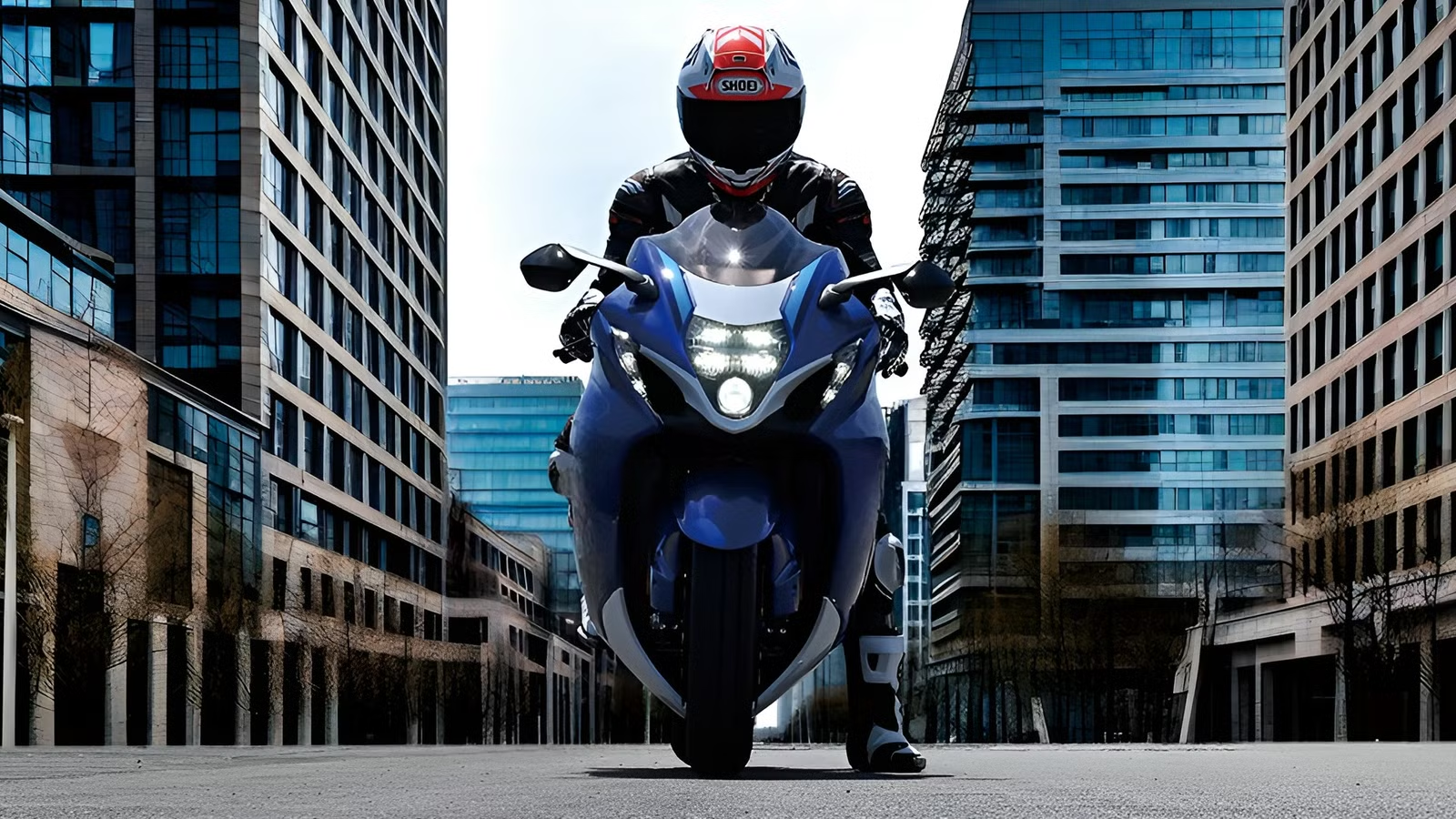
Suzuki’s 2027 Hayabusa announcement landed on July 15, and the community reaction followed a familiar script: scan the spec sheet, find what changed, then argue about whether it should have. The headline news is a special edition colorway—Pearl Brilliant White and Metallic Oort Gray with red accents, priced at $20,399—but the more loaded story is what Suzuki left exactly where it was.

The 1,340cc inline-four returns unchanged in displacement. The twin-spar aluminum frame stays. The 264 kg wet weight holds, with only 2 kg trimmed despite a round of chassis refinements. For loyalists who’ve tracked every generation since the unrestricted 1999 original hit 194 mph and triggered an industry-wide gentlemen’s agreement, that continuity reads as either principled restraint or a missed opportunity—depending on which corner of the Hayabusa world you’re standing in.
What Suzuki Actually Changed for 2027
The confirmed mechanical spec for 2027 is largely a carry-forward from the third-generation platform. The 1,340cc four-cylinder produces 187 bhp and 150 Nm of peak torque—figures that already reflect the Euro 5 emissions compliance hit the model absorbed when it relaunched, dropping from 197 hp to 190 hp. The torque curve was reworked to be rounder and more responsive at low and mid-range speeds, which Suzuki framed as a net gain for real-world rideability even as the peak number fell.

Electronics remain comprehensive. The Suzuki Intelligent Ride System (S.I.R.S.) bundles adjustable traction control, power delivery modes, Launch Control, and Motion Track ABS. A bi-directional quickshifter and Smart Cruise Control are standard. Braking comes from Brembo Stylema front calipers with the Motion Track Brake System. KYB inverted forks with DLC-coated 43mm inner tubes handle the front suspension. None of that is new for 2027—it’s the established third-gen package, now dressed in new colors.
The Power Number That Still Stings

The emissions story is worth sitting with, because it cuts to the heart of the Hayabusa’s identity. The 1999 original was built around one explicit goal: become the fastest production motorcycle on the planet. It hit 191–194 mph in independent testing, and the number was the point. Every subsequent generation has carried that legacy while operating under the 299 km/h gentlemen’s agreement cap—which means the peak power figure has become the last remaining scoreboard.
When that number goes down, it upsets people. The 7 hp reduction from 197 hp to 190 hp driven by Euro 5 compliance wasn’t unique to the Hayabusa—the 2027 Kawasaki Ninja H2 took a far more severe hit, dropping from 228 hp to 197 hp under EPA Tier 4 rules—but context doesn’t fully soften the sting. The Hayabusa was never supposed to be the bike that lost horsepower. For the generation that remembers the unrestricted 1999 model and its 220 mph speedometer, any downward movement on the spec sheet feels like a philosophical retreat, even if Suzuki’s engineers argue the torque curve improvement makes the bike faster where it counts.
What Suzuki Conspicuously Didn’t Touch

The silences in the 2027 announcement are as telling as the updates. The frame architecture is unchanged. The bodywork—that bulbous, peregrine falcon-inspired silhouette with stacked headlights that became one of motorcycling’s most recognizable shapes—remains intact. Weight reduction was minimal. There’s no new engine architecture, no displacement bump, no major aerodynamic overhaul.
For a segment of the Hayabusa community, that’s exactly right. The argument goes that Suzuki has already found the formula: a long-stroke, torque-heavy four-cylinder in a chassis tuned for high-speed stability and touring comfort, wrapped in bodywork that’s aerodynamically serious without being track-aggressive. The 2027 doesn’t fix what isn’t broken. For another segment, the lack of meaningful mechanical evolution raises a harder question—whether Suzuki is actively developing the Hayabusa’s performance identity or simply refreshing a platform that’s now several years old.
Evolution Or Dilution—Where The Community Lands

The Hayabusa has always attracted riders who care about the whole package: top-speed credibility, long-haul comfort, and a character that separates it from track-focused superbikes. That dual identity is precisely why the debate over modernization cuts so deep. Adding Smart Cruise Control and a full electronics suite makes the bike more capable and more accessible—but it also moves it further from the raw, unmediated experience of the 1999 original, which remains the only Hayabusa sold without electronic intervention of any kind.
The honest read on 2027 is that Suzuki is managing continuity, not chasing headlines. The Special Edition packaging and colorway refresh suggest a brand keeping a loyal base engaged rather than recruiting new riders with a ground-up reinvention. Whether that’s enough—whether the Hayabusa’s identity survives intact through another generation of emissions-driven constraints and incremental updates—is the question the announcement leaves open. For now, the speed king still wears the crown. The debate is about how long that framing holds.

Related posts
Latest Post


No Comments