
The Motorcycle That Makes Adventure Riding Less Intimidating
Adventure riding has developed a bit of an image problem. Scroll through social media, and it can look like it requires a toweringmotorcycle, advanced off-road training, several thousand dollars’ worth of equipment, and the confidence to drag a 500-pound machine through terrain that would make a mountain goat reconsider its life choices. Plenty of riders have much simpler ambitions. They want to explore gravel roads, local trails, rural shortcuts, and the occasional route that disappears from the navigation screen halfway through. For that kind of riding, the best starting point may not be a traditional adventure motorcycle at all.
Adventure Bikes Have Become Bigger Than Many Adventures Require

Modern adventure motorcycles are exceptionally capable, but much of that capability is built around crossing countries rather than exploring the trail behind town. Large fuel tanks, passenger accommodations, wind protection, integrated luggage, powerful engines, and complex electronics all make sense on a long journey. They also add weight, height, cost, and a growing collection of expensive pieces waiting to meet the ground.
Weight Matters More When The Pavement Ends

Horsepower sells motorcycles, but manageable weight often builds confidence. A lighter machine is easier to balance at walking pace, redirect around obstacles, and rescue when the front wheel follows the wrong rut. It’s also far less intimidating to pick up after a fall, which matters because falling over is a normal part of learning off-road rather than evidence that the rider has brought shame upon the family.
Less mass also reduces the consequences of hesitation. Riders can dab a foot, stop on an awkward incline, or correct a poor line without immediately fighting hundreds of pounds of momentum. That encourages experimentation instead of survival-mode riding. When a motorcycle doesn’t punish every mistake, beginners have enough mental space left to improve their clutch control, braking technique, body position, and awareness.

The Most Approachable Adventure Motorcycle Isn’t Always An Adventure Bike

A small dual-sport can deliver the part of adventure riding that many owners actually use. It can commute through the week, legally connect separate trail systems, handle broken pavement, and continue when an ordinary street bike has reached the end of its comfort zone. It sacrifices some highway refinement and luggage capacity, but it also avoids surrounding the rider with unnecessary size and complexity.
Simplicity shouldn’t be confused with limited capability. Modest power encourages smooth throttle inputs rather than dramatic wheelspin, while a narrow chassis makes it easier to move around and stand on the footpegs. Conventional mechanical components can also make maintenance less mysterious for riders who are learning how to adjust a chain, clean an air filter, or fix minor damage without submitting a service request through mission control.
The Kawasaki KLX230 Makes Adventure Riding Less Intimidating

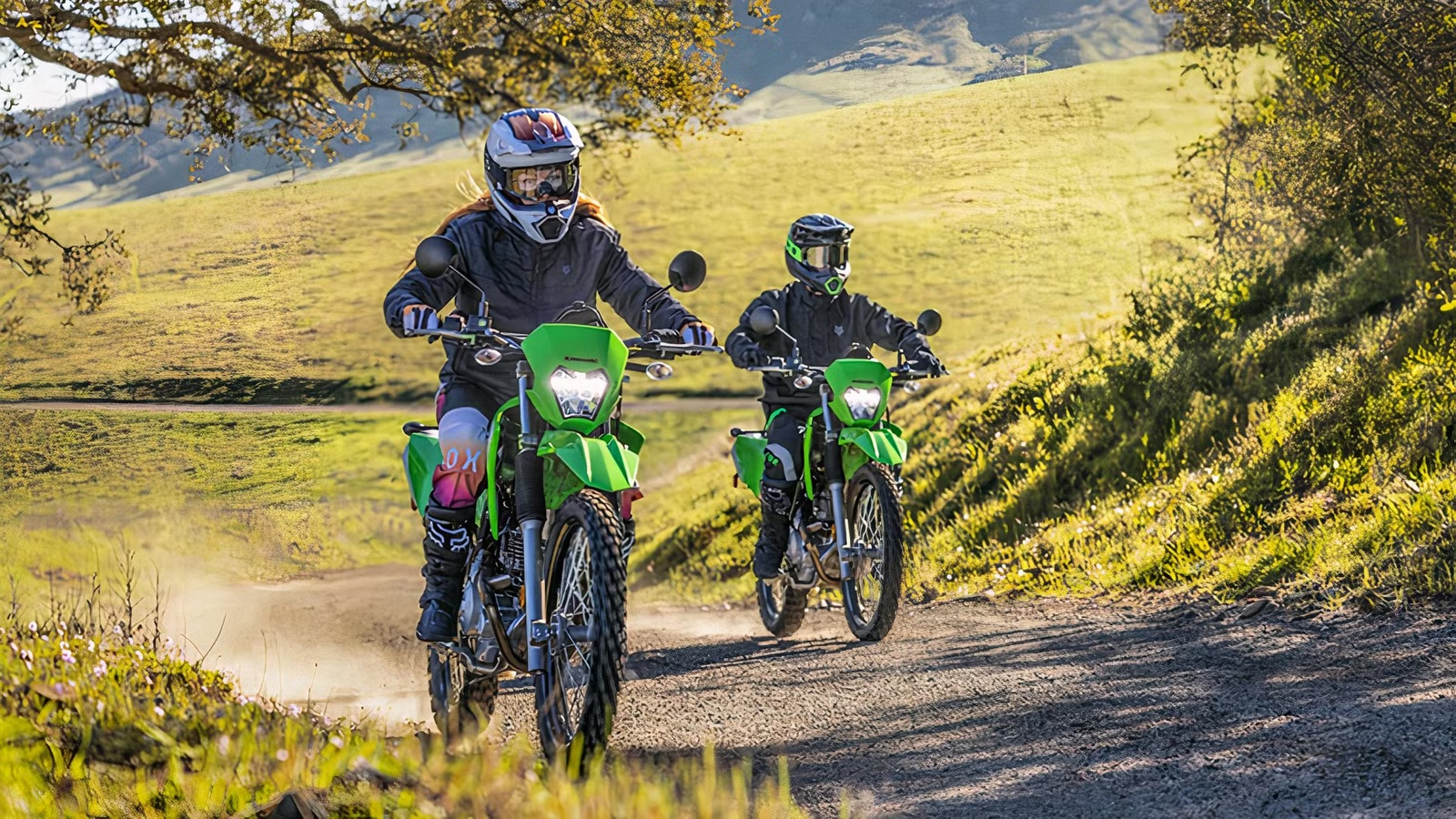
The Kawasaki KLX230 S fits that philosophy almost perfectly. The latest version is powered by a fuel-injected, air-cooled 233cc four-stroke single-cylinder engine with a single overhead cam and two valves. It uses a six-speed transmission, chain final drive, electric starter, and a simple steel perimeter frame rather than chasing large horsepower figures or highway-dominating performance.
Its full-size wheel combination matters more than the engine’s output. A 21-inch front and 18-inch rear wheel help the bike roll across rocks, holes, and rough surfaces that can deflect smaller wheels. Kawasaki fits a 2.75 x 21 front tire and 4.10 x 18 rear tire, backed by a 265mm front petal disc with a dual-piston caliper and a 220mm rear disc with a single-piston caliper. The ABS system can also be switched off when conditions call for it.
Suspension consists of a 37mm telescopic fork offering 7.9 inches of travel and a Uni-Trak rear setup with preload adjustment and 8.8 inches of travel. Ground clearance is a useful 9.4 inches, while the compact two-gallon tank keeps the motorcycle narrow between the rider’s knees. The latest model also includes an LCD instrument panel with smartphone connectivity through Kawasaki’s Rideology mobile app. The KLX230 S ABS carries a $5,499 MSRP, while the non-ABS KLX230 S can be yours for $5,199, giving shoppers a less expensive entry point into the dual-sport world.
A Lower Seat Makes Learning Less Stressful

The “S” in the model name identifies the more approachable version, with a 33.3-inch seat height that makes reaching the ground easier than on many full-size dual-sports. That extra confidence matters when stopping on loose gravel, turning around on a narrow trail, or balancing on an uneven camber. Riders won’t necessarily plant both feet flat, but they have less distance to manage when momentum suddenly disappears. Despite the lower seat, the KLX230 S doesn’t shrink its wheels or discard useful suspension travel. It measures 81.9 inches long, 33.3 inches wide, and 44.9 inches tall, with a 53.7-inch wheelbase. Kawasaki lists a 50-state curb weight of 290.9 pounds, or 288.9 pounds for the 49-state version. That still isn’t bicycle-light, but it’s vastly easier to manage than an adventure motorcycle weighing well beyond 450 pounds.
The KLX230 Family Offers Several Different Ways To Explore

The KLX230 name now covers several machines aimed at different interpretations of lightweight riding. The standard S remains the straightforward street-legal dual-sport, while the Sherpa S ABS leans further toward approachable exploration. The DF ABS adds protection and utility equipment, the SM trades dirt-focused wheels for supermoto hardware, and the R models remove street equipment entirely for dedicated trail use.
The $5,899 Sherpa S ABS drops the seat to 32.5 inches and adds a more utilitarian trail-bike character. The $5,999 DF ABS keeps a 33.3-inch seat but gains items such as an aluminum skid plate and additional protective equipment. Meanwhile, the $5,799 KLX230SM ABS uses 17-inch road wheels for pavement-focused riding and that unmistakable supermoto silhouette, while the $4,999 KLX230R and KLX230R S are off-road-only motorcycles.
Less Motorcycle Can Lead To More Adventure

Adventure riding is often marketed through motorcycles built to cross continents, but confidence usually develops much closer to home. A manageable dual-sport can teach more on a gravel road 20 miles away than a premium ADV parked in the garage because its owner is nervous about scratching it. The smaller bike may carry less luggage and surrender highway speed, yet it can make exploration far more accessible.
The KLX230 doesn’t remove the challenge from off-road riding, nor should it. Instead, it removes some of the barriers that discourage riders from trying: excessive weight, intimidating dimensions, complicated equipment, and premium-bike pricing. Its greatest strength isn’t that it can conquer every landscape on Earth. It’s that when the pavement ends, and an unfamiliar trail appears, the rider might actually want to take it.
Source: Kawasaki

Related posts
Latest Post


No Comments