
Kawasaki Disguised Its Secret Superbike In Honda Paint To Beat The CB750
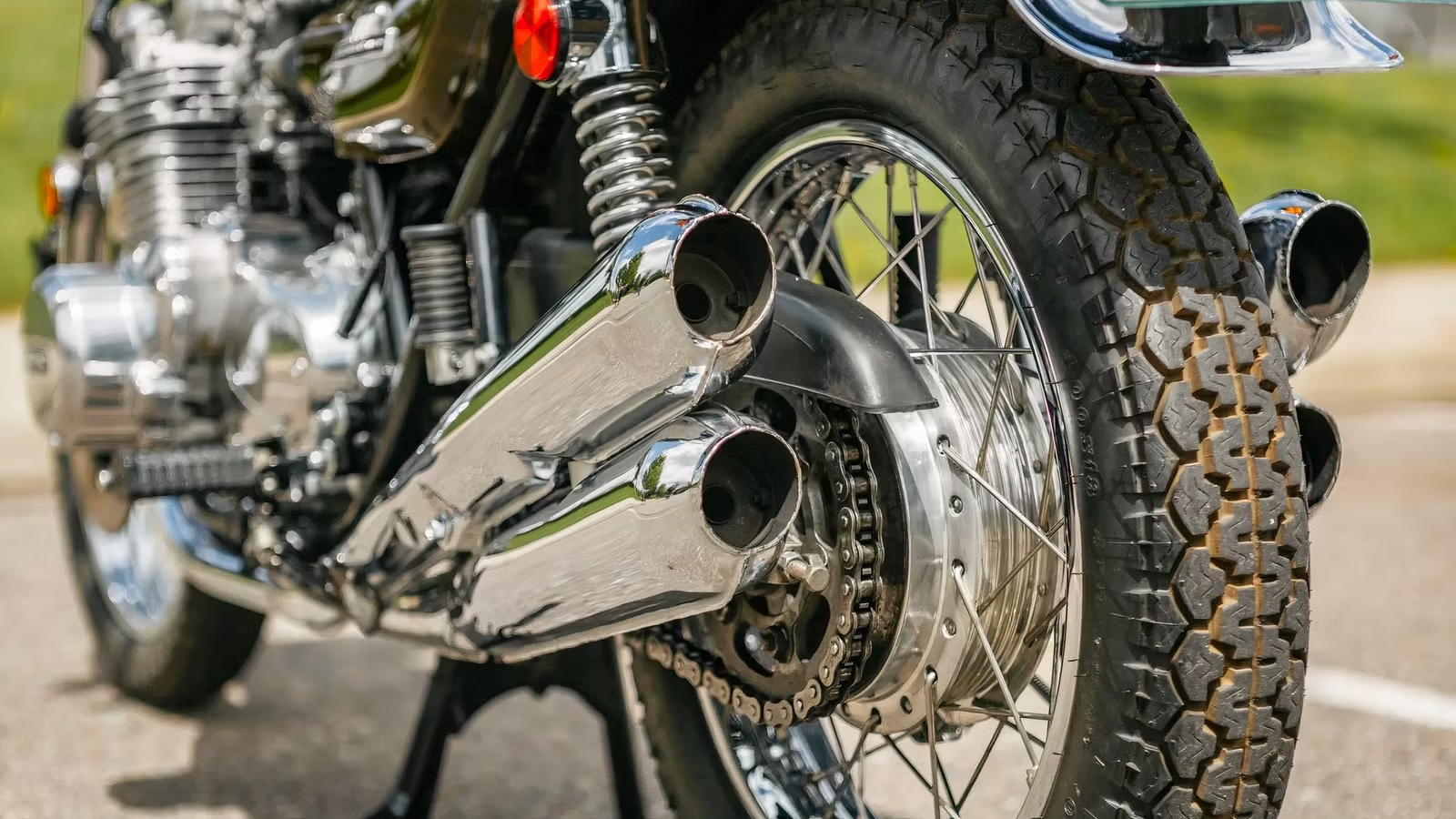
The year 1969 represented a massive turning point for the entire motorcycle industry, initiated by the release of Honda’s legendary CB750 Four. It represents one of the most important chapters in motorcycling lore, because the CB750 was an absolute game-changer on so many levels. Not only did it democratize the inline-four engine layout while being faster and orders of magnitude more reliable than contemporary performance bikes from Britain, but it also pioneered the use of a disc brake on production motorcycles and felt considerably smoother than British twins. The CB750’s launch kicked off the golden age of Universal Japanese Motorcycles (UJMs), and many enthusiasts point to it as the world’s first superbike.
Changing The Two-Wheeled Landscape Forever

Fitted with a 736cc inline-four that could produce 67 horsepower and 44 lb-ft of torque, Honda’s flagship could hit speeds of up to 124 mph. It did all this without demanding a premium over its rivals, so the CB750 became the obvious choice for many buyers. British manufacturers struggled to keep up and were eventually faced with bankruptcy, whereas other Japanese brands followed Honda’s lead toward widespread global success. But what you may not know is that Honda almost wasn’t the one to open the floodgates in the late sixties, because Kawasaki was also working on a recipe similar to the CB750 at the time of its release. Had development progressed just a little more slowly, the pages of motorcycling history might have told a very different tale.
Glory Was Within Kawasaki’s Reach, Then Honda Stole It

Kawasaki’s thinking was along the same lines as Honda’s — to develop a 750cc motorcycle with four cylinders and groundbreaking performance. Dubbed “New York Steak” (and sometimes referred to as N600), the project looked extremely promising as it went through testing and neared its final stages, but the plan fell apart when the Honda CB750 broke cover at the Tokyo Motor Show in October 1968.

Despite that, Kawasaki wasn’t willing to just throw in the towel and let more than a year’s hard work on its DOHC inline-four prototype go to waste, so the New York Steak was instead used as the basis for something bigger and better. The company was back with a vengeance by 1972, delivering the fastest production bike in existence at the time and a true icon of the UJM heyday.
The Kawasaki Z1 900 Took Just About Everything To The Next Level

Kawasaki’s unwillingness to accept defeat paid off with the release of the legendary Z1 in ‘72, surpassing Honda’s flagship in every way that mattered. At its core, it had a 903cc inline-four with eight valves operated via dual overhead cams, inhaling through a quartet of 1.1-inch Mikuni carbs. Compression was rated at 8.5:1, and the engine’s power made its way to the rear wheel by means of a five-speed transmission. At 8,500 rpm, the mill reached a peak output of 82 hp — 15 more than the CB750 and more than enough to make the Kawi considerably faster. Torque was also stronger at 54 lb-ft, and the Z1 boasted a top speed of around 135 mph. Moreover, it managed to complete the quarter-mile sprint in just 12.61 seconds according to a period test performed by Cycle World.
Now, the less informed among us might assume the DOHC arrangement was a reactionary move to gain the upper hand over the first-gen CB750’s single-cam layout. But Kawasaki planned on using twin camshafts ever since the earlier development phases of the N600 project, before Honda had even lifted the covers off its four-banger. Another interesting piece of lore is the way Kawasaki took the first Z1 prototypes out for road testing in the United States, as keeping it a secret until the right moment was absolutely crucial for maximum impact. And the method used to guarantee that secrecy was genuinely creative, though it would be far harder to pull off today with smartphone cameras virtually everywhere and social media posts just a few taps away.
How The Z1 Was Kept Hidden From Prying Eyes

When the new prototypes (then codenamed V1) went out to be tested on U.S. roads, Kawasaki had them disguised in Honda paint and badges to keep the bike’s true identity under wraps. The Z1’s development wasn’t just longer than many people realize — it also involved genuine covert operations for everything to work out as well as it did. It’s a detail often lost in the retelling of this iconic UJM’s story, yet one that makes it all the more captivating with an additional layer of intrigue. Kawasaki’s plan clearly worked, because no one expected its 903cc DOHC machine to arrive and steal the CB750’s crown in such spectacular fashion. All these years later, we are still marveling at its story and feeling the ripple effect of its colossal impact.
From Undercover CB Slayer To Cult Classic Treasure

When you take all the details of the Z1’s fascinating tale into account, it’s no wonder that it commands so much respect and admiration among enthusiasts today. It is undoubtedly one of the most precious vintage UJMs you can get your hands on, and current prices on the second-hand market tend to accurately reflect all that clout. The cleanest Z1s are commonly sold for more than $20,000 at auction, with one specimen fetching $28,500 on Bring a Trailer last year. Another was sold for $26,500 in May 2023, and the most recent Bring a Trailer sale took place in June of this year for 20 grand. Clearly, buyers are willing to pay a premium for something with this much historical significance, even if Kawasaki produced a large number of units during the model’s production run.
Around 85,000 units are believed to have been built between 1972 and 1976, which was also the period when Kawasaki’s superbike held the title of the world’s fastest production motorcycle. It showed the industry how it was done before bowing out gracefully, while Honda allowed the first-generation CB750 to fade away without any meaningful changes. Once again, it bears noting how different things might have turned out if Kawasaki had finished developing its New York Steak just a bit earlier, practically rendering the Honda CB750 irrelevant and fundamentally changing a whole chapter of motorcycle history. That’s why exploring its story in depth is so rewarding, and it should be considered essential knowledge for every enthusiast who values classic Japanese heritage.
Sources: Cycle World, Kawasaki, Bring a Trailer

Related posts


Latest Post


No Comments