
Ferrari 849 Testarossa Spider driven: a 1036bhp, top-down triumph
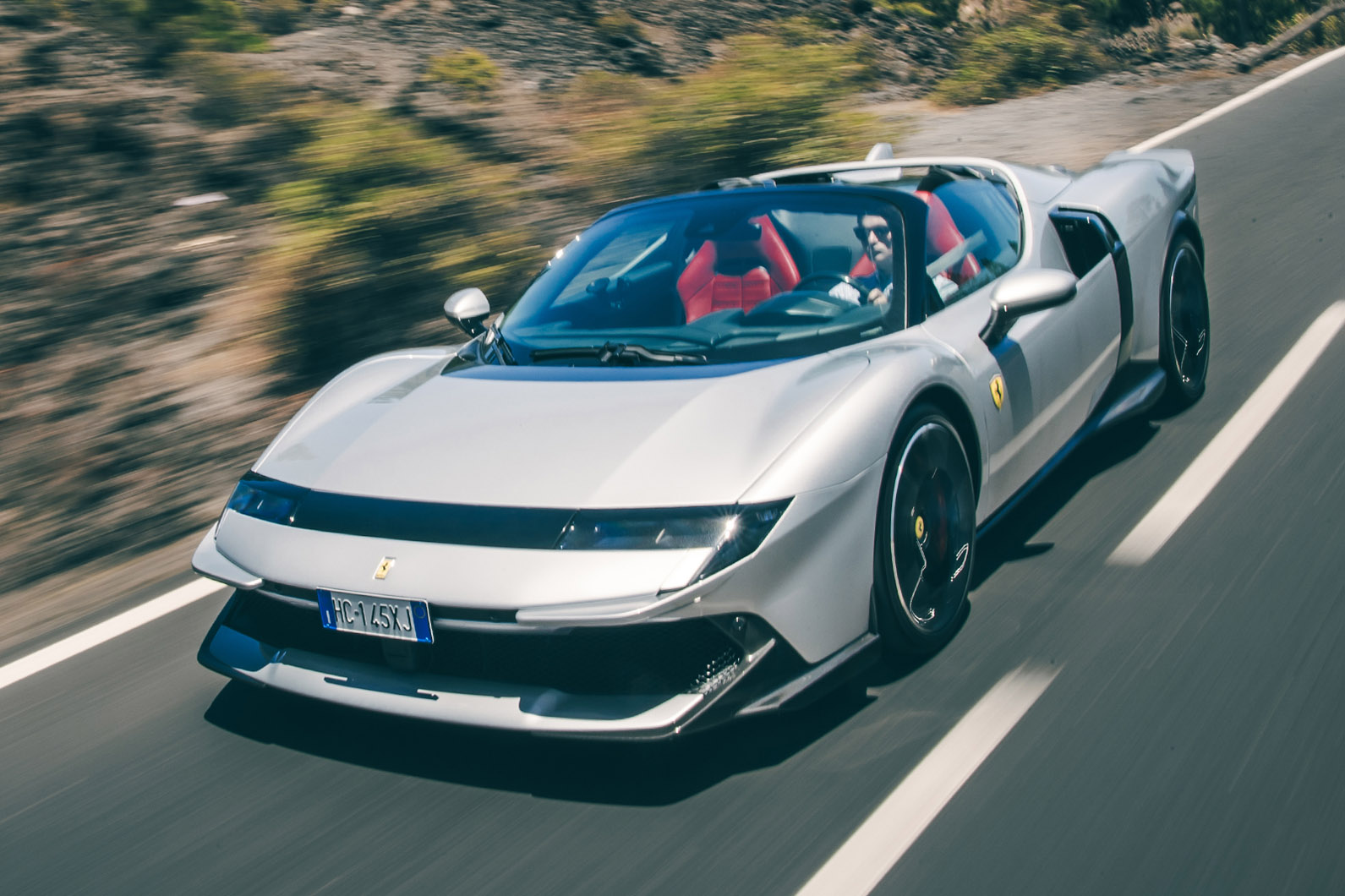
The 849 uses an evolved version of Ferrari’s plug-in hybrid V8 powertrain, with the combustion engine supplying 819bhp and the electric element chipping in another 217bhp to give total combined outputs of 1036bhp and 641lb ft.
The electric part of this system comprises two radial-flux motors on the front axle, which drive a wheel each through independent transmissions to give fully asymmetric torque-vectoring abilities, and an axial-flux MGU-K between the engine and the gearbox (like in a Formula 1 car), which can either work as a generator to top up the battery or to provide extra power under load.

The 7.45kWh battery itself can’t be DC charged but can be fully replenished in just a few miles if you drive calmly in ICE-only Qualifying mode. Then you can expect around 15 miles of EV range outright. Scoff you may at the notion of actively choosing to shut off the V8 while driving, but there’s much to be said for being able to leave the house – or the city – in silence and start making noise when you hit the good roads.
Ferrari is keen to emphasise that removing the roof doesn’t take anything else away from the 849 experience; rather the idea is that it adds significantly to the general sense of drama and emotion by allowing the full audio output of the V8 to make its way to the cockpit unmuffled.

The effect is not, perhaps, as theatrical as it might have been in Spiders of old. Generously endowed though it is, this is not an especially soulful or bombastic engine relative to some of Maranello’s more aurally impressive powerplants. It barks playfully on start-up and settles into a pleasingly ominous burble at idle, but under load through the mid-range it sounds slightly sanitised and clinical in its delivery, both in the car and out – not totally dissimilar to a superbike, for the sake of comparison.
It’s an inherent trade-off of the flat-plane crankshaft that’s so integral to this engine’s stupendous performance, but it does fall short of what you might expect of a half-million-pound supercar – especially one that looks this wild.
It’s a shame, especially considering how uncanny a V12 impression the lower-order 296’s V6 is capable of when you stick a boot in it, but it’s all relative, of course. This is still a 4.0-litre twin-turbocharged V8 with a 8300rpm redline – one that you don’t even need all that much space to attain. Keep it pinned on a tight mountain pass and you can get the shift lights flashing angrily away in just a couple of hundred metres between hairpins.
Probe the upper reaches of the ratios and the soundtrack morphs into an unmistakably race-flavoured shriek – in duet with the piercing whistle from the mammoth turbos – that rips through the gap between the seats and spirals deliciously around the cockpit. And it still does the whole whub-whub-whub thing as you bring it briskly down through the ratios of the razor-sharp eight-speeder, making the deceleration process almost as engaging as bringing it up to the limit.
The overall soundtrack is more penetrative and intoxicating than it would be in the coupé. We erected the roof and rear screen briefly through a particularly thick patch of mountain fog and found it conspicuously muffled by comparison.
Our test route took us through plenty of long, echoey tunnels, and the effect was no less intoxicating than you would imagine. It would be doubly so, with a hollower timbre and a bit more snapping, crackling and popping.
We wait with bated breath to see if a rawer and more visceral version, evolved from the SF90 XX, could introduce a racier exhaust with a slightly more theatrical aura.

Related posts
Latest Post


No Comments