
The Cruiser That Riders Buy When They Want To Keep One Bike Forever
Generally, adventure bikes and sport-tourers make a solid case for forever motorcycles. These two take the lead for their strong all-around abilities. But cruiser motorcycles make a wild-card entry here, being solid forever motorcycles with their timeless appeal.

Their design (old-school ones specifically), comfort, and riding experience are aspects that riders seldom tire of. Combine stress-free ownership with solid reliability, and we have cruiser bikes that riders don’t want to part with. Japanese cruiser bikes make the best forever bikes in the low-slung segment because of their balance of comfort, visual appeal, versatility, and refinement. In that regard, a neo-retro Honda cruiser bike with some cool tricks up its sleeve offers the most well-rounded package for riders who want a one-bike garage.
Different Types Of Cruisers That Make For A Desirable One-Bike Garage
Cruiser bikes make for solid forever motorcycles because they blend comfort and style so well. Interestingly, the cruiser bike segment goes beyond just timeless styling, meaty torque, and elevated comfort. For those who want cultural stardom, the Harley-Davidson Fat Boy is the perfect pick. For affordable sporty appeal, the Kawasaki Vulcan S and even the sub-$6,000 CFMoto 450CL-C make solid choices, thanks to their shared sportbike engines.


Then there are the likes of the Triumph Rocket 3 GT and the Ducati Diavel V4, which offer performance in excess. Harley-Davidson and Indian Motorcycle also offer fairly accessible power cruisers with the Low Rider S and the 101 Scout, respectively. Each of these cruiser bikes makes its case for a forever motorcycle depending on what the rider demands. However, if we look at the cruiser bike segment as a whole, Japanese motorcycles also end up being the default choice for a forever motorcycle.
Japanese Offerings Make The Best Forever Cruiser Bikes

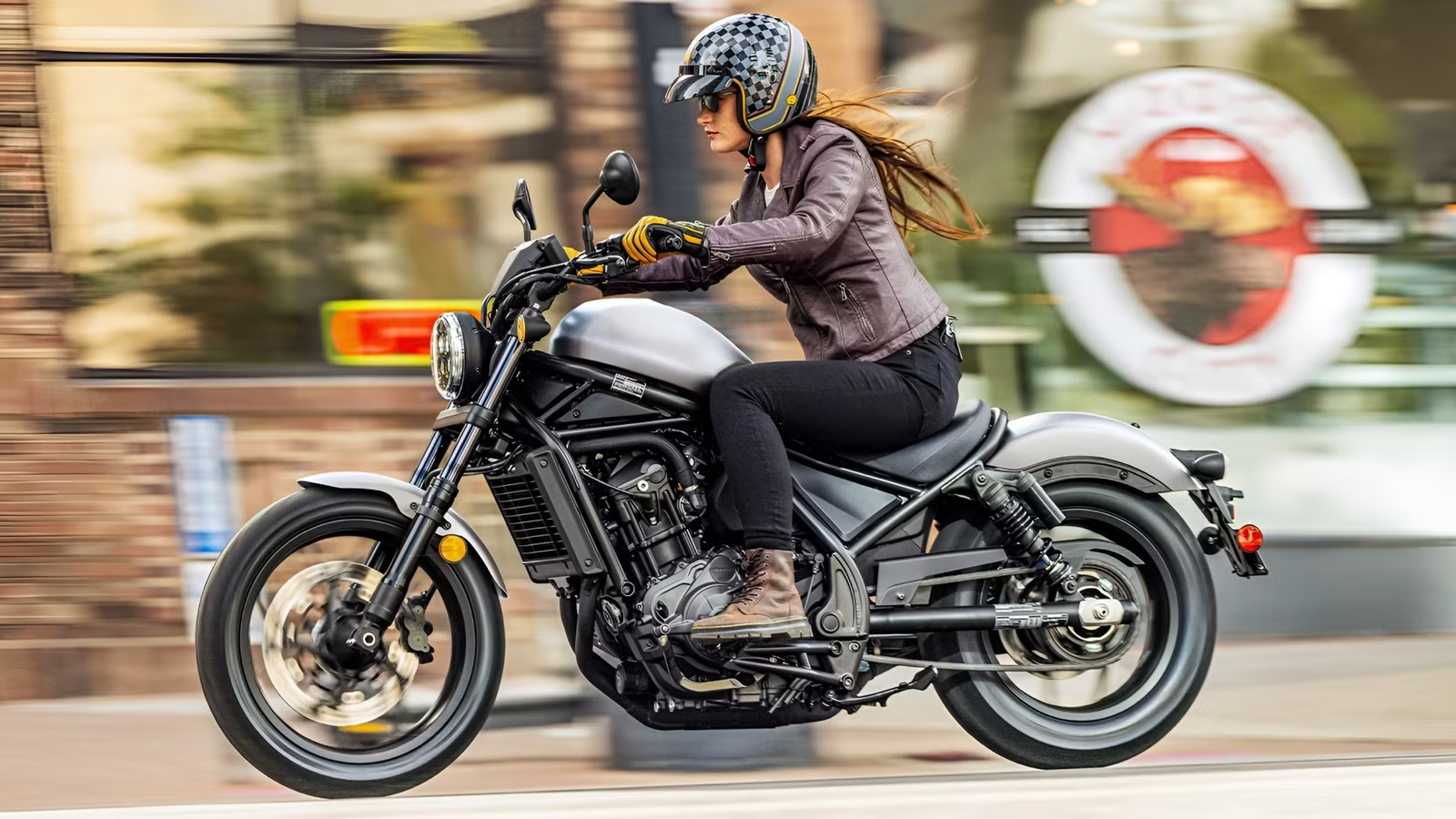
This is mainly due to their high levels of refinement and reliability. Furthermore, long production timelines help minimize failure rates and make servicing and spare parts greatly accessible. None of this need make Japanese cruiser bikes boring or devoid of soul, as is often debated. Prime examples defying the perception include the charming Suzuki Boulevard M109R power cruiser, the custom-styled Honda Shadow Phantom, and the timeless Yamaha V-Star 250, which is also the most affordable V-twin motorcycle on sale today. However, the Honda Rebel 1100 takes the spotlight for not just being a worthy forever bike contender but also a solid do-it-all cruiser motorcycle.
The Honda Rebel 1100 Is The Cruiser Bike That Riders Want To Keep Forever
Price: $9,699

The Honda Rebel 1100’s versatility is the primary reason it’s a top-tier forever motorcycle. It is powered by a highly tractable parallel-twin engine that also powers an adventure bike, a sporty tourer, and even a cafe racer. The chassis is compact yet rigid, making the Rebel 1100 noticeably smaller than its class suggests. In fact, it will take a bit more time for the untrained eye to differentiate the smaller Rebel 500 from the 1100.

Its compact form factor and accessible seat height make the Rebel 1100 a formidable urban companion, too. Then there are the various Rebel 1100 models, ranging from the standard bare-bones cruiser bike to the fully-prepped highway-ready bagger. Honda has designed the Rebel 1100 and the additional components of the various models to fit together like LEGO blocks. This further adds to its versatility.
The Rebel 1100 Lineup Is Quite Vibrant

Kicking things off is the bare-bones Rebel 1100 priced under $10,000. This also makes it an exceptional value offering as the most affordable 1,000+ cc cruiser bike on the market today. Then comes the $10,399 Rebel 1100 DCT that swaps the traditional six-speed transmission for a more sophisticated yet easy-to-ride six-speed dual-clutch transmission.
This is also the only automatic cruiser motorcycle as of 2026. Honda also offers a stylish Rebel 1100 DCT SE trim level that stands out with its custom-inspired design cues. Notable features include a unique shade (Deep Pearl Gray), bar-end mirrors, a body-colored headlight cowling, bronze alloy wheels, and a custom solo-seat design.

While Honda lists the Rebel 1100T as a separate model, it’s essentially the Rebel 1100 cruiser with a batwing fairing, standard two-up seating, and weatherproof side cases. These baggers elevate long-distance riding comfort over the standard cruiser models. The engine, chassis, and most hardware components remain unchanged.
Packs A Parallel-Twin That Doesn’t Run Out Of Steam

A versatile 1,084 cc parallel-twin engine powers the Rebel 1100 lineup. This liquid-cooled mill might seem familiar, as Honda also uses the same engine on the Africa Twin ADV and the NT1100 touring bike. It also powers the forbidden Hawk 11 cafe racer, which we wish were available in America. These instances highlight the highly versatile nature of this parallel-twin engine.
On the Rebel 1100 lineup, it is tuned for more meaty mid-range torque, producing 80 percent of its peak figure of 72.3 pound-feet at 3,000 RPM. Its peak power of 87 horsepower is produced at 7,250 RPM. The early torque surge helps the Rebel 1100 feel peppy for swift urban runs and breezy highway overtakes. On the base models, power is sent to the rear wheel via a six-speed manual gearbox coupled to a final chain drive.
Can Be Had With A DCT Gearbox, Making It The Only Automatic Cruiser Bike

An automatic transmission unlocks a whole new, simplified riding experience and is standard on the expensive trim levels of the Rebel 1100 lineup. Riding convenience is its primary selling point, as the DCT-equipped Rebel 1100 cruiser bikes operate like a twist-and-go scooter in Auto mode. For riders who crave a bit more engagement, Honda also offers a manual ride mode with paddle-like shifters on the handlebars, allowing them to shift gears at their discretion.
Advantages of the DCT automatic motorcycle gearbox over the traditional six-speed setup include no stalling, which notably reduces fatigue both in tight city traffic and on long stretches of highway, improved low-speed maneuverability especially on inclined roads, and the ability to achieve better MPG figures in certain riding conditions.
The Rebel 1100 Feels At Home Both On Highways And City Roads

Apart from its versatile engine and automatic transmission, the Rebel 1100’s dimensions also make it quite accessible and easy to ride for a 1,000+ cc cruiser bike on both city streets and highways. It has a wheelbase under 60 inches and still manages to deliver the quintessential cruiser-bike stance, with a 28-degree rake and a 4.3-inch trail.
Furthermore, a low seat height of just 27.9 inches makes it a very accessible cruiser bike and puts it among the lowest-seat-height cruisers for 2026. The non-DCT models also have a notable weight advantage, with the curb weight of 497 pounds. All of these factors help make the Rebel 1100 a very comfortable and nimble cruiser bike to ride.
Complemented By Underpinnings Ready For Any And Every Riding Scenario

The Rebel 1100 series is underpinned by a semi-double cradle steel main frame, which is also shared with the Africa Twin ADV. Beyond the main frame, the chassis is extensively modified to suit the cruiser bike formula. The aluminum sub-frame helps balance rigidity and weight. The engine is utilized as a stressed member, which also helps keep the weight low and dimensions tight.
Suspension duties are handled by 43 mm forks up front with 5.5 inches of travel. The rear gets Showa-tuned dual shocks with 3.7 inches of travel and preload adjustability. Honda claims this suspension setup offers a balanced profile for stable highway and nimble urban runs.

Braking duties are courtesy of a single 330 mm disc coupled to a radially-mounted four-piston caliper up front. The rear gets a 256 mm disc coupled to a single-piston caliper. Grip duties are taken care of by fairly chunky 130-section front and 180-section rear tubeless tires wrapped around lightweight 18-inch front and 16-inch alloy wheels. The unsprung mass is kept in check, which further helps with nimble riding dynamics.
Surprisingly Stacked Technology Suite Makes The Rebel 1100 Cooler

Honda has equipped the Rebel 1100 with impressive technological features, especially for the price. The cockpit is adorned with a crisp five-inch TFT screen that runs Honda RoadSync software, enabling seamless smartphone connectivity. This gives the rider easy access to phone calls and text messages, music playback, and navigation.
Furthermore, it gets a stacked suite of technology features to enhance riding dynamics, assistance, and safety. Notable ones include five ride modes (Standard, Sport, Rain, and two user-defined modes), ride-by-wire throttle, dual-channel ABS, traction control, Engine Braking Control, and cruise control. It even gets standard wheelie control, a feature mostly reserved for track-ready sportbikes.
Five Years After Launch, And Rivals Still Struggle To Match Up

The only worthy rivals to the Honda Rebel 1100 are the sub-$10,000 Harley-Davidson Nightster and the Indian Scout Sixty Bobber. The Harley is lighter and more powerful than the Rebel, with a modern, liquid-cooled Revolution Max V-twin. But the Rebel 1100 edges out with superior technology and the DCT gearbox’s unrivaled advantages.
The Indian Scout Sixty Bobber beautifully fuses old-school charm with a modern and tractable engine, but it lags in performance and is heavier. This weakens its versatility, especially in urban riding. The combination of Honda’s famed reliability and refinement, paired with top-spec technology and accessible dimensions, justifies the Rebel 1100’s enduring appeal, making it an undisputed option among cruiser bikes.
Source: Honda Powersports

Related posts

Latest Post


No Comments