
7 Targa Top Sports Cars To Grab Before Prices Take Off
Targa-top sports cars hit a sweet spot that full convertibles often miss. They give drivers wind, noise, sky, and a little drama, but they usually keep more body strength, more coupe style, and fewer “why is my carpet wet?” moments. Now that enthusiasts keep circling back to analog cars with real roof panels, real engines, and real personalities, those cars are getting more and more attention.

There’s one simple problem, though. The good ones no longer hide in the cheap seats forever. Some already cost serious money, while others still sit in the “people forgot how cool these are” zone, but not for long. This list looks at seven targa-style sports cars with strong enthusiast pull, interesting stories, and enough market heat to make buyers move before prices get spicy.
7
Toyota Supra A80
Average sale price: $101,756
The fourth-generation Toyota Supra already lives in legend territory, but the removable-roof A80 adds one more layer of want. Toyota called it a removable aluminum Sport Roof, not a targa, because Toyota engineers apparently feared fun names. Still, the idea worked great. Buyers got the shape, strength, and hatchback drama of the coupe, plus open-air noise from one of the most famous inline-sixes ever sold. The real prize remains the twin-turbo model, since Classic.com tracks the A80 Twin Turbo at a six-figure average.

 37 autotech Engine |
Power |
Torque |
0-60 MPH |
Top Speed |
|
3.0-liter twin-turbo I6 |
320 hp |
315 lb-ft |
4.6 seconds |
160 mph |
The A80’s appeal does not come only from movie fame or internet worship. The 2JZ-GTE earned its reputation because it takes tuning abuse like a cast-iron gym teacher. Stock examples are getting rarer and more wanted, though. The wild body kits, giant turbos, and laptop-tuned weekend warrior builds made clean cars feel rare, especially U.S.-market Turbo Sport Roof cars with three pedals.
11 Perfect Affordable Porsche 911 Alternatives For Every Budget
If the beloved Porsche 911 is a bit out of reach, we have eleven perfect cheap alternatives to replace it.
6
Porsche 911 Carrera 2 964 Targa
Average sale price: $90,892

A Porsche that’s cheaper than a Toyota? In the current market reality, yes – that’s the case with the 964 Carrera 2 Targa manual, which sits in a very Porsche-shaped gap between old and modern. It still has the classic removable roof panel and stainless Targa bar, but it also brings the 3.6-liter M64 flat-six, cleaner bumpers, power steering, ABS, and a more grown-up chassis. Classic.com puts the manual Carrera 2 Targa average just over $90,000.

|
Engine |
Power |
Torque |
0-60 MPH |
Top Speed |
|
3.6-liter flat-6 |
250 hp |
229 lb-ft |
5.7 seconds |
162 mph |
This car works because it gives collectors the air-cooled smell without going full museum piece. The Carrera 2 layout also matters. It sends power only to the rear wheels, which gives it the cleanest steering feel and the most traditional 911 flavor. The 964 Targa never looked as sleek as the coupe, and that used to hold values down. Funny how time works. The same roof that once made people say “close, but not a coupe” now makes the car feel more special. It is the last chapter of the old removable-panel Targa before later generations went to bigger glass-roof ideas.
5
Ferrari 308 GTS
Average sale price: $77,967

The Ferrari 308 GTS gives the targa formula a mid-engine Italian accent. It took the 308 GTB’s Pininfarina wedge and added a removable roof panel, which turned an already pretty car into the poster version of a junior exotic. Classic.com tracks the 308 GTS average at $77,967.
|
Engine |
Power |
Torque |
0-60 MPH |
Top Speed |
|
2.9-liter V8 |
240 hp |
192 lb-ft |
6.7 seconds |
158 mph |
The 308 GTS has one of the best “looks expensive, sometimes still is not crazy expensive” profiles in the collector world. That may not last long, though. Carbureted early cars, fuel-injected GTSi models, and Quattrovalvole cars each have their own crowd, but all share the same basic draw with low cowl, pop-up lights, gated shifter, and a V8 close enough to the driver’s spine to make every tunnel feel like a life choice. It is not the fastest thing here. Sure, a modern hot hatch could bully it between stoplights, then apologize out of respect. But the 308 is about shape, sound, and occasion.
10 Manual Transmission Sports Cars Of The 2000s That Are Now Massive Bargains
The oughts were a great time to be an enthusiast – here are the best stick-shift bargains from that iconic era.
4
Mazda MX-5 Miata RF
Average sale price: $26,765

The Mazda MX-5 Miata RF is the modern car on this list, and that makes it easy to overlook. Big mistake. The RF does not use a lift-off panel like an old 911 or Supra, but it nails the targa mood with an electronically retractable fastback roof. The RF joined the fourth-generation MX-5 lineup for 2017 and uses a hard retractable fastback roof instead of the soft top. Current RF specs keep the recipe simple and honest – a 2.0-liter four-cylinder, 181 hp, 151 lb-ft of torque, rear-wheel drive, a standard short-throw six-speed manual, and manual-transmission curb weight under 2,500 pounds. Brilliant.

|
Engine |
Power |
Torque |
0-60 MPH |
Top Speed |
|
2.0-liter I4 |
181 hp |
151 lb-ft |
5.8 seconds |
135 mph |
The RF’s case grows stronger because new cars keep getting heavier, quieter, and more filtered. The Miata still feels like a car designed by people who understand that speed and joy do not always split the same dinner check. It is not rare in the exotic sense, but manual RFs with the right trim, limited-slip differential, and clean history could age well because they offer something the market keeps losing; a small, naturally aspirated, rear-drive sports car with a roof trick. It also works as a real car, which collectors sometimes pretend not to care about until rain starts falling. The RF adds security, better weather comfort, and coupe-like looks without killing the Miata’s playful balance.
3
Chevrolet Corvette C4 Coupe
Average sale price: $21,887

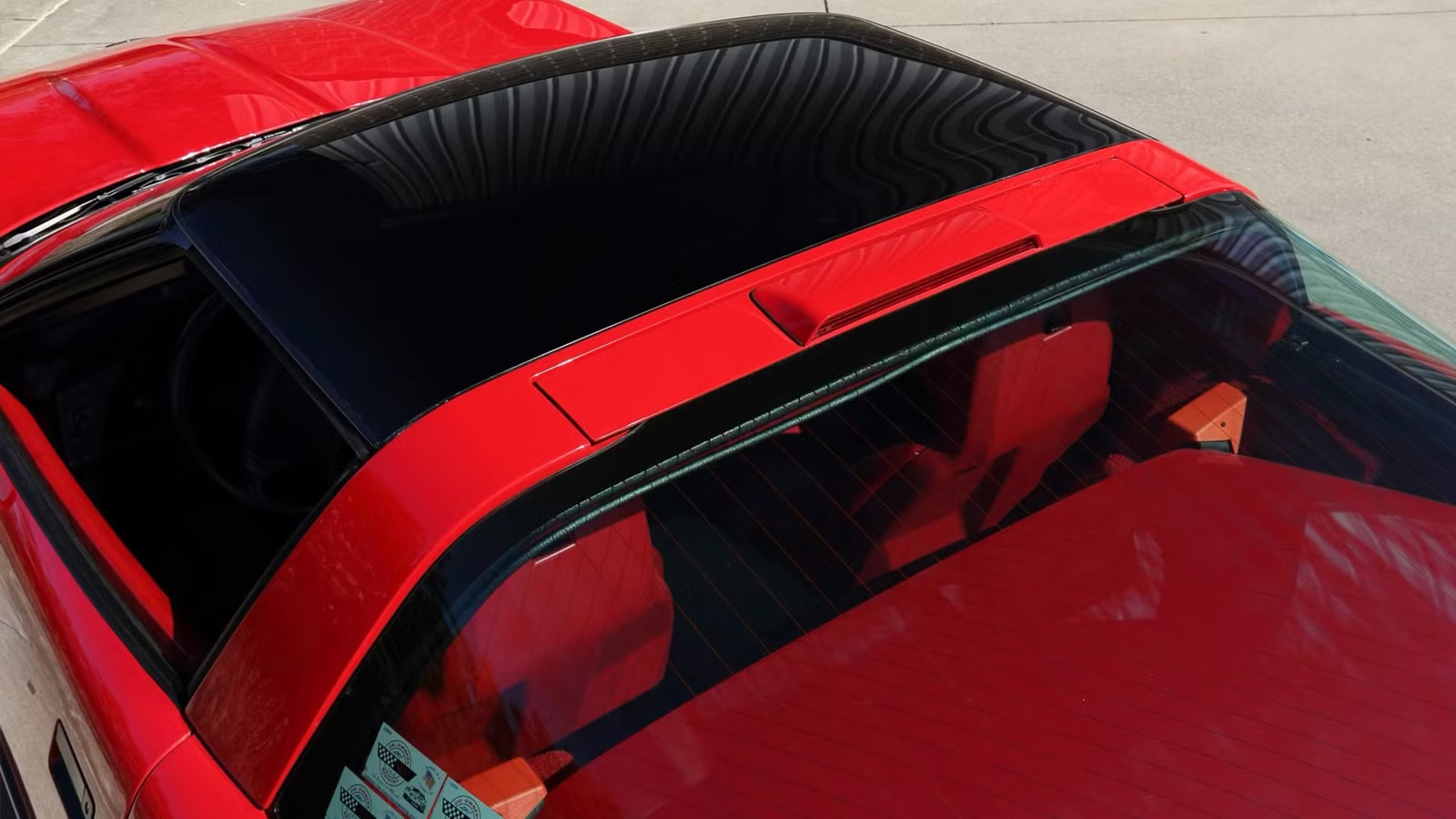
The C4 Corvette coupe may be the most obvious targa bargain hiding in plain sight. Every C4 coupe brought a removable roof panel, so the open-air experience comes baked into the car. The generation ran from 1984 through 1996, and Classic.com tracks the C4 Corvette average around the low-$20,000 range. The C4 also marked a serious engineering break from the C3, with a new chassis, sleeker body, glass hatch, digital instruments, and a roof panel that owners could pull off when the weather behaved.

|
Engine |
Power |
Torque |
0-60 MPH |
Top Speed |
|
5.7-liter V8 |
300 hp |
330 lb-ft |
5.7 seconds |
163 mph |
The trick here is picking the right C4. Early cars have peak 1980s charm, a digital dash that looks like an arcade game, and ride quality that can make potholes feel personal. Later LT1 cars, especially 1992-1996 models, make more sense for drivers because the LT1 V8 brought 300 hp, and six-speed cars feel much sharper than their reputation suggests. The C4 still suffers from old jokes about squeaks, plastic interiors, and gold-chain stereotypes, but those jokes have aged worse than the car. Clean coupes with good paint, working electronics, intact weatherstripping, and the ZF manual already stand apart from the tired Craigslist specials.
2
Pontiac Solstice GXP Coupe
Average sale price: $16,368

The Pontiac Solstice GXP Coupe feels like a concept car that escaped during a fire drill. Pontiac took the Solstice roadster, added a sleek fastback roof, kept a removable targa-style panel over the cabin, and then disappeared as a brand soon after. That timing turned the coupe into a true oddball. With a turbocharged 2.0-liter direct-injection four-cylinder making 260 hp and 260 lb-ft, it had just enough power for those beautiful weekend trips.

|
Engine |
Power |
Torque |
0-60 MPH |
Top Speed |
|
2.0-liter turbocharged I4 |
260 hp |
260 lb-ft |
5.2 seconds |
140 mph |
Rarity gives the GXP Coupe its real punch. Enthusiast records widely cite only 1,266 Solstice coupes in total, and the GXP sits at the top of the heap because it combines the rare body with the hot LNF turbo engine. It also has one very funny flaw – the main roof panel does not stow neatly in the car like a Corvette’s panel. Pontiac offered a soft emergency cover, which sounds like an umbrella with homework. Still, that weirdness adds to the car’s charm – the Solstice GXP Coupe looks special, makes strong power for its size, and came from the final gasp of a brand that once sold GTOs, Firebirds, and all sorts of glorious nonsense.
11 Classic Cars Collectors Are Quietly Buying
Classic cars from different eras are quietly attracting collector attention and rising in value.
1
Fiat X1/9
Average sale price: $13,080

The Fiat X1/9 proves that a sports car does not need big horsepower to matter. It was a compact two-seat Targa with a mid-engine layout, created to replace the Fiat 850 Spider, and credits Marcello Gandini of Bertone with the design. The X1/9 brought wedge styling, pop-up headlights, a removable roof, and a clever layout that stored the roof panel under the front lid. Classic.com tracks the average sale price at just $13,080, which feels almost suspicious in a market where anything with a wedge shape and a famous designer usually costs more.

|
Engine |
Power |
Torque |
0-60 MPH |
Top Speed |
|
1.5-liter I4 |
85 hp |
87 lb-ft |
10.4 seconds |
115 mph |
The X1/9 is not fast. Nobody should buy one expecting supercar thrust unless that person also thinks a strong espresso counts as forced induction. Early cars used a 1.3-liter four-cylinder, while later 1.5-liter five-speed cars added a bit more flexibility. The magic lives in the balance. Fiat took front-drive mechanical pieces, put them behind the seats, and created a tiny mid-engine car that teaches momentum better than any driving school lecture. It also has front and rear storage, which means it can carry luggage and still look like a baby Lancia Stratos that found a coupon.
Source: Classic.com

Related posts


Latest Post


No Comments