
The Sport Bike Nobody Appreciates Enough
Change is sometimes difficult to accept. But, as the old adage goes, “the only constant is change,” and the same is true for the motorcycle industry. A combination of factors has seen certain segments flourish, and others wane. The rise in demand for more versatile motorcycles has had a profound effect on the supersport class in particular, which has been radically reshaped over the past decade or so.
The Modern Supersport Segment Is Very Different To The Past

All the way through the 00s, the supersport class bikes saw constant updates, and untold amounts of funding thrown at them. It was a golden age for all kinds of sport bikes. But all good things need to come to an end. These small-displacement, high-performance inline-four engines served as the canary in the coal mine when it comes to emissions.

That was only one part of the reason why these bikes fell out of favor. Even with emissions curbing further development, most consumers had already woken up to the fact that these bikes were painfully impractical. Most people wanted more practical motorcycles, bikes that could conceivably be ridden every day. To answer this call for more practical motorcycles, each of the major manufacturers responded by developing a different kind of supersport for the 21st-century buyer.

All these modern supersports have more comfortable ergonomics, and all make use of powertrains that are both more efficient and offer superior midrange performance. For those looking for a track bike, there are still a handful of the old-school inline-four supersports on sale. But, for the vast majority of us looking for something more user-friendly, these new sport bikes are better in every conceivable way. A prime example of this is one unappreciated Yamaha.

The Yamaha YZF-R7 Has More To Offer Than Initially Meets The Eye Right
MSRP: $9,399

Out of all these new supersports, it is the YZF-R7 that seems to get a lot of unnecessary hate directed towards it. Much of this is down to the timing of its launch, and the name Yamaha chose. With it getting launched just after the R6 got discontinued, expectations were set unnecessarily high. It needed to fill a void left by what was quite possibly the best 600cc class sport bike ever produced.
This was also not the first time Yamaha made use of the YZF-R7 name. The previous R7 was a homologation special from the late 90s, and while everyone knew the new bike wasn’t going to be anything like that motorcycle, it made the model desperately easy to hate. Looking at the bike more objectively, you will see a modern supersport that is well-suited to real-world riding conditions, and can conceivably be used every day.
A Proven Crossplane Twin-Cylinder Engine Powers The Midweight YZF
Power: 72 HP

The CP2 parallel-twin is one of the most versatile modern engines that offers an unrivaled reliability record. With the vast majority of its torque available from 2,000 RPM, it offers impressive midrange grunt. This is essentially the antithesis of what the old supersport class was all about, all equipped with inline-four engines that developed almost no torque at all below 8,000 RPM.
Brings A More Balanced Approach

While those screamers were fun to ride on a track, they were a chore to ride pretty much anywhere else. The moment you got the revs up high enough to make decent power, you were most likely already breaking at least one law. The CP2 might not offer the same top-end performance of those engines, but it is certainly no slouch. It is a genuinely characterful powertrain that has the ability to make a grown man giggle.
Adjustable Suspension Brings An Added Advantage

While the suspension is not from a fancy Swedish brand, KYB has been in the business for a long time and certainly knows how to put together a decent sport bike suspension. The 41mm forks are fully adjustable, while the rear monoshock offers both rebound and preload adjustability. The travel has been reduced from 5.1 inches to 4.7 inches at the front and 4.8 inches at the rear. This has helped lower the ride height a little, and will also alter the geometry ever so slightly.
All these added tech features will serve to make the R7 an even better real-world sport bike. While the outgoing model may have flattered to deceive in some respects, the latest bike feels like a more complete package. While it won’t be out of place on a track day, it just feels like a bike which is better suited to hunting apexes on public roads. In the real world, where speed limits exist, more powerful bikes seem unnecessary. The R7 is no less fun to ride at road-legal speeds, and will be ideal for those looking for a canyon carver that can double up as an efficient, reliable commuter.
The YZF-R7 Certainly Looks The Part

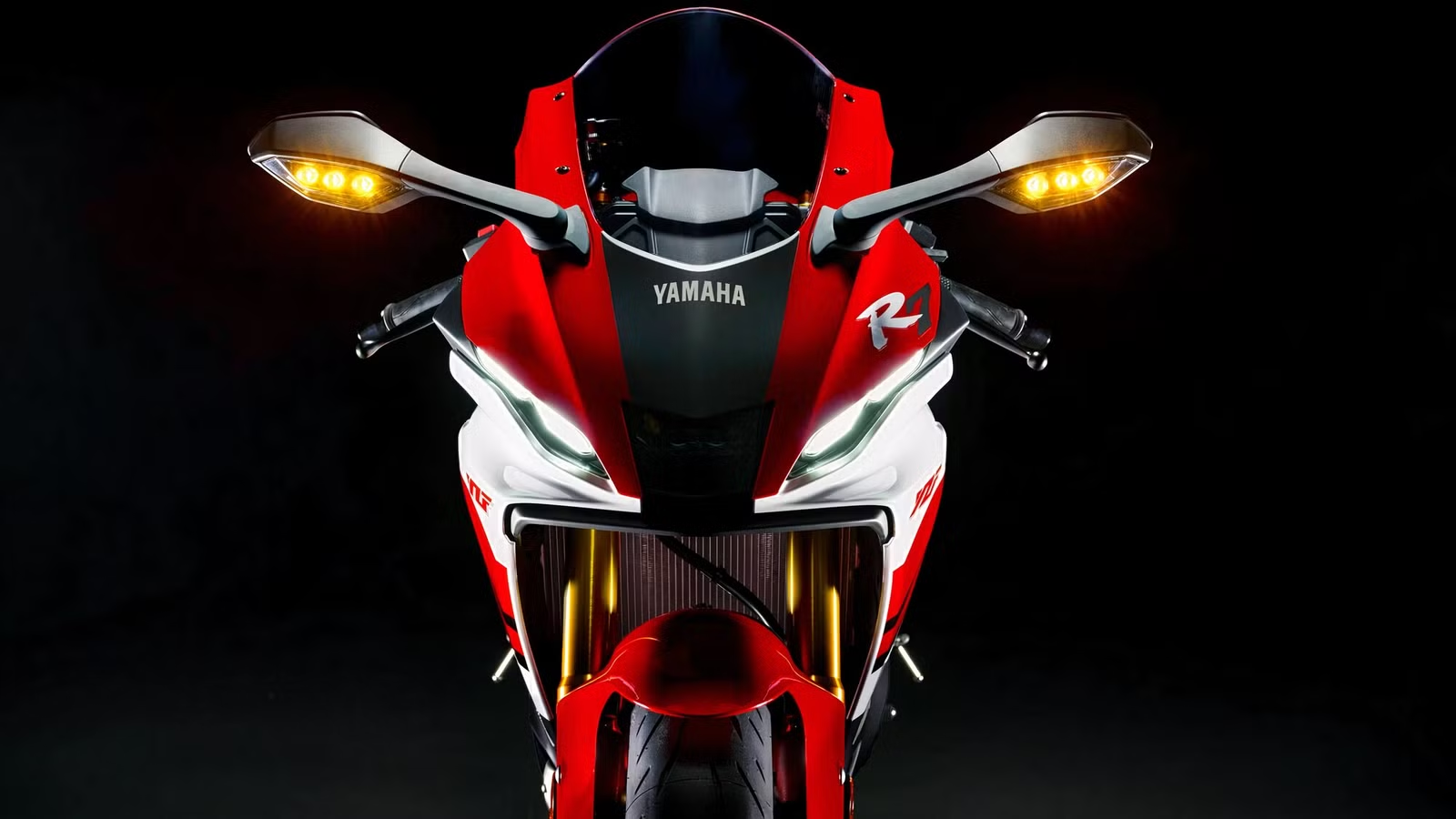
Subjectively speaking, the new standard colorway Yamaha added is fantastic. Breaker Cyan/Raven (pictured above) is a neat callback to the funky colors manufacturers used back in the 90s, but just because we like it doesn’t mean you will. The one colorway that costs more is most likely going to be the most popular, at least for this model year. The 70th Anniversary Edition livery (pictured below) is actually a dead ringer for the aforementioned late 90s homologation special, and, in our opinion, is well worth the additional $300. It isn’t just a case of “bold new colors” either.
A Smorgasbord Of Tech Features

Yamaha made the decision to tweak the chassis this year, and while this won’t make a significant difference, the tech that has been added to the bike most certainly will. In one update, the R7 has gone from having the least tech features in this sub-$10k class, to the most. It is now, for the meantime, the only bike in this space with an IMU.

This means it now has features like lean-sensitive traction control and cornering ABS. It also gets ride modes, cruise control, a quickshifter, and a TFT dash. Rather surprisingly, the addition of all this modern tech did not actually have much of an effect on its overall weight. Somehow, Yamaha was able to shave enough weight in other areas to compensate, with the new bike only 3 pounds heavier than the 2025 model, with a wet weight of 417 pounds.
Source: Yamaha Motorsports

Related posts

Latest Post


No Comments