
Bronco Raptor: Ford’s 418-HP Desert-Weapon SUV Broken Down
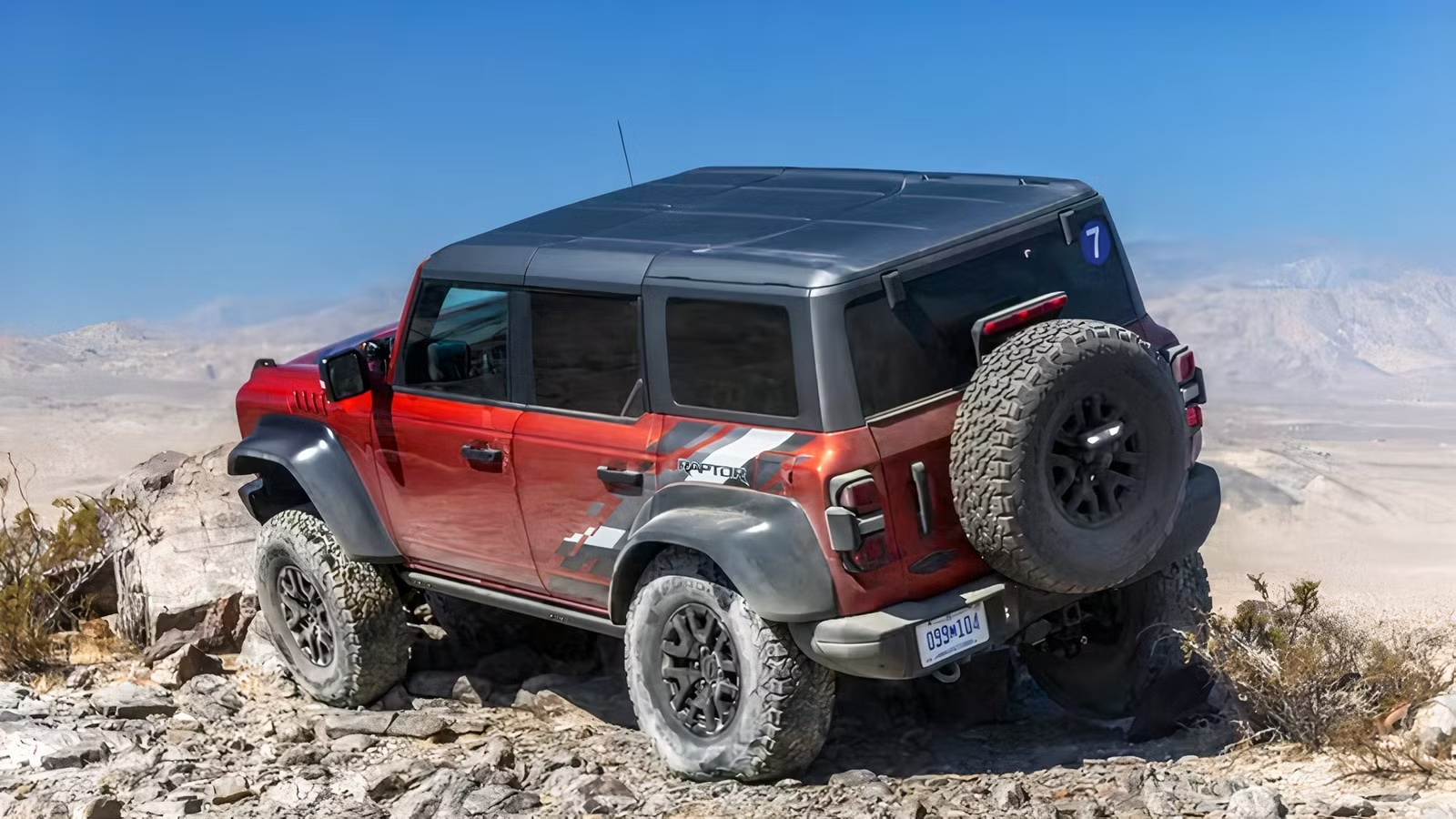
Few modern off-road SUVs command the same respect as the Ford Bronco Raptor. Based on the already very capable sixth-generation Ford Bronco, the Raptor is Ford’s answer to the growing American off-road and desert-dashing SUV market.

We have broken down what exactly makes a Ford Bronco Raptor such a weapon off the pavement in its own right and up against Jeep and Chevrolet’s finest off-roading models, and we will be looking at Ford Bronco Raptor specs, its twin-turbo engine, Ford Bronco horsepower output, its suspension setup, and its performance prowess.
Introduction: The Bronco Raptor And The Desert SUV Wars
The sixth-gen Bronco was already a very capable factory-built off-road SUV on sale, but the Bronco Raptor exists for those of us who think that it isn’t enough.

This is Ford’s answer to the modern desert-performance SUV arms race: a wider, tougher, more powerful Bronco engineered to run across sand, gravel, and broken terrain without falling apart. Think of it as a Baja-inspired halo model that sits above every other Bronco.
More importantly, the Bronco Raptor takes on a segment that has suddenly become very competitive. Jeep answered with the V8-powered Wrangler Rubicon 392, while the Ram TRX SRT proves there’s a huge appeal for factory-built off-road weapons and genuine high-speed capability.
Ford’s response wasn’t to build the loudest SUV or the biggest-engined SUV; it was to build the most desert-focused Bronco ever, combining twin-turbo power, long-travel suspension, and race-bred toughness into a package that can be used on the commute during the week and through the dunes on the weekend.
The 3.0-Liter Twin-Turbo EcoBoost Engine: 418 HP Breakdown

The Bronco Raptor has one engine option: a twin-turbo V6. The Ford Bronco Raptor’s 3.0-liter twin-turbo EcoBoost V6 has the following specifications.
|
Spec |
Ford Bronco Raptor |
|---|---|
|
Engine |
3.0-Liter Twin-Turbocharged EcoBoost V6 |
|
Transmission |
Ten-Speed Automatic |
|
Horsepower |
418 hp |
|
Torque |
440 lb-ft |
Instead of chasing cubic inches like Jeep’s 6.4-liter HEMI, Ford opted for forced induction to deliver strong torque across a broad rev range (from 2,750 rpm, with a redline of 6,000 rpm). The result is an engine that feels muscular at low speeds and remains strong through the mid-range, exactly what you need when climbing loose terrain or powering out of sandy dunes.
Power is routed through a ten-speed 10R60 automatic box, and the pairing works exceptionally well off-road. The transmission keeps the V6 in its sweet spot, whether you are crawling or charging. The Garrett twin-turbo setup adds another advantage: compared to a naturally aspirated V8, it loses less performance at altitude, making the Bronco Raptor feel strong at both sea level and on mountain trails. It may not have the soundtrack of the Wrangler 392, but it delivers performance very consistently.
Suspension, Chassis And Off-Road Capability

The Bronco Raptor’s biggest transformation happens beneath the body. The Bronco Raptor’s suspension is built around Ford’s HOSS 4.0 (High-Performance Off-Road Stability Suspension) long-travel setup, which transforms the Bronco from a great trail SUV into a machine designed for real abuse, allowing for excellent wheel articulation over rocky ground.
At each corner are massive FOX 3.1-inch Live Valve internal bypass dampers that constantly adjust damping based on terrain and driving conditions. Hit a series of whoops and the suspension firms up to control body motion; slow down for technical obstacles, and it softens to keep the tires planted.

The standard four-door Ford Bronco measures in at 189.4 inches long by 75.9 inches in width by 73 inches in height, and has a ground clearance of 11.5 inches. The Bronco Raptor measures in at 191 inches long by 86.9 inches in width by 77.8 inches in height, and has 13.1 inches of ground clearance. Plus, the Bronco Raptor has an 8-inch wider track compared to the Bronco.
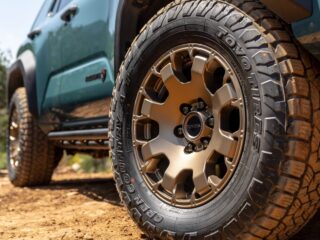
The Bronco Raptor tires are 37-inch BFGoodrich KO2 all-terrain tires, and are the largest factory-fitted tires ever fitted to a production Bronco. They not only help with ground clearance, but also with approach, breakover, and departure angles, and they provide a larger footprint and tougher sidewalls needed for rocky trails and soft sand. It has the following approach, breakover, and departure angles.
|
Approach Angle |
Breakover Angle |
Departure Angle |
|---|---|---|
|
47.2° |
30.8° |
40.5° |

The Raptor is also equipped with a heavy-duty Dana 44 AdvanTEK semi-float front axle designed to withstand the heavy loads imposed by off-road driving and oversized tires. At the rear, you also get a Dana 50 AdvanTEK solid axle with an electronic locking differential, which means you get maximum traction by sending equal power to both rear wheels whenever you need grip.
Unlike the growing number of performance-oriented unibody crossovers that prioritize on-road dynamics over outright durability, the Bronco Raptor rides on a traditional body-on-frame chassis. The separate ladder-frame construction is better suited if you’re looking to absorb impacts and resist chassis twist compared to a unibody.
Bronco Raptor vs. Ram TRX vs. Jeep Wrangler 392: Head-to-Head


There is no doubt that the Bronco Raptor is one of the best off-road SUVs ever created, but it faces a lot of competition from the Jeep Wrangler Rubicon 392 and the Ram 1500 TRX SRT. The Bronco Raptor vs. Wrangler 392 vs. Ram TRX debate has become one of the biggest rivalries in the high-performance off-road segment.
The Bronco Raptor was designed as a purpose-built desert runner, made for suspension travel, chassis control, and confidence at speed over rough ground. The Wrangler 392 takes Jeep’s proven rock-crawling formula and injects it with proper naturally aspirated V8 performance, while the TRX is a high-horsepower supertruck that blends Baja-inspired suspension with immense straight-line performance. Ford Bronco specs compared to Ram 1500 TRX SRT and Jeep Wrangler Rubicon 392 specs are as follows.
|
Spec |
Ford Bronco Raptor |
Jeep Wrangler Rubicon 392 |
Ram 1500 TRX SRT |
|---|---|---|---|
|
Engine |
3.0-Liter Twin-Turbo EcoBoost V6 |
6.4-Liter NA HEMI V8 |
6.2-Liter Supercharged HEMI V8 |
|
Horsepower |
418 hp |
470 hp |
777 hp |
|
Torque |
440 lb-ft |
470 lb-ft |
680 lb-ft |
|
Towing Capacity |
4,500 lbs |
3,500 lbs |
8,100 lbs |
On paper, the Ford Bronco Raptor specs don’t dominate. The Bronco Raptor’s 0–60 time of around 5.6 seconds can’t match the TRX’s supercharged sprint of 3.5 seconds or the Wrangler 392’s 4.5-second sprint, while the 4,500-pound towing capacity also trails the Ram by a significant margin.
However, these figures only tell part of the story. Rather than chasing headline horsepower, Ford has concentrated heavily on suspension engineering, lightweight performance, and chassis balance to create an SUV that is truly built for speed across bad terrain.

The differences become obvious once the pavement ends. The TRX’s long-travel suspension is very capable but still has to balance the demands of being a full-sized truck, so it can be argued as a more road-biased model compared to the Wrangler and Bronco. The Wrangler 392 remains the benchmark for technical rock crawling thanks to its solid axles, locking differentials, and immense low-speed capability, but its shorter wheelbase and firmer setup make it less composed during high-speed off-roading.
The Bronco Raptor sits in the middle, combining excellent wheel control with predictable handling and a responsive V6 to make it a highly confidence-inspiring vehicle at speed. A CarBuzz test drive of the Ford Bronco Raptor sums it up nicely.
With the diffs set to deal with the sand, confidence comes quickly at speed, but it becomes about mechanical grip slowing down for super-tight second-gear kinks in sandy trails. Even without airing down the 37-inch all-terrain tires but keeping the momentum and power consistent, the Braptor just carved through like a sports car on a canyon road.
Value is another important consideration. The 2026 Ford Bronco Raptor has an MSRP of $79,995; the new Wrangler Willys 392 has a starting price that is $10,000 less, and the 2027 TRX SRT has a starting price of $99,995 before destination fees.
The more comparable prices of the Bronco Raptor and the Wrangler 392 make them closer in terms of value, but buyers must choose between naturally aspirated V8 power and nearly unmatched rock crawling, or genuine desert racing capability for a bit more money.
Pricing, Trim, And Options

There is just one model of the new Ford Bronco Raptor, and at build, you do get a huge amount for your money. The new Ford Bronco Raptor price is $79,995 and gets you an advanced 4×4 system with on-demand engagement, a 4.7 axle, and the Raptor-Lux Package Group, which includes a 360-degree camera, adaptive cruise control and a Bang & Olufsen sound system.
You also get a 12-inch central display running SYNC4, 17-inch alloys, a carbonized gray hard top, heavy-duty bash plates, a front stabilizer disconnect, rubberized floor mats, and the 400-watt Pro Power Onboard system.

However, that is not where things end. You can opt for a painted hard top for $1,450, tube doors for $1,250, keyless entry for $195, a rear cargo box for $560, the Carbon Fiber Pack for an extra $1,725, a three-year plan for SiriusXM with 360L for $300, Code Orange seatbelts for $495, a safe deposit box for $420, a tailgate table for $410, and an engine block heater for $190.
If you are looking for exterior upgrades to make the looks of the Raptor stand out even further, you can also opt for different appearance packages. They have the following prices.
|
Raptor Black Appearance Package |
Raptor Shadow Black Appearance Package |
Raptor Code Orange Appearance Package |
Raptor Graphic |
Black Appearance Raptor Side Graphic |
|
|---|---|---|---|---|---|
|
Price |
$8,945 |
$8,945 |
$6,175 |
$1,725 |
$500 |
If a new Bronco Raptor is slightly out of budget, Kelley Blue Book says that the 2023 Bronco Raptor has an average used price range of $56,220 to $63,620; the 2024 model has an average used price range of $61,150 to $71,450, and the 2025 Bronco Raptor has an average used price range of $76,100 to $78,500.
Ownership And Long-Term Reliability

Alongside the tough build, Ford says that a new Bronco Raptor is covered by the Ford New Vehicle Limited Warranty, which includes a comprehensive set of warranties, including:
- Bumper-to-Bumper Coverage: 3 years or 36,000 miles.
- Powertrain Warranty: 5 years or 60,000 miles.
- Safety Restraint System: 5 years or 60,000 miles.
- Corrosion Coverage: 5 years/unlimited miles for perforation.
- Emissions Coverage: 8 years or 80,000 miles.
- Roadside Assistance: 5 years or 60,000 miles.
CarEdge says that it will cost $77,929 to own a Ford Bronco; however, the Bronco Raptor is somewhat more specialized and more powerful. While that may mean it will hold its value somewhat better than the 57% depreciation rate that the Bronco faces after five years, and, according to Classic.com, a fully loaded, mint-condition model sold for $115,500, it will likely cost more for fuel and maintenance over the same period. The $115,500 example was also custom-built by Doetsch Off Road; the market benchmark for the sixth-generation Raptor is $86,056.
Edmunds estimates, on the other hand, that the true cost to own a one-year-old Bronco Raptor is $83,650, which includes $4,649 in maintenance, $900 for repairs, and nearly $32,000 in depreciation over five years. In comparison, Edmunds also says that the 2025 Bronco Big Bend will cost you $47,534 to own over the same time.
The Bottom Line: Is The Bronco Raptor Worth The Hype?

The Ford Bronco Raptor does live up to its reputation because it doesn’t try to be everything at once. Those looking for real off-road capability rather than outright horsepower will find exactly what they are looking for. If you are looking to spend weekends on the trails, exploring the wilderness, or charging across a desert, the Bronco Raptor delivers exactly what its reputation promises.
Its twin-turbo V6, long-travel suspension, reinforced axles, and 37-inch tires all work together very nicely as a proper package instead of a bunch of individual upgrades. This is what ultimately separates the Ford Bronco Raptor from other performance SUVs at the moment.

The Bronco Raptor is designed with a clear purpose, and that focus becomes clear every time the road gets rough. It isn’t the fastest, nor the loudest or most powerful machine in its class, but it feels complete. Owners say that the Bronco Raptor is surprisingly composed on the road (aside from some road noise at speed) and very stable off-road, making it a capable all-rounder.
There is no doubt that the Ford Bronco Raptor is made for desert racers and off-road enthusiasts rather than luxury buyers, but it can also be a head-turning, tough, and distinctive American SUV.
Sources: Ford, Jeep, Ram, CarEdge, J.D. Power, and Kelley Blue Book.

Related posts


Latest Post


No Comments