
The Motorcycle Nobody Regrets Buying
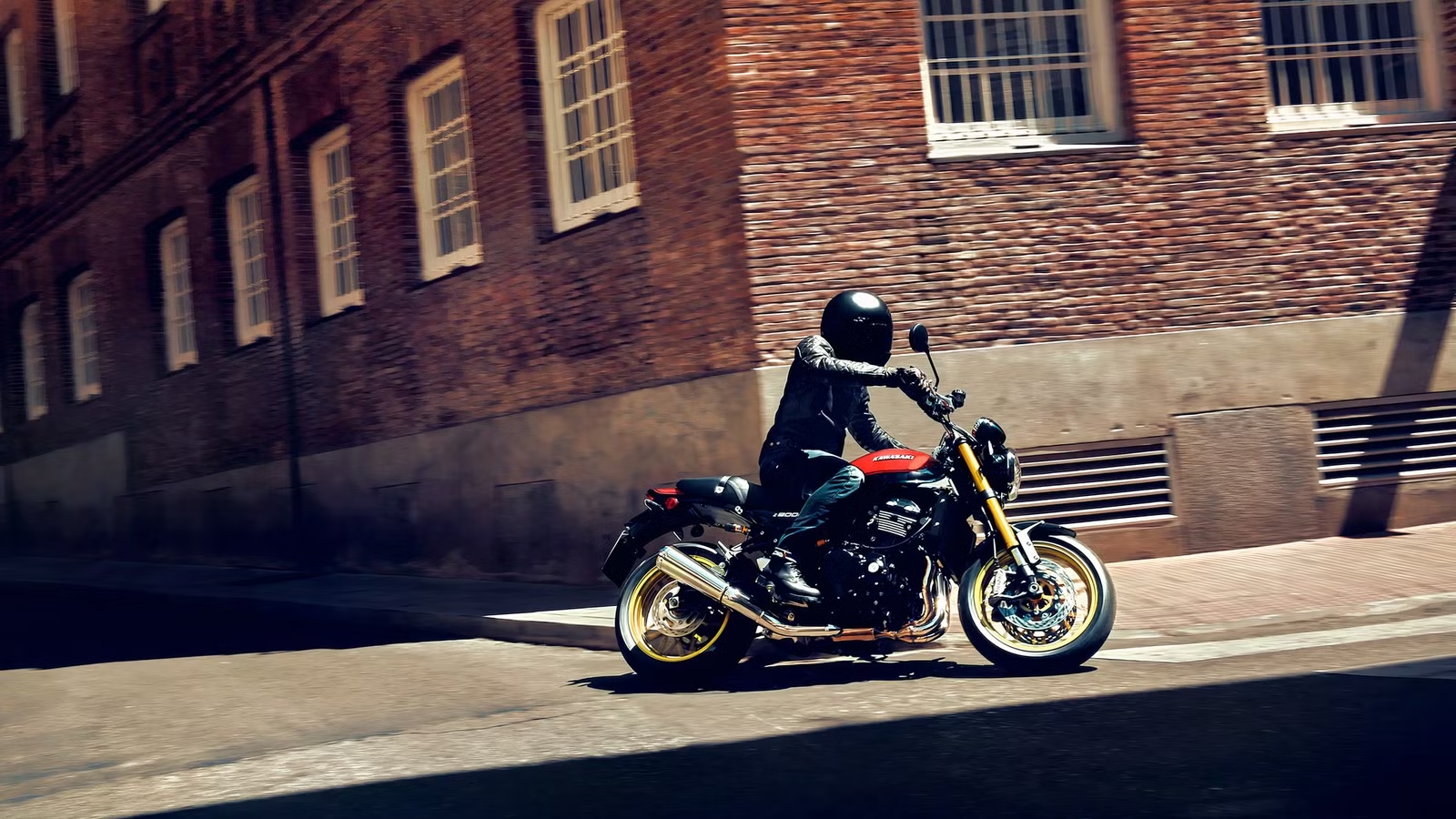
The trouble with buying a motorcycle for a single type of riding is that it locks you into the genre. You buy the supersport because a track day lit up something in you. Then a friend wants to do a cross-country ride over a long weekend, so you spend the whole trip folded over the clip-ons with your aching wrists. Or you spent on the big tourer, because comfort sounded like age-old wisdom, but you hit a tight ribbon of canyon road that makes the thing feel like steering a sofa through it.

The bike was right for the day you bought it. But this may have been a decision taken in the undeniable excitement of getting a new bike. The time between what you imagined doing with it and what you actually ended up doing is exactly where buyer’s remorse breeds. And the fix is a bike that takes the guesswork out of the decision-making, especially if your riding is forever changing.
A Roadster Never Boxes You Into One Kind Of Riding
A standard, roadster or naked motorcycle sidesteps the whole problem. You see, most bikes demand a focused riding scenario and are built accordingly. A cruiser commits you to a foot-forward slouch, an adventure bike to a tall seat, long-travel suspension for dirt you may never touch, and a sports bike morphs you into a wrist-loading crouch. The standard asks for no such commitments, sitting you upright with your weight over your hips. So one bike covers the weekday slog, the canyon run on a Sunday, and the gravel between them.


Then comes the slower regret that surfaces years later when a bike styled to look current the day you bought it has aged into something you feel nothing about. And that stings because a motorcycle purchase is almost always an emotional one. The neo-retro standard opts out of that trap, too, reaching back to a shape that has already outlasted fashion fads many times over. Yet it still pulls your eyes back for one more glance after you park it, even a decade on. The current market is teeming with such neo-retro motorcycles, but the Japanese ones have a special tinge of nostalgia. Not only are they iconic, but the whole resurrection of the UJM (Universal Japanese Motorcycle) makes the case for a standard stronger still.
The Kawasaki Z900RS Is The Motorcycle Nobody Regrets Buying

To say that the neo-retro wave has peaked would be highly inaccurate, as the revival is just a little beyond the nascent stages. Like the other Japanese Big Four, Kawasaki has had the Z900RS for a while now. It’s the bike this whole piece has been building toward, and it fits the bill nearly perfectly. It wraps the 948cc inline-four from the Z900 naked in the silhouette of the 70s Z1, with the retro tank, the round headlight, two analog dials for instrumentation, and the famous ducktail rear.

Kawasaki hasn’t been lazy about the details either, with the pseudo-air-cooling fins machined into a liquid-cooled engine to complement the theme. Since the Z1 is the bike that built Kawasaki’s name in America and the RS reaches back into its own history rather than borrowing a recent trend, Kawasaki has even got the pricing spot on. At $12,899 for the 2026 ABS model, it undercuts most of the premium retro field while handing you a genuine in-line four layout that defined the era it is dressed from. It does not specialize in anything particular, but it also does not age out.
A Versatile Engine For Every Riding Style

For 2026, the 948cc inline-four was reworked with revised cam profiles, the compression ratio bumped up to 11.8:1, and a redesigned crankshaft deployed with lighter flywheel mass to let it spin up faster. The motor now makes a claimed 115 horsepower and 73 lb-ft. It’s still a few horses shy of its more powerful shared-engine sibling, but it keeps its easy low-rpm manners and complies with the latest emission regulations with the recent changes.

New electronic throttle valves clean up the response in traffic, and the downdraft throttle bodies, a re-engineered intake, closer gear ratios, and a new 43-tooth rear sprocket keep it in the meat of the powerband on a twisty road. The breadth of performance, calm at the bottom and eager high up, is the practical core of why this bike fits every kind of riding.
Suspension And Brakes That Work Everywhere

The 476-pound Z900RS rides on a fully adjustable 41mm inverted fork and a horizontal back-link rear shock with rebound and preload adjustment. So you can firm it up for better feedback or soften it for a rough commute. Step up to the SE ABS for $1,700 more, and you get an Öhlins S46, a premium rear shock for sharper control. It’s these elements that riders actually care about, and Kawasaki has paid attention to provide the options.

Dual 300 mm front discs with radial-mount four-piston calipers and a Nissin ABS unit give you firm, progressive stopping power that should keep you rubber-side up even when you hit a gravel patch mid-corner. The Z900RS, of course, isn’t built to chase dirt, but the adjustability, compliance and predictability are what let it shrug off the broken pavement and loose connectors that a stiffer, sharper naked or sports bike would’ve left you fighting with.
Modern Electronics Hiding In Plain Sight

The 2026 update brings a six-axis IMU as standard, unlocking the Kawasaki Cornering Management Function that can read lean angles and adjust traction control and engine power delivery accordingly. Electronic cruise control and a bidirectional quickshifter join the package, along with Bluetooth connectivity through Kawasaki’s Rideology app. The Z900RS, however, never even hints at hiding this level of tech, with the dash still consisting of two analog dials separated by a small LCD, with simplistic switchgear. It is worth pointing out that for a bike sold purely on nostalgia, the tech is current enough that the Z900RS will not feel dated in five years or longer.
How The Z900RS Stacks Up Against The Other Retro Standards

Two alternatives sit close on price with the same versatile, refuse-to-specialize, retro-UJM theme. The Yamaha XSR900, at $10,599, builds its retro silhouette around the 890cc CP3 triple, pairing it with a six-axis IMU, cruise control, and a quickshifter. It is the sharper, racier tool, if you’re so inclined, though it evokes a mood rather than a machine you can name.

Honda’s CB1000F, also priced at $10,599, and we knew this one was coming back when it was still a concept at the Osaka show. It borrows its 1000cc inline-four from the CB1000 Hornet SP, retuned for midrange grunt, wrapped in CB750F-inspired bodywork and backed by a six-axis IMU with cornering ABS.

For $12,899, the Kawi asks a little more, but hands back the soulful in-line four that defined the era it is styled from. It’s the most direct line to a genuine icon in the OG Z1. The Honda is the wild card and the Yamaha is the scalpel, but the Kawasaki covers the widest spread of riding ranges, while the latest updates bring it up to its most modern spec. It is the bike you most want to keep, a bike that you never end up regretting putting your hard-earned cash on.
Source: Kawasaki

Related posts

Latest Post


No Comments