
The Long Island Chevy Dealer That Guaranteed 11-Second Quarter-Miles In Writing
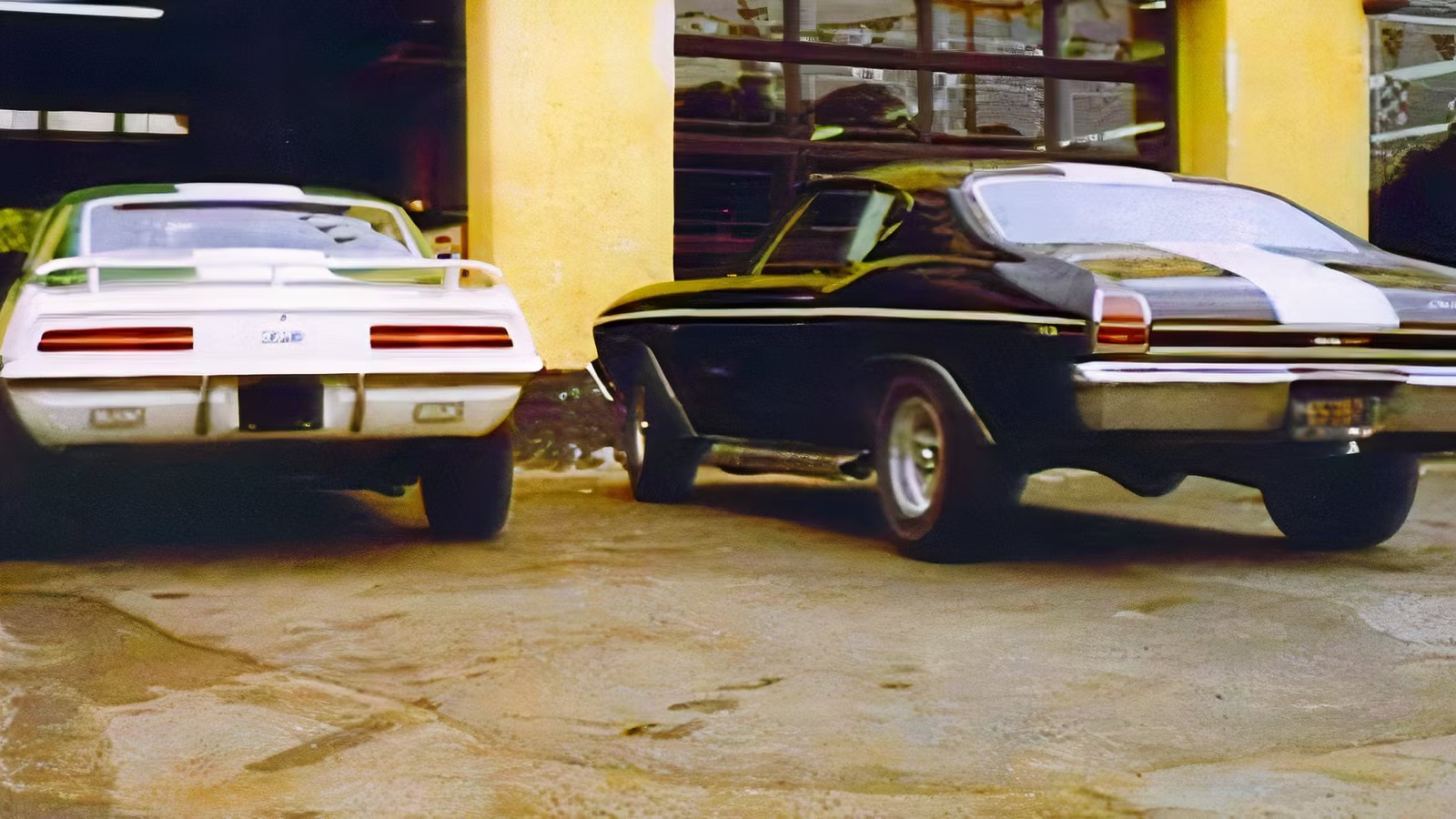
Ah, Long Island—a place with sprawling beaches, perpetual gridlock traffic, and single family homes sold at five to ten times the national average for no good reason. But beyond the Gold Coast mansions, the South Shore boardwalks, and mile after mile of suburbia, Long Island, New York, was once home to one of the most remarkable muscle car dealerships the world has ever seen. What other dealer could guarantee a mid-11-second quarter mile pass or your money back? Eat your heart out, Domino’s Pizza.
Long Island: An Under the Radar Speed Freak’s Paradise

Before suburbia, at the turn of the 20th century, Long Island used to have a deep, intensely passionate relationship with speed. The area was home to the Long Island Motor Parkway, a road stretching from Queens through Nassau and Suffolk County, all the way to Lake Ronkonkoma, where some of America’s first sanctioned auto races took place.
Instead of single-family homes, racetracks in towns like Bridgehampton, Westbury, Islip, and Freeport used to help Long Islanders cut loose on a track, not on the highway. Elsewhere, Long Island was once a powerhouse in aviation. It was home to America’s first dedicated flight school, the starting point for Charles Lindbergh’s flight across the Atlantic, as well as iconic aircraft manufacturers like Curtiss, Grumman, and Republic.
With all that heritage concentrated into a land area no bigger than a couple of counties, it’s no wonder the foremost authority in custom-ordered factory drag cars wound up just off the Sunrise Highway in a hamlet called Baldwin. As any Long Islander will tell you, folks there are well-known for their boisterous, over-the-top personalities. But the man at the helm in Baldwin was on a whole other level.
Joel Rosen: Long Island Native, Automotive Visionary
Well, Brooklyn is technically located on Long Island, so it wouldn’t be wrong to call Joel Rosen a lifelong Long Islander who made his mark on the American auto industry. Having launched a performance tuning business called Motion Performance in 1963, the venture operated out of a Sunoco station in Brooklyn until Rosen moved the whole shebang to Nassau County.
Rather than beating the rent prices like most businesses that make the same leap today, Rosen’s reasoning for the move was simple. The drag strips, dirt ovals, and impromptu road courses were all bunched around that long, thin strip of island. It was a simple matter of proximity, which also meant his shop’s location right next door to Baldwin Chevrolet on the Sunrise Highway was no accident.
In short, Rosen knew his audience, possibly even better than they knew themselves as far as what they wanted to drive. It sounds ridiculous, but what resulted from the two neighbors joining forces would go on to become legendary. No joke — their joint venture sold custom-ordered, street-legal drag cars in the same space as Corvairs and Suburbans. It all came together in 1967, the same year the muscle car wars reached their zenith.
Baldwin-Motion: A Supercar Killer Factory in the Heart of Long Island

Okay, one quick recap about factory drag cars from Big 3 OEMs in the early-to-mid ‘60s. At one point, GM, Ford, and Chrysler all supported NHRA-sanctioned drag race teams running factory hardware, with drivers hired on as engineers or PR people to receive steady paychecks. Icons like the “Swiss Cheese” Pontiac Catalina, the Ford Galaxie 500 Lightweight, and the Mopar Max Wedge came from this period.
To make a long story slightly shorter, that all went bye-bye by roughly the time Joel Rosen was moving to Long Island. Call it fear of government regulation, call it fear of being held responsible when people raced the interstate like a drag strip and caused the resulting carnage, but folks who wanted factory GM drag cars had to look elsewhere — well, anywhere but the factory. This was where Baldwin-Motion came into play, offering a secretive but viable path to scratching that very specific itch.
How it worked was simple, and yet infinitely exciting. You’d walk in the front door, right past the C10 trucks, G10 vans, and straight-six Chevy II commuters, and step into a place that felt like automotive nirvana. In this back corner of the lot, Joel Rosen would fill out a form for GM’s Central Office Production Order, or COPO. Using this, Chevrolet could build and spec a powertrain specific to each COPO request, leapfrogging GM’s archaic factory drag car ban at the express request of the dealership. If that sounds like the coolest idea ever, that’s because it really was.
Coolest Chevy Dealer in the World? Very Possibly

At Baldwin-Motion, exploiting COPO loopholes intended for police forces and taxi cab operators wasn’t just standard business practice, it was an art form. Most famously, Baldwin-Motion was one of the few places in the world where you could order a COPO Camaro, complete with a 427-cubic-inch L88 V8 and a heavy-duty suspension. Of course, the Camaro is the most famous COPO application, but it was far from the only one.
You could also order a Chevelle, a Nova, or even a Corvette with the same COPO treatment, and that’s where things start to get seriously interesting. On top of his famous “Mid-11s or your money back” guarantee, Joel Rosen aspired to build drag cars you could drive on the street without issue. That meant building drag cars with factory solid lifters and clever tuning, making for ferocious drag pulls, plus steady cruising down I-495, or any of Long Island’s sprawling state parkways.
When Chevy flat-out wouldn’t put a 427 V8 in a Nova or Camaro, he’d simply order standard cars and do the swap on the premises. By 1969, the formula was all but perfected. Inside, a Baldwin-Motion drag car was very different from typical GM fare. Each example might’ve come from Baldwin with basic vinyl interiors. Yet by the time the dealer-side retrofitting was done, they sported seats trimmed in leather and tweed, stainless steel trim pieces, a Hurst shifter for the Muncie four-speed gearbox, and a polished metal tachometer bolted right to the dashboard.
Next-Level Performance, and Serious Notoriety

So, we know Baldwin-Motion’s bread-and-butter treatment was fitting 427 drag racing motors into cars GM expressly told the factories not to, but that’s only half the story of what lies beneath the skin. Underneath, the semi-unibody frames of the Nova and Camaro, plus the body-on-frame Chevelle and Biscayne, were reinforced to handle all that power.
Joel Rosen’s Fabulous 5 (Late ’60s Only)
|
Car |
Power |
Torque |
1/4 Mile |
Top Speed |
Recent Auction Price |
|
Phase III Camaro |
500-600 hp |
460-500lb-ft |
11.5 sec |
140-150 mph |
$135,000 to $390,000 |
|
Phase III Chevelle |
500-600 hp |
500-600 lb-ft |
11.5 sec |
130-150 mph |
$125,000 to $220,000 |
|
Phase III Corvette GT |
430 to 530 hp |
500-600 lb-ft |
low-11 sec |
150-160 mph |
$225,000 to $275,000+ |
|
Phase III Nova |
500+ hp |
460-500 lb-ft |
low-11 sec |
130-150 mph |
$75,000 (High Bid) |
|
Phase III Biscayne |
500-600 hp |
460-500 lb-ft |
11.5 sec |
140-150 mph |
N/A |
The most powerful Phase III Chevelle used a full perimeter frame, and the flagship Phase III GT Corvettes sported a fully boxed steel ladder chassis and an unmistakable fiberglass body from local hot rodder and customizer Joe Silva, bolted on top. Such was the impetus for Baldwin-Motion’s most radical creation, the Maco Shark. As a counter to the OEM-designed, C3-Vette-based Mako Shark II concept, the Baldwin Maco Shark is largely seen as the better looking of the two. It was just one of Rosen’s flagship custom builds over the years, but it was by far the most memorable.
Somehow, the simple change from a “K” to a “C” in the naming scheme was enough to keep GM’s lawyers off Joel Rosen’s back. Meanwhile, the Baldwin-Motion side of Baldwin Chevrolet continued to offer COPO drag cars for a few more years — until old Johnny Law came in to stop the fun for good.
Enter the EPA, and the end of Baldwin-Motion

The mid-1970s weren’t a great period for the auto business — just ask anyone who had to wait in miles-long lines to fill up with gas because of a war-related oil crisis. No sooner did the 1973 oil crisis kick off than the newly-minted Environmental Protection Agency and Department of Transportation started to crack down on operations just like Rosen’s.
Facing an EPA Clean Air Act Violation that could’ve easily ruined Rosen financially, chronic tampering with performance-choking emission-regulating equipment netted his company a cease-and-desist letter straight from the Feds. Just like that, the key “special sauce” that made his Phase III GT street racers possible disappeared completely. For a short time in the ’70s, Rosen pivoted from the 427 motor to the larger 454 engine, but development ended right as the federal government stepped in.
From there, the only way Rosen could keep the business afloat was to export custom cars abroad and to build custom show cars for major events like SEMA, while doing a handful of passion-project builds well into the 2000s. Gone were the days when Joel Rosen would take you to one of Long Island’s local drag tracks just to prove his claims, or offer a full refund. Frankly, that kind of marketing is so specific to the ‘60s, it’d look cartoonish to modern sensibilities.
Today, GM treats the COPO moniker as a marketing name for its limited-run factory drag cars. Even then, it hasn’t been used since the late-model Camaro went out of production in 2023. These days, if you ask GM to build you a factory drag car for the street, frankly, they probably won’t even read the email. In that way, Joel Rosen was a very special man indeed. So the next time you see one roll past the auction block, do yourself a favor and pay attention.
Sources: Hemmings, motionperformance.com, Classic.com, Mecum

Related posts




Latest Post


No Comments