
The Forgotten Dodge That Beat Porsche To Variable-Geometry Turbos By 20 Years
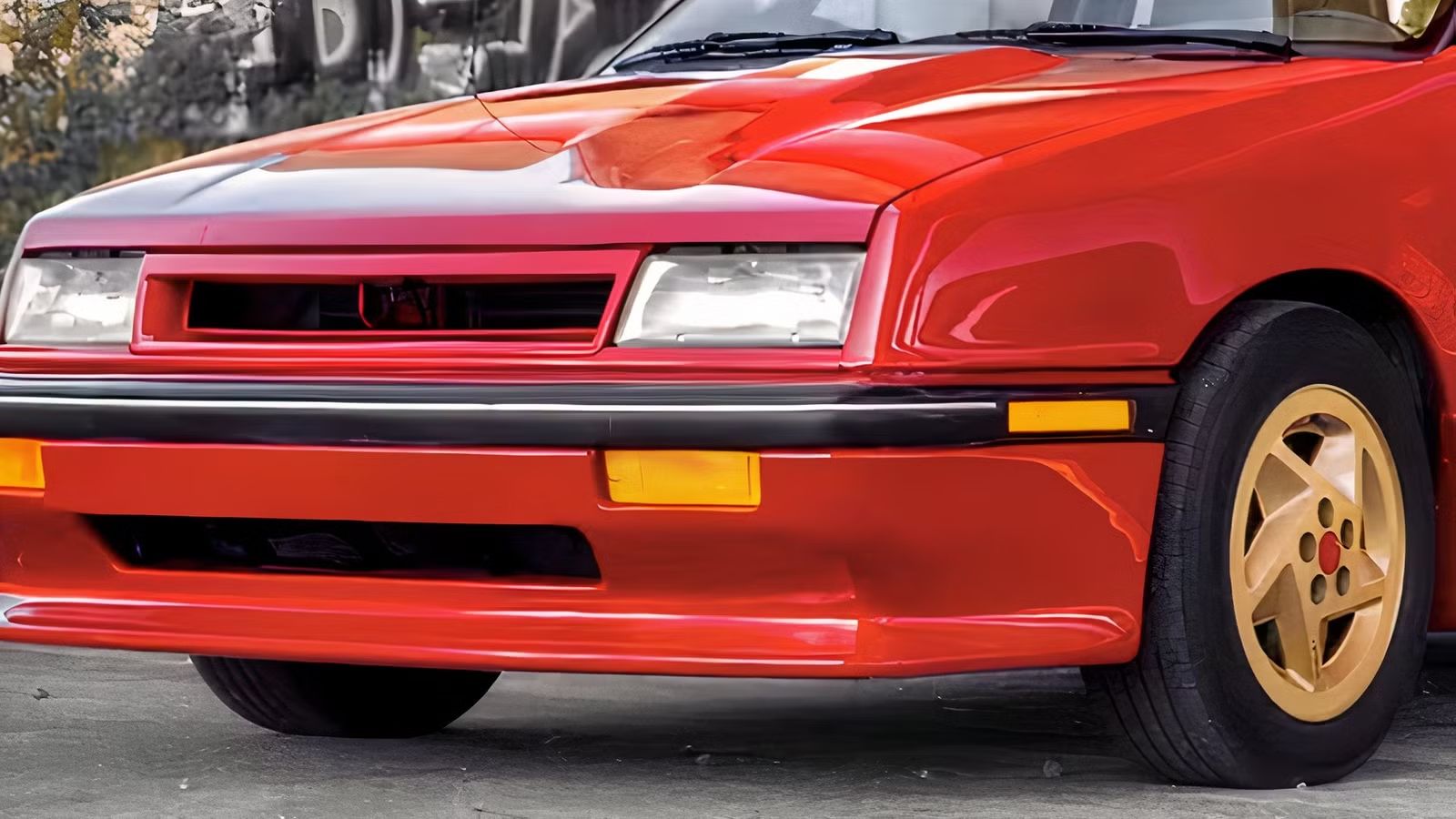
It’s maddening listening to people slander 80s American cars, and say nothing good at all came out of the country in that decade. Sure, the malaise era of the ’70s and the downsizing that followed wasn’t the best time for Detroit. Heck, Chrysler nearly didn’t make it out of the decade at various points. Still, to say they sat on their hands and built nothing but junk for ten straight years doesn’t account at all for a little collaboration with a man called Carroll Shelby. In a stroke of genius, he brought a sports car to the Mopar lineup that even the Germans wouldn’t do until years later.
Chrysler in the ‘80s: Pulling off an Engineering Marvel in the Midst of Chaos

For a brief moment, let’s take stock of what Chrysler was up to at the turn of the 1980s. Right before the decade, the company had taken on billions in guaranteed government loans in a desperate attempt to not be destroyed by the Malaise era. At the time, Japanese manufacturers were chipping away at Chrysler’s market share, with offerings like the Honda Civic and Toyota Corolla laying waste to almost any significant profit accumulation of the period. By 1979, Chrysler was effectively days away from declaring a bankruptcy that they would’ve almost assuredly not recovered from.
Instead, Chrysler got its loans, to the tune of considerable controversy from financial analysts of the day. In the end, the money kept the lights on long enough for a former Ford man named Lee Iacocca to start making some changes. He started with a hardcore downsizing campaign that saw the introduction of Chrysler’s K platform. For the most part, the K platform supported hum-drum, boring cars that never moved the enthusiast needle, but was just what Chrysler needed to battle Honda, Toyota, and Nissan.
Icons of the era included the Aries and Plymouth Reliant, and even the original Dodge Caravan and Plymouth Voyager minivans. They were the kind of cars that made enthusiasts groan, and everyone else was just content enough with the price to not notice how, well, visually challenged they often were. After all, it’s not like Chrysler was trying to win a beauty contest, it just needed to survive. But that didn’t mean that nothing innovative or creative came out of Chrysler in the ‘80s. At that time, all that was needed was the right set of circumstances.

Shelby Just Made Its Most Dangerous Snake Yet
First-ever Super Snake-R prototype breaks cover in Monterey, promising 850+ hp and track-hungry handling.
Dodge Shadow, Meet Carroll Shelby

The Shelby nameplate is practically joined at the hip with the Ford brand these days. But for a time, Carroll Shelby’s decades-long friendship with Lee Iacocca helped to tempt him from Ford over to the Mopar side of things. In the days before the Viper, Chrysler had all of exactly nothing to use as the foundation for a sports car. With that said, if Chrysler truly wanted to introduce a sports car quickly, they’d have to use one of their typical grocery-getter platforms as its underpinnings.
Enter a wimpy little two-door hatchback called the Dodge Shadow. Also called the Plymouth Sundance, the Shadow was based on a modified K platform chassis called the P-body. It was smaller, lighter, and more agile than the larger K platform. As one of the cheapest Mopar vehicles ever built, a 1987 base model MSRPed for just $7,500 back then. That’s only around $21,000 in modern money. In 2026, it’s genuinely difficult to buy a car for a similar price. Ironically, everything that made the Shadow cheap made it relatively easy to make it fast.
Shelby CSX: An Ugly Duckling Becomes a Turbocharged Swan

Let’s paint the scene for you. The year is 1987; the venue is Shelby Automobiles’ corporate headquarters in LA County, California. A shipment of stripped-out Dodge Shadows has just been unloaded from their transport truck. Under the hood, there’s a 2.2-liter Turbo II intercooled four-cylinder engine in a body shell barely larger than an original Beetle. Now, Old Man Shelby was getting ideas about what he wanted to do with them.
The answer was called the Carroll Shelby eXperimental, but most just call it the CSX. Right off the bat, Shelby started modifying and upgrading suspension components, adding Monroe Formula GP struts and larger brake discs to mimic the setups in equivalent European sports coupes. Before a single change to the powertrain, the CSX was already a more competent-handling car than almost anything else built in America, and most of what was built in Europe.
The CSX would’ve been a crowning achievement just with these mods alone, a signifier that Americans really could build a well-handling car when they felt like it. Of course, that’s not the kind of person Carroll Shelby was. For the man that gave us the Shelby GT500, the stock 2.2-liter turbo four-cylinder wasn’t going to cut it. Knowing this, what Carroll Shelby had in store was something the Germans wouldn’t replicate until years later.
Ford Built A Turbocharged Shelby Mustang In 2008 And Then Buried It — Until Now
Most people remember the GT500KR. Few know Ford and Shelby secretly built a turbocharged Mustang that almost disappeared from history.
CSX-VNT: A Leap Forward for All Turbo Sports Cars

Dodge and Shelby built around 750 CSXs in 1987, and a further 1000 were built for the Thrifty rental car company in white with gray and blue trim in ’88. But by 1989, it was clear in Carroll Shelby’s mind that there was more power latent within that turbo engine. To squeeze every last drop out of what was then an aging platform, Shelby partnered with the turbo experts at Garrett to do something no road car had done before.
Shelby CSX-VNT Vs 911 Carrera
|
1989 Shelby CSX-VNT |
175 hp, 205 lb-ft |
6.8 seconds to 60 |
|
1989 Porsche 911 Carrera |
217 hp. 195 lb-ft |
6.3 seconds to 60 |
Known far more for its work in aerospace for most of the 20th century, Garrett AiResearch worked on everything from the B-29 bomber’s pressurization system to NASA’s Apollo program. In World War II, they gained a reputation for making the most reliable aeronautical turbochargers in the world. By the 1960s, the company had helped Oldsmobile produce the first non-sports car turbo engine application with the Jetfire Rocket. They also helped Indy 500 and Le Mans racers sprint to championships.
Now, they were being turned loose on the CSX. What they did was take the upgraded Turbo IV, fit it with an upgraded intercooler and stronger internals, and add a variable-geometry turbocharger (VGT) derived directly from aerospace research. Garrett engineer Ted von der Nuell first developed a turbocharger whose aerodynamic vanes could move or change shape as far back as 1951.
By altering the passage of exhaust gas flowing through the inlet, VGTs can match the spool of the turbo vanes to the engine’s exact RPM. It meant that for the first time ever, the endless turbo lag associated with early setups could finally be mitigated. Not completely, but enough to turn a bland little wedge of an economy car into a genuine sports coupe. Not just a good one by early post-Malaise American standards, but the global standard.
A World Class Sporty Coupe, If Ever So Briefly

Let’s put it this way: in 1989, BMW’s front-line sports coupe was still the E30 M3. Its 2.3-liter inline-four made in the neighborhood of 192 horsepower, which people around the world pegged as pretty darn good for the time. Well, the Shelby CSX-VNT put down 175 hp, plus 205 lb-ft of torque. That was substantially more torque than the equivalent M3, and it meant a CSX-VNT could sprint to 60 mph in just under seven seconds. With a perfect launch, it’d be hovering around half a second quicker than the E30 from a dig.
Of course, the E30 was a more balanced car; 50/50 weight distribution tends to do that. But with five-on-the-floor and a heavily upgraded suspension, the Shelby was also quite fun to throw around corners. Admittedly, torque steer was a huge issue, but not one that couldn’t be overcome with a competent driver. Closer to a hot hatchback in feel than a proper European sports coupe, the CSX-VNT melded both worlds pretty brilliantly.
Did we mention this thing was put together in California? Carroll Shelby really was out there making OEMs across two continents do a double-take in the late ’80s—and yet, some of his biggest fans don’t know it exists. Compared to other Euro and JDM gems like the Mk2 Golf GTI, the Celica GT-S, and the Peugeot 205 GTI, the CSX-VNT was remarkably similar in feel and a little bit faster.
Blink and You’ll Miss it Personified

Just 2,251 Shelby CSXs were made in total between 1987 and 1989. Only 500 of them were sold with the special VNT package in its sole 1989 model year. That makes these Mopar Shelbys exceptionally rare. Considering they beat the Porsche 911 to the VGT game by a solid 17 years, the fact that one recently sold for $63,000 proves such a historic car has value on the used market.
Source: Classic.com

Related posts

Latest Post


No Comments