
The Power Cruiser That Finally Gets Comfort And Reliability Right
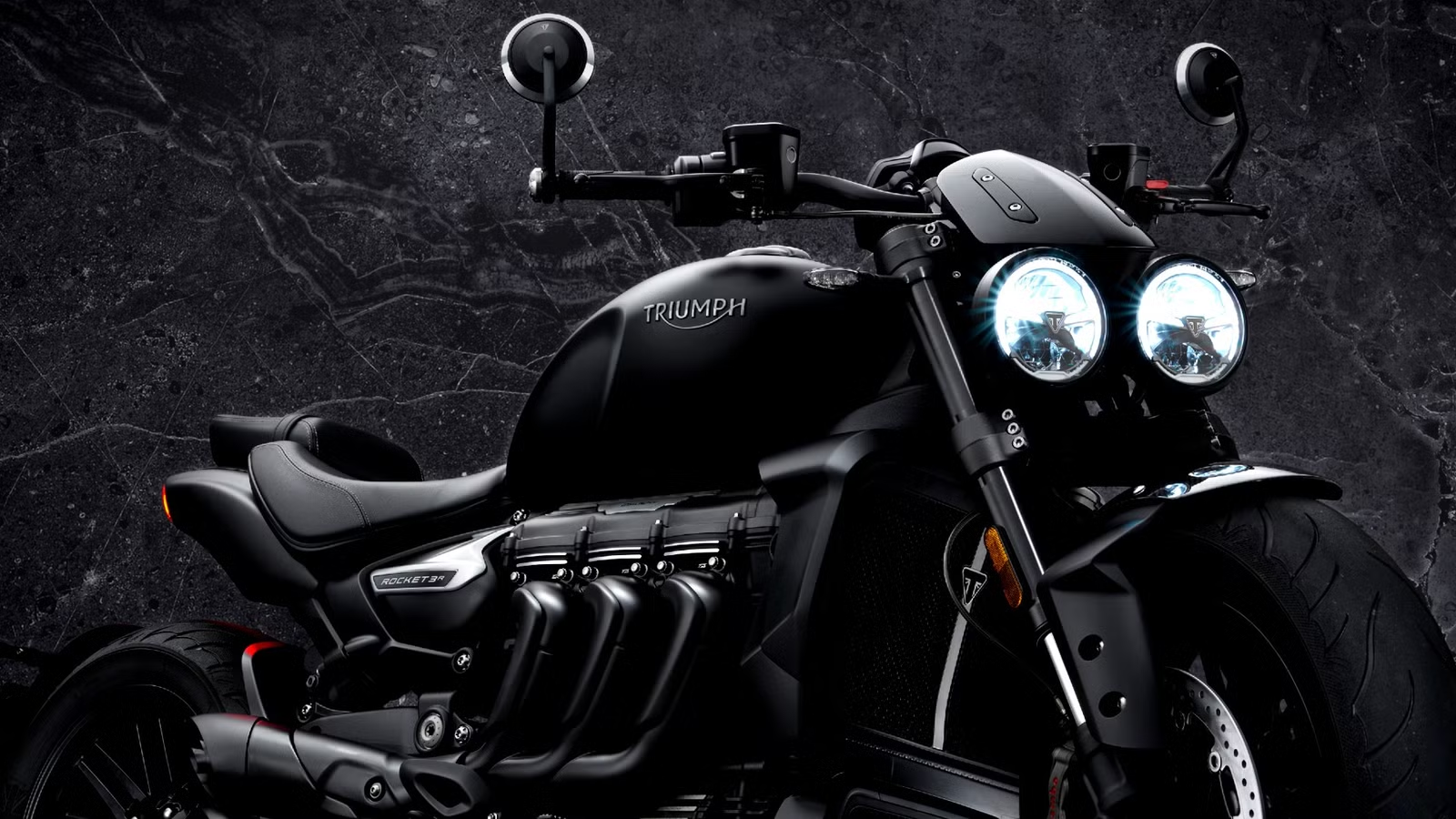
Power cruisers have always been a little ridiculous by design. They’re built for riders who want more than relaxed ergonomics and chrome theater. They need presence, torque, comfort, and enough mechanical drama to make every stoplight feel like a launch sequence. The problem is that this segment often asks riders to compromise somewhere, whether that’s weight, heat, range, handling, or long-term dependability.

That’s what makes this particular bike interesting. It doesn’t try to be a traditional American V-twin cruiser, and it doesn’t pretend to be a sport-tourer in disguise either. Instead, it takes the whole “big engine, relaxed ride” idea and turns the volume up in a way that’s deeply dramatic without becoming silly. The result is a cruiser that’s more comfortable than its size suggests, more dependable than its spec-sheet drama implies, and far more complete than the word “muscle bike” usually allows.
Power Cruisers Usually Make You Pick Your Compromise
The whole idea of a power cruiser sounds simple until you try to make one work in the real world. Give riders a massive engine, low-slung styling, and enough torque to make passing traffic feel effortless, then somehow make the bike steer, stop, idle in traffic, and survive long rides without turning into an expensive punishment device. That’s where many bikes in this category start to wobble, because the fantasy is easy to sell, but the engineering has to live with the consequences.
Big Torque Often Comes With Big Trade-Offs


Huge torque is fun because it makes speed feel casual. You don’t need to chase the redline or tap dance through gears to get the bike moving with real authority. The downside is that big engines usually bring heat, weight, fuel thirst, and packaging problems. A cruiser can have all the attitude in the world, but if it cooks your legs, drags its hard parts too early, or feels like it’s arguing with every corner, the novelty starts wearing off fast.
Reliability Matters More When The Bike Is This Extreme

The bigger and more theatrical a motorcycle gets, the more important trust and reliability become. Riders can forgive a basic commuter for being simple, and they can accept a race replica being demanding because that’s part of the deal. A premium power cruiser sits in a more complicated place. It has to feel special every time you press the starter, but it also has to behave like something you can use regularly without treating every ride like a mechanical wellness check.
A Power Cruiser Has To Feel Special Without Feeling Fragile

That’s especially true when the price is deep into luxury-bike territory. At around $25,000, the expectation isn’t just speed or styling. The bike needs premium hardware, a strong dealer-backed ownership experience, and long service intervals that make the whole thing feel less like a gamble. Shaft drive helps, too, because it removes chain maintenance from the ownership equation. On a motorcycle with this much output and mass, that kind of everyday simplicity carries real value.
The Triumph Rocket 3 Is The Power Cruiser That Finally Gets Comfort And Reliability Right

The bike that pulls this balancing act off best is the Triumph Rocket 3, specifically the current Rocket 3 Storm R. It starts at $26,695 in the US, so it is absolutely not pretending to be an affordable cruiser. What it does offer is a rare mix of outrageous engine character, premium components, and real-world usability. It’s the kind of motorcycle that should be a one-note party trick, yet somehow comes across as a properly engineered flagship instead.
Its 2,458cc Triple Is The Whole Plot

At the center of the Rocket 3 Storm R is a liquid-cooled, 12-valve, DOHC inline-three with 2,458cc of displacement. It produces 180 horsepower at 7,000 rpm and 166 pound-feet of torque at 4,000 rpm, which is a hilarious sentence to write about a production cruiser. The engine uses multipoint sequential electronic fuel injection with electronic throttle control, a wet multi-plate hydraulically operated torque-assist clutch, a six-speed gearbox, and shaft drive. The exhaust is a stainless 3-into-1 header system with three exits, because subtlety left the building several exits ago.
|
Engine |
Liquid-cooled, 12-valve, DOHC, 2,458cc inline-three |
|
Output |
180 horsepower at 7,000 rpm and 166 pound-feet at 4,000 rpm |
|
Transmission |
Six-speed manual, wet multi-plate hydraulically operated torque-assist clutch, shaft final drive |
|
0 to 60 mph |
2.73 seconds, based on Triumph’s Rocket 3 production motorcycle record |
What Makes The Rocket 3 More Livable Than It Looks

The clever part is that Triumph didn’t just build a giant engine and bolt wheels to it. The Rocket 3 Storm R uses a full aluminum frame and a single-sided cast aluminum swingarm, which help keep the whole thing from riding like an industrial appliance. It still weighs 699 pounds wet, so physics remains very much employed, but the package is more controlled than its numbers suggest. The 30.4-inch seat height also helps, especially when maneuvering something this wide and expensive at low speed.
The Chassis, Ergonomics, And Electronics Do Serious Heavy Lifting

The hardware list is seriously long. Up front, it gets 47mm Showa upside-down cartridge forks with compression and rebound adjustment, plus 4.7 inches of travel. Out back, there’s a fully adjustable Showa piggyback reservoir shock with remote hydraulic preload adjustment and 4.2 inches of travel. Braking comes from twin 320mm front discs with Brembo Stylema four-piston monobloc calipers and a single 300mm rear disc with another four-piston caliper. It also gets cornering ABS, traction control, switchable throttle maps, cruise control, and a color TFT display.
|
Frame |
Full aluminum frame with single-sided cast aluminum swingarm |
|
Suspension |
Showa 47mm upside-down cartridge fork with compression and rebound adjustment, 4.7 inches of travel; fully adjustable Showa piggyback reservoir rear shock with remote hydraulic preload adjustment, 4.2 inches of travel |
|
Brakes |
Dual 320mm front discs with Brembo Stylema four-piston monobloc calipers; single 300mm rear disc with Brembo M4.32 four-piston monobloc caliper; optimized cornering ABS |
|
Wheels and Tires |
17 x 3.5-inch cast aluminum front wheel with 150/80 R17 tire; 16 x 7.5-inch cast aluminum rear wheel with 240/50 R16 tire |
|
Wet Weight |
699 pounds |
The Rocket 3 Is A Smart Buy Whether New Or Used
Price is the unavoidable part of the conversation. For 2026, the base Rocket 3 Storm R variant already costs more than many excellent motorcycles at $26,695, and it asks riders to accept the realities of a big, premium, high-output machine. It’s not light, it’s not small, and it’s not trying to be sensible in the boring meaning of the word. But in this class, sensible has a different job. It means the bike justifies its madness with build quality, comfort, equipment, serviceability, and a riding experience that doesn’t run out of charm once the acceleration party is over.
The used market makes the argument even stronger. Earlier examples of the current-generation Rocket 3 can often be found well under $15,000, which changes the whole value conversation. At that point, you’re not just getting a weirdly huge cruiser for less than a new one. You’re getting the same basic monster-engine formula, shaft-drive convenience, premium hardware, and road presence for money that overlaps with far more ordinary motorcycles.
It’s Expensive, But It Also Doesn’t Have Many Real Rivals

That’s why the Rocket 3 works. Its 10,000-mile or 12-month service interval gives it a practical backbone, while the shaft drive and premium chassis parts make it easier to live with than the displacement figure suggests. More importantly, it isn’t just a cruiser trying to win a dyno argument and calling it a personality. It’s a power cruiser with comfort, presence, engineering depth, and enough reliability-minded design to make the whole thing feel like a proper, well-engineered motorcycle.
Buying new gets you the latest Storm spec, the full warranty experience, and the cleanest version of Triumph’s biggest cruiser. Buying used, meanwhile, gives riders a way into the same absurdly special platform at a much less terrifying price. Either way, the Rocket 3 stands out because it doesn’t rely on nostalgia or brand mythology to make its case. It earns attention the old-fashioned way, by being enormous, overpowered, surprisingly polished, and much easier to live with than it has any right to be.
Source: Triumph Motorcycles

Related posts

Latest Post


No Comments