
The Roadster That Makes Simplicity Feel Special
Modern motorcycles are getting very good at doing almost everything for the rider. More power, more modes, more screens, more sensors, more acronyms, and more ways to make a simple Sunday ride feel like you’re booting up a laptop with wheels. That stuff has its place, especially on fast bikes and long-distance machines, but it can also bury the basic reason many riders fell in love with motorcycles in the first place.

The funny thing is that simple bikes are now some of the hardest ones to get right. Strip away the fairings, giant spec numbers, and big-screen drama, and there’s nowhere left to hide. A roadster has to work on proportion, response, comfort, sound, and the little bits of feedback that make a normal ride worth taking the long way home. When that balance lands, simplicity stops looking basic and starts feeling like the whole point.
Simple Motorcycles Are Getting Harder To Find
There was a time when a standard motorcycle (popularly known as naked bikes now) was just that: an engine, a seat, two wheels, a comfortable handlebar, and enough performance to make an ordinary road more interesting. Today, even middleweight bikes can arrive with electronics packages that sound like they were copied from a superbike brochure. That isn’t automatically a bad thing, but it can make a casual ride feel weirdly over-managed.

Part of the issue is that motorcycles are often sold the same way phones are sold. There’s always a sharper version, a faster processor, a bigger display, and a new feature you didn’t know you were supposed to want. Bikes can fall into the same trap. More stuff gets added, the price climbs, and suddenly the rider who just wanted something charming, capable, and easy to enjoy is staring at a machine that’s trying too hard.
More Tech Can Rob You Of Connection

For a lot of riders, connection doesn’t come from the number of settings buried in a menu. It comes from throttle response that makes sense, torque that arrives without a committee meeting, brakes that are strong without being grabby, and a riding position that doesn’t punish you for having errands. A good roadster should feel natural within the first few minutes, not after an entire afternoon of button pressing.
The Modern Classic Formula Only Works If It Rides Right

Modern classics are especially tricky because style gets them through the front door, but it can’t carry the whole experience. A bike can have the right tank shape, the right stance, the right brushed metal, and the right badge, then still feel dull once the wheels start turning. Nostalgia is a great hook, but nobody wants to pay modern money for something that only works when it’s parked outside a coffee shop.
This is also where a lot of modern classics either find their personality or lose it completely. Too much softness and the bike becomes a rolling costume. Too much aggression and it starts missing the relaxed charm that made the category appealing in the first place. The sweet spot sits somewhere between easygoing and alert, where the bike lets you ride without constantly reminding you that it has something to prove.
The Triumph Speed Twin 900 Makes Simplicity Feel Special

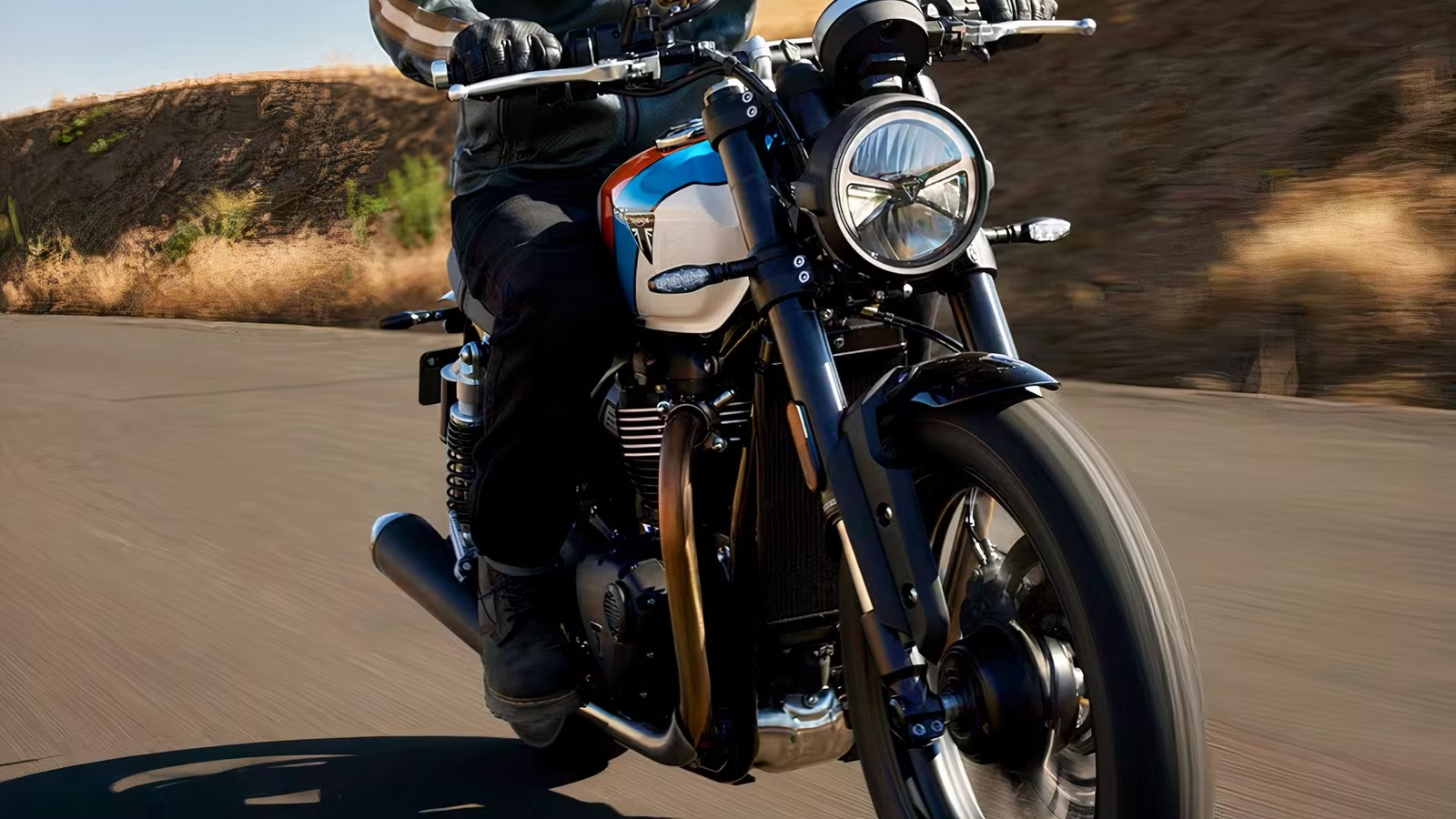
The Triumph Speed Twin 900 lands right in that sweet spot, and it does so without pretending to be the wildest thing in Triumph’s showroom. The current model starts at $11,495, which puts it in that interesting space between entry-level nostalgia and premium modern classic. It isn’t cheap, but it also isn’t trying to sell you a museum piece with turn signals. Let’s dive deeper into the deets.
The 900cc Twin Just Gets It Right

At the center is Triumph’s 900cc liquid-cooled parallel twin with eight valves, SOHC, a 270-degree firing order, multipoint sequential electronic fuel injection, and a brushed stainless 2-into-2 exhaust with black painted silencers. Output is rated at 64 horsepower at 7,500rpm and 59 pound-feet at 3,800rpm, sent through a five-speed gearbox with a torque-assist clutch and chain final drive.
The numbers aren’t outrageous, and that’s fine. Peak torque arrives early, the firing order gives it a more interesting pulse than a flat-sounding commuter twin, and the power delivery is shaped around real roads instead of fantasy lap times. That’s the charm of the Speed Twin 900. It lets you use more of what it has more often. The bore and stroke measure 84.6mm by 80mm, compression sits at 11:1, and the engine has enough character to make a short ride feel worth suiting up for. Being friendly, responsive, and satisfying is the idea.
|
Engine |
900cc liquid-cooled parallel twin, 8-valve, SOHC, 270-degree firing order |
|
Output |
64 horsepower at 7,500rpm, 59 pound-feet at 3,800rpm |
|
Transmission |
5-speed manual, torque-assist clutch, chain final drive |
|
0 to 60mph Time |
Around 4 seconds |
The Updates Make It More Polished Without Ruining The Point
The current model also gets the right kind of updates. Up front, there’s a 43mm upside-down Marzocchi fork with 4.7 inches of travel, while the rear uses twin Marzocchi units with external reservoirs, adjustable preload, and 4.6 inches of travel. The frame is tubular steel, the swingarm is aluminum, and the geometry includes a 56.5-inch wheelbase, 24.9 degrees of rake, and 4.1 inches of trail. Braking hardware is properly modern without looking out of place. The front uses a single 320mm floating disc with a Triumph-branded four-piston radial caliper, while the rear gets a 255mm fixed disc with a Nissin two-piston floating caliper.

The rolling stock keeps the classic stance intact with an 18-inch front wheel and 17-inch rear wheel, wrapped in a 100/90-18 front tire and 150/70 R17 rear tire. Seat height is a friendly 30.8 inches, wet weight is 476 pounds, and the 3.17-gallon fuel tank keeps the bike compact rather than turning it into a long-haul barge. Tech-wise, the bike also gets just the right amount of technology. Optimized cornering ABS is standard, joined by switchable traction control, Road and Rain ride modes, ride-by-wire throttle, an immobilizer, and full LED lighting. A hybrid LCD and TFT display with My Triumph connectivity.
|
Frame |
Tubular steel frame, aluminum swingarm |
|
Suspension |
43mm Marzocchi upside-down fork, twin Marzocchi rear suspension units with external reservoirs and preload adjustment |
|
Brakes |
320mm front disc with 4-piston radial caliper, 255mm rear disc with Nissin 2-piston floating caliper |
|
Wheels and Tires |
18-inch front, 17-inch rear; 100/90-18 front tire, 150/70 R17 rear tire |
|
Wet Weight |
476 pounds |
Why This Bike Makes More Sense Than Its Bigger Siblings For Many Riders

Triumph will happily sell you more Speed Twin if that’s what you want. The Speed Twin 1200 starts at $15,395, while the sharper 1200 RS starts at $17,195, and both bring more power, more muscle, and more performance credibility. The 1200 range makes 103.5 horsepower and 83 pound-feet, so there’s no pretending the 900 is secretly the fast one. It isn’t. It’s the one that makes a different argument.
That’s what makes it special. Not because it reinvents the roadster, and not because it humiliates motorcycles with bigger engines and scarier spec sheets. It works because it understands that a good ride doesn’t need to be complicated. Sometimes it just needs the right engine, the right stance, the right amount of technology, and enough personality to make a simple loop around town feel like the reason motorcycles exist.
Source: Triumph

Related posts

Latest Post


No Comments