
The Japanese Supercar That Made More Money As A Toy
Through the ’70s and ’80s, we’re fairly certain every kid’s bedroom in North America would’ve had a Ferrari, Lamborghini, Porsche, or Chevrolet Corvette poster draped on a wall. One day, those kids would have hoped to own one, and so too would plenty of parents and grandparents with deep enough pockets to buy one of these incredible machines.

Over in Japan, though, there was a domestic supercar that you were able to buy as a die-cast toy, one that was sure to have captured the imaginations of many children alongside European exotica and a real taste of Americana. For those kids, though, this very special supercar would be one they could never have, and this is its story.
It Started With A Dream To Go Racing
In 1975, a new Japanese car manufacturer was born from the mind of Minoru Hayashi: Dome Co. The name even played into childhood, translating in Japanese to “child’s dream”.

That ‘child’s dream’ was to create a small-volume sports car manufacturer using technologies drawn directly from racing, something close to Hayashi’s heart. He had previous experience producing one-off racing cars, starting with the Honda S600-based ‘Karasu’ in 1965, which won on debut at the Suzuka Clubman Race, followed by the S800-based ‘Macransa’ three years later and eventually the ‘Kusabi’ and ‘Panic’ Formula Junior cars.
Dome Co would be at a scale above that, though, with Hayashi aiming to compete at the 24 Hours of Le Mans, the most prestigious endurance race on the planet. He needed money to fund those ambitions, though.
10 Forgotten Japanese Sports Cars You’ve Never Heard Of
Not all great Japanese cars are famous. Here are some of Japan’s coolest sports cars that time forgot.
The Dome Zero Was Supposed To Fund That

|
Engine |
2.8-liter straight-six |
|---|---|
|
Horsepower |
143 hp |
|
Torque |
167 lb-ft |
|
0-60 |
~7.0 seconds (est.) |
|
Top speed |
~140 mph (est.) |
Three years later, Dome arrived at the Geneva Motor Show with an absolute bombshell. At the time, if you wanted a serious sports car from Japan, you’d have to look for a Datsun Fairlady Z, Toyota 2000GT or a Mazda Cosmo.
All fine machines in their own right, but nothing quite on the level of the most revered European exotics in terms of performance. The Dome Zero was set to be the car that could match them.
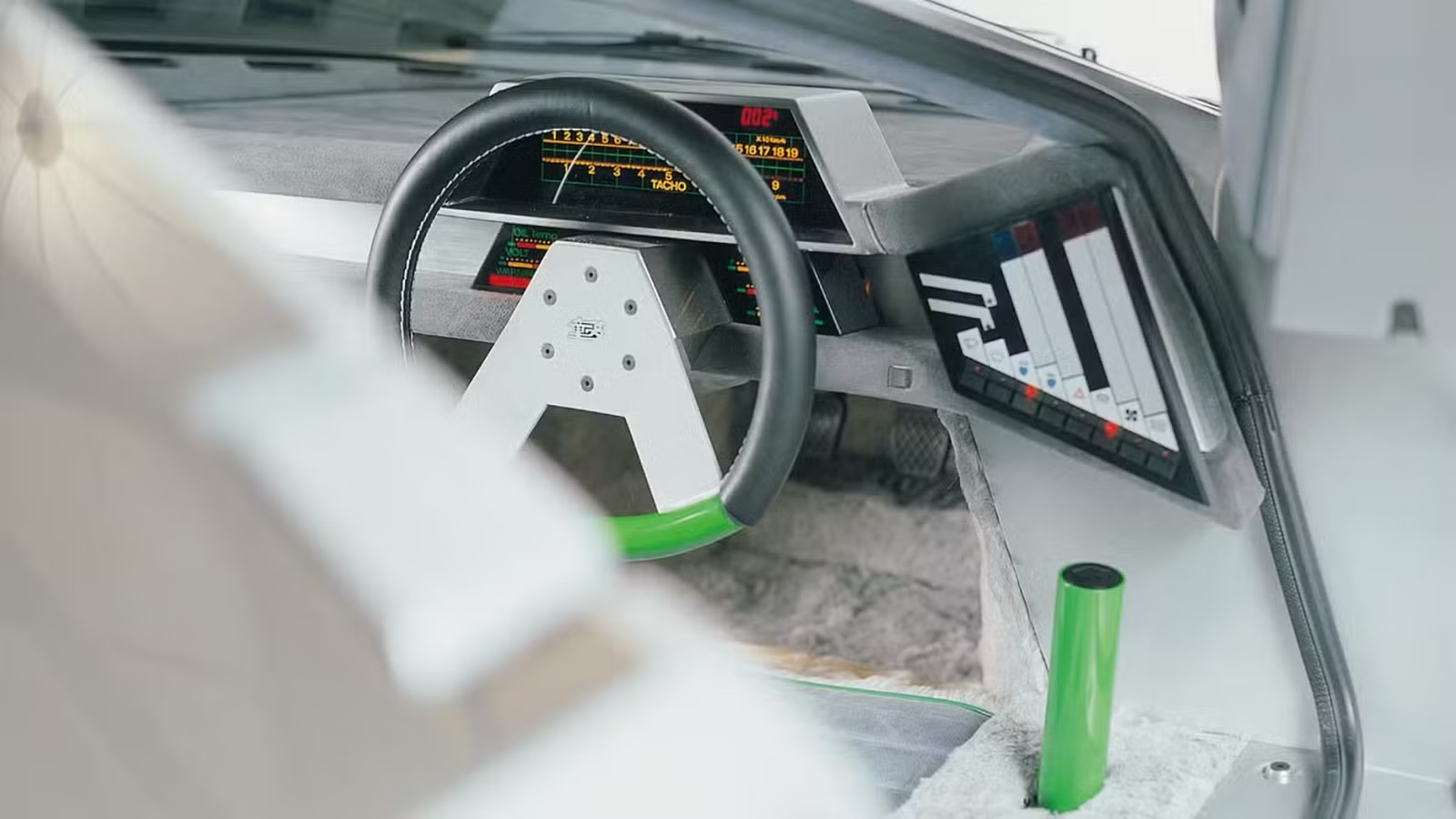
Built around a bespoke steel semi-monocoque chassis, the wedge-shaped car’s design and mid-engined layout echoed the likes of the Lamborghini Countach and Ferrari 512 BB. It would ride lower than those as well, with its 980mm height set to make it the lowest production sports car built to that point.
The technology underneath its dramatic bodywork was appropriately cutting-edge for the time, too. It used a five-speed manual transmission, double-wishbone suspension, and disc brakes on both axles. Its peak power output was low compared to European rivals, but a curb weight of just 2,030 lbs

Given that Dome was a small company with lofty ambitions, it’s no surprise to learn it leaned on other Japanese manufacturers to provide parts. Sitting in the middle of the car was a 2.8-liter Nissan L28 engine, as seen in the Datsun 280Z at the time.
Its front brake calipers were taken from a Subaru Leone, its steering column from a Honda Accord, and even the interior door pulls had to be borrowed, in this case from the Toyota Celica.
Having gained serious recognition on the biggest international motoring stage, then, everything seemed set for the Dome Zero to kickstart a new era of Japanese sports cars. Only, it wouldn’t pan out that way.
10 Factory Sleepers That Came With Engines From Supercars
These carmakers shoehorned their very powerful supercar engines into average family haulers.
Japan Wouldn’t Let It Happen

As with so many promising ventures, government regulation meant the Dome Zero couldn’t make it to production. It’s unclear what exactly prevented the sports car from meeting the Japanese Ministry of Transport’s homologation rules (and good luck trying to track down 50-year-old information from Japan to verify exactly why), but ultimately safety regulations prevented it. Without the funds to develop it further to adapt to those regulations, Dome had to get creative.
The result was the Dome Zero P2, a reworked version of the car designed to meet the comparatively less restrictive US regulations. The intention was to sell the Dome Zero in the US, allowing for Japanese buyers to re-import the car via a loophole allowing for ‘export only’ cars to make their way back to the country.
Sadly, though, that car never made it any further than a prototype stage, leaving the Dome Zero confined to the history books of sports cars that could’ve been.
The Dome Zero Did Have An Unexpected Second (And Third) Life

While the Dome Zero could never find its way into the garage of sports car collectors, it had plenty of presence in diecast car collections. Following the reveal of the original Dome Zero prototype, toy giant Tomys saw the potential and was quick to license the rights to produce small-scale versions of the car under its Tomica range, leading to a windfall of cash for Dome.
That cash would set the manufacturer up to go racing, too, ultimately resulting in the Dome Zero RL, which debuted at the 1979 24 Hours of Le Mans but failed to finish, and also retired early from the 1980 and 1981 editions of the race.
Although that car would then be retired, Dome would continue to have a presence in motorsport, notably building Toyota TOM’S race cars through the ’80s and expanding into a global race car constructor that continues to operate today. It even had a brief flirtation with Formula 1, producing a car with the intention of entering the pinnacle series in 1997, though ultimately failing to do so.
Decades after its introduction as a prototype, the Dome Zero would find a new global audience through its inclusion in the Gran Turismo video game series. It would debut virtually in the PlayStation 2 title Gran Turismo Concept 2001 Tokyo, subsequently appearing in GT4, GT5, GT6 and the PSP spin-off title.
It Even Tried To Make An F1-Powered Road Car That Everyone Forgot

Even after establishing itself in motorsport without relying on a road car business, Dome couldn’t help itself from continuing to pursue a road car.
In 1989, the Jiotto Caspita debuted at the Tokyo Motor Show. Its bodywork was designed by Jiotto Design Incorporated, with Dome handling production. Like the Zero, it was a mid-engined sports car but this time using an engine originally designed by Motori Moderni for use in Formula 1.
5 Japanese Cars Collectors Are Quietly Buying
While JDM icons keep climbing in value, here are the 5 Japanese cars that collectors are quietly buying before their popularity skyrockets.
This flat-twelve engine was a failure in its racing application, but provided tantalizing performance potential in the Caspita with 450 hp and a quoted 0-60 mph time of 4.7 seconds. Subaru pulled the plug on the engine, though, leaving any potential production Caspita without an engine.
A year later, a ‘MkII’ appeared with a Judd-sourced V10 engine producing 585 hp and a screaming 10,500 rpm redline. With that housed in a carbon fiber chassis, it had the ingredients to be a legendary supercar.
However, with the Japanese economy crashing in the early ‘90s, demand for the Caspita simply wasn’t enough to get the model off the ground, again remaining just a prototype.
Sources: Road & Track, Gran Turismo Fandom

Related posts

Latest Post



No Comments