
The Honda Engine That Powers Three Different Bikes Past 100,000 Miles
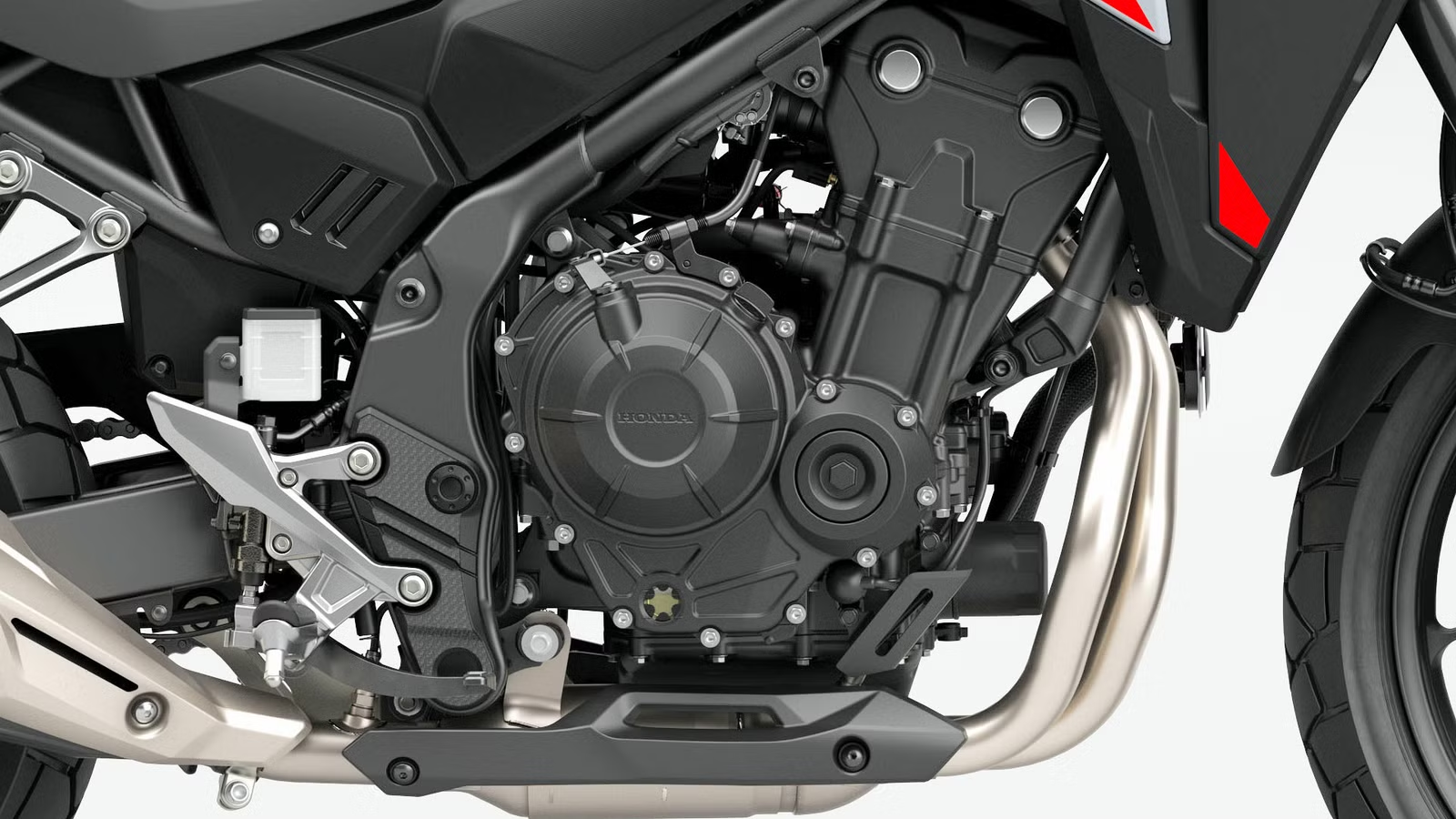
Most motorcycle engines live and die by the spec sheet. Big horsepower numbers get the headlines, wild torque figures get the comments section moving, and anything that looks dramatic in a brochure tends to get all the attention. But one of Honda’s most interesting modern middleweight engines isn’t fascinating because it’s loud, exotic, or terrifyingly fast. It’s interesting because it keeps showing up in different motorcycles and keeps doing the same very Honda thing: starting, running, sipping fuel, and refusing to make ownership complicated.
Why Honda’s Most Interesting Engine Isn’t Its Most Powerful One

Power sells motorcycles, but patience keeps them on the road. That’s where this Honda parallel-twin cylinder engine starts to make sense. It was never built to bully bigger bikes or scare new riders into pretending they’re having fun. Instead, it delivers enough shove to handle highways, city riding, commuting, weekend trips, and everyday nonsense without feeling strained. That middle-ground approach sounds boring until you realize boring is often what survives the longest.
The Appeal Is In The Stress-Free Formula

The recipe is simple in the best possible way. We’re talking liquid cooling, dual overhead cams, four valves per cylinder, fuel injection, a six-speed manual transmission, and a tune that favors smoothness over drama. It’s not a fragile, high-strung engine that demands perfect conditions to be happy. It’s the kind of motor that makes sense when a rider wants one bike to learn on, commute on, tour on, and keep around after the new-rider glow wears off.
The 100,000-Mile Motorcycle Conversation Usually Starts Much Bigger


When riders talk about 100,000-mile motorcycles, the conversation usually starts with machines that look ready to cross a continent before lunch. Big touring bikes, adventure bikes, boxer twins, giant Japanese engines, and mile-eating luxury rigs tend to dominate that space. It makes sense. Bigger engines often work less hard at highway speeds, and large-displacement bikes usually come with the comfort and luggage capacity that encourage huge mileage.
Small Engines Don’t Usually Get This Kind Of Credit

The problem is that smaller engines rarely get credit for being durable because they’re usually judged by what they lack. They don’t have huge torque, massive road presence, or the kind of overbuilt feel that makes a rider assume every part was designed during a very serious engineering meeting. But the right small engine can last precisely because it isn’t chasing chaos. Lower stress, reasonable output, good cooling, and Honda’s habit of not overcomplicating things can be a pretty strong survival strategy.
That’s why this story needs a little nuance. A larger Honda like the Africa Twin is still the more obvious forever long-haul adventure answer for riders planning to live at highway speeds with luggage and bad ideas. But that doesn’t make the smaller platform irrelevant. It just gives it a different job. Instead of being the obvious 100,000-mile choice, it becomes the surprising one, especially when real-world owners keep proving that approachable doesn’t have to mean temporary.
This Honda Engine Easily Brings Three Different Bikes Past 100,000 Miles

The engine is Honda’s 471cc liquid-cooled parallel-twin seen on the Rebel 500, SCL500, and the CB500 family, which now includes the NX500 as the successor to the CB500X and the CB500 Hornet as the updated naked-bike nameplate. On current US models, Honda lists the same core architecture: 67.0mm x 66.8mm bore and stroke, 10.7:1 compression ratio, dual overhead cams, four valves per cylinder, fuel injection, and a six-speed manual gearbox with E-Clutch offered on some models.
|
Configuration |
471cc liquid-cooled parallel-twin, DOHC, four valves per cylinder |
|
Bore x Stroke |
67.0mm x 66.8mm |
|
Compression Ratio |
10.7:1 |
|
Fuel System |
Programmed Fuel Injection, 34mm throttle bodies |
|
Output |
Around 47 horsepower and 31.7 pound-feet |
One Engine, Several Personalities

The clever part is how differently that same basic engine behaves depending on the chassis around it. In the Rebel 500, it sits in a low, practical cruiser package with a 27.2-inch seat height, 3.0-gallon tank, 414-pound curb weight, 41mm fork, dual shocks, ABS-equipped 296mm front and 240mm rear discs, and 16-inch wheels wearing 130/90 front and 150/80 rear tires. It starts at $6,799, or $6,999 in SE trim, and turns the engine into something relaxed, approachable, and easy to manage.

In the Honda SCL500, the same twin gets dressed for scrambler duty without pretending to be a desert racer. It has a 31.1-inch seat height, 3.2-gallon tank, 425-pound curb weight, 41mm fork with 5.9 inches of travel, dual shocks with 5.7 inches, a 310mm front disc, a 240mm rear disc, standard ABS, and a 19-inch front with a 17-inch rear wheel. At $6,999, it gives the engine a taller stance, retro attitude, and enough everyday usefulness to avoid becoming costume jewelry.

The NX500 and CB500 Hornet show the other two sides of the same idea. The 2026 NX500 starts at $6,899 and uses a 41mm inverted Showa SFF-BP fork, dual 296mm front discs, a 4.7-gallon tank, 32.8-inch seat height, 7.1 inches of ground clearance, and a 432-pound curb weight. The 2026 CB500 Hornet starts at $5,899 with 17-inch wheels, dual front discs, 4.5 gallons of fuel capacity, a 31.1-inch seat height, and a 414-pound curb weight. Same foundation, very different jobs.
The Real Proof Is In Fuel Economy, Mileage, And Boring Maintenance
The numbers become more convincing when you move away from brochures and into owner use. Reports around the CB500X, the adventure-style predecessor to the NX500, include a round-the-world example approaching 100,000 miles, while CB500F riders have reported excellent economy in the 80 to 90 mpg range under favorable riding. Rebel 500 longevity accounts also point to bikes crossing roughly 85,000 miles with regular maintenance, which is exactly the kind of unglamorous evidence this engine needs.

Fuel economy also helps explain why owners keep piling on miles. Depending on model, speed, load, gearing, and throttle habits, real-world figures can land anywhere from around 60 mpg to more than 90 mpg. That range is wide because a low cruiser, a naked bike, and an adventure-style machine don’t slice through the air or carry weight the same way. Still, even the lower end keeps running costs sensible, while the upper end makes the engine look almost annoyingly responsible.
|
Transmission |
Six-speed manual |
|
Final Drive |
Chain |
|
Cooling |
Liquid-cooled |
|
Valvetrain |
DOHC, four valves per cylinder |
|
Fuel Economy |
Roughly 60 to 90 mpg in real-world use |
Why Experienced Riders Don’t Always Outgrow This Beginner Engine

That’s the twist. This engine is easy to recommend to beginners, but it’s not only useful because it’s beginner-friendly. It has the kind of calm, flexible personality that makes sense after the learning phase, too. Experienced riders often talk about outgrowing motorcycles as if every bike needs to be replaced the moment it stops being intimidating. But a motorcycle that starts every morning, uses little fuel, doesn’t weigh a ton, and still handles real roads with confidence has a funny way of staying relevant.
Honda didn’t build one flashy engine for one famous motorcycle here. It built a dependable shared platform that lets a cruiser, a scrambler, a naked bike, a sports bike, and an adventure-style machine all make sense for different people. The Africa Twin may still be the more obvious answer for riders planning a massive 100,000-mile adventure-filled life, but the 471cc twin deserves its own spotlight. It brings Honda’s long-haul reputation into lighter, cheaper, less intimidating bikes, and that might be the more impressive trick.
Source: Honda Powersports

Related posts



Latest Post


No Comments