
Oldsmobile Aurora GTS-1: The Accidental Racing Legend
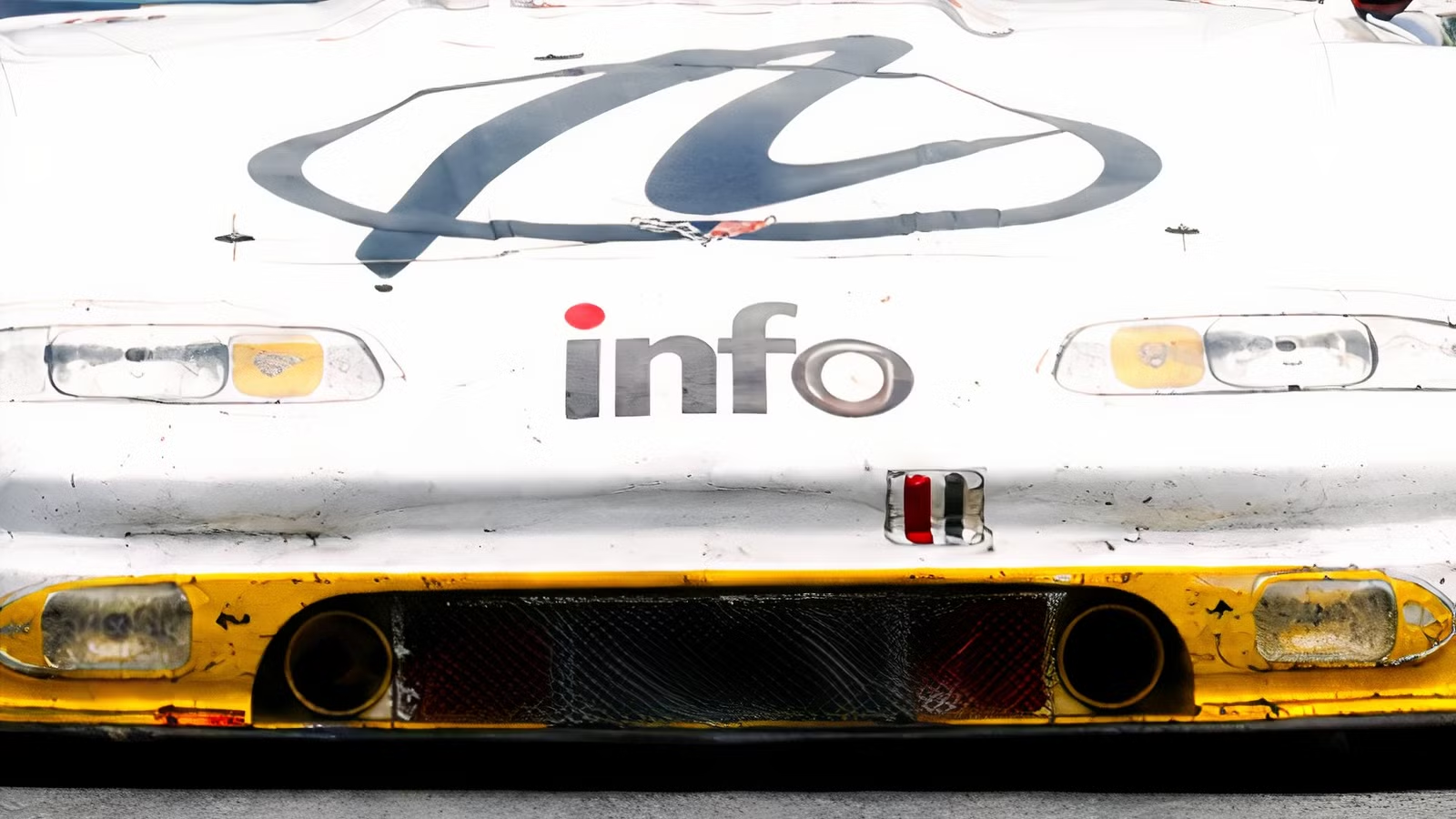
There’s a shortlist of places you probably didn’t want to be back in 1996. One was near the peak of Mt. Everest in the middle of May, and another was an Oldsmobile boardroom. Well, depending on what you classify as dinner theater, you probably wouldn’t want to be there. For most of its executives at the time, the state of affairs was anything but entertainment. That doesn’t mean there weren’t highlights mixed in with considerable lows. In one case,GM’slong-lost brand really was on top of the world in the ’90s, if ever so briefly.


Oldsmobile in the ‘90s: Not Ready to Abandon Ship, But Close

In Oldsmobile’s golden years, the company separated itself from lower-end Buicks and Chevrolets, as well as high-end Cadillacs, by daring to be different wherever possible. Innovations like the iconic Rocket V8, early automotive turbocharging, front-wheel-drive powertrains, and the bulletproof Hydra-Matic automatic gearbox gave Oldsmobile a palpable edge over domestic manufacturers and the scant few foreign competitors around.
By the ’60s, the ‘Olds lineup reflected this in the form of all-time great muscle cars like the A-body Cutlass Supreme and 442, plus the front-wheel-drive Toronado, among others. Owning an ‘Olds muscle car really meant something in the late 1960s, but after a few decades of emissions restrictions, brand scuffling within GM itself, and about a million other things mostly out of ‘Olds’ control, the brand was a downsized, worn-out, and fundamentally altered entity by the time the mid-’90s rolled around.
A few historic ‘Olds nameplates were still around by then. Famous names like the 88, the 98, and the Cutlass managed to survive as neutered husks of what they once were—but this time, they weren’t just competing with other American brands, but also with the titans at Honda, Nissan, and Toyota. Knowing their backs were against the wall, work was already underway at ‘Olds on an all-new full-size luxury sedan for the new millennium as far back as 1989.
The Aurora: Oldsmobile’s Last Gasp in its Former Bread and Butter Segment

Evocatively named the Tube Car, ‘Olds designer Bud Chandler envisioned a car without a typical front grille, all in the name of better aerodynamics. Riding the Cadillac-derived G platform, Oldsmobile’s final luxury sedan would be front-wheel-drive only like the old Toronado. With fully independent suspension using MacPherson struts up front and an aluminum semi-trailing multi-link setup in the back, the G platform was surprisingly competent for the underpinnings of the lumbering Cadillac DeVille and Seville.
The Pontiac Bonneville and Buick Riviera also rode the platform at various points in the ’90s and 2000s, and the Aurora arrived at the party in January 1994 for the following model year. Powered by a transverse-mounted 4.0-liter L47 V8 borrowed from Cadillac’s Northstar line, it was the Northstar’s only variant designed exclusively for Oldsmobile. With 250 hp and 240 lb-ft of torque from the factory, the same motor, tuned to 320 hp, also powered the Shelby Cobra reboot, the independently-built Series 1.
Paired to a four-speed automatic gearbox, the Aurora was a lazy, old-school, docile American luxo-barge for the millennial generation. As it turned out, those who could afford the modern equivalent of over $68,000 for a base Aurora much preferred to buy Lexus LS400s, S-Classes, and mid-size SUVs instead. By its final full model year in 2003, Oldsmobile moved all of 4,000 Auroras. The company would fold for good the following year, but make no mistake, the Aurora had more than one memorable moment—on the race track—not at the dealership.
Aurora GTS-1: A Mid-Tier Luxo Barge Becomes a Race-Winning Track Beast

They ought to write a book or film a movie about how someone managed to turn a middle-of-the-road full-size sedan into something even remotely close to a race car. If someone cares to pick up the script, the story begins with the same desperate refresh that started the Aurora program to begin with. Turning the Aurora into an IMSA-spec GT racer was another step inOldsmobile’s rehabilitation that tried to make the brand coolagain, and the results were stunning.
Under the leadership of GM Motorsports, and collaborating with the seasoned race car manufacturers at Pratt & Miller, the Aurora’s exterior looked similar to the road car—save for the race-spec decals, graphics packages, and aero kits. However, under the skin, IMSA’s Exxon Supreme GT Series gave manufacturers plenty of leeway to get creative. As long as the basic silhouette was the same as the road car, ‘Olds had the all-clear to ditch that FWD drivetrain for the race conversion.
In its place was a chromoly steel tube-frame chassis, complete with a race-optimized Oldsmobile Northstar engine with a high-flow intake, higher compression, and billet internals wherever possible. Suddenly, an engine that was once objectively underpowered was pushing 600 hp at the crank. Naturally aspirated and mounted lengthways inside the chassis, it was enough to give Roush-built Camaros, factory-backed Mustangs, Ferrari 348s, and Porsche 911 GT2s some real problems.
Great Car, Better Drivers

So there the IMSA Aurora GTS-1s were—lined up to start the 1996 IMSA GT Championship season with a bunch of flagship supercars and million-dollar prototypes. In its first year on the circuit, the race-tuned Aurora was entrusted to Brix Racing. With Irv Hoerr behind the wheel at that year’s 24 Hours of Daytona, one of Brix’s two Aurora racers—the #1 car—claimed pole position.
When the #1 car ran into trouble late in the race, the backup #5 car soldiered ahead. Hoerr pulled double duty that night, joined by teammates Rob Morgan, Charles Morgan, Joe Pezza, and Jon Gooding. The #5 car would go on to finish seventh overall, ahead of a field of supercars the standard Aurora had no business sharing a parking lot with. Shortly after, at the 12 Hours of Sebring, the #1 machine went on an all-out track blitz. By enduring crashing apex bumps and close-quarters racing mile after mile, the Brix Racing team secured the GTS-1 class victory by once again finishing seventh overall.
In 1997, the Brix team handed the reins of the Aurora GTS-1 program to Houston, Texas’ Robinson Racing. Proving the prior season was no fluke, the twin Aurora racers remained competitive, securing another class win at Sebring. It was a poetic swansong for the Aurora racing program, but looming regulatory changes for the 1998 season prompted GM to wind down the program after the ’97 season. Not long after the program ended, the very same Northstar engine was fitted with twin-turbos and mounted in Cadillac’s LMP Le Mans Prototype.
A Somber Retrospective: A Roaring, Defiant Farewell

Of course, the Aurora GTS-1 program was effectively just a flash in the pan compared to the insurmountable problems on the consumer side of things. Squeezed more and more by Chevy, Buick, and more foreign competitors than you can shake a stick at, it could be argued that ‘Olds’ fate was sealed long before the last Aurora rolled off an American assembly line. But don’t think for a single solitary second that Oldsmobile’s final decade was a wall-to-wall failure—the Aurora GTS-1 is a testament to the opposite. For two magical years, the Aurora really did conquer giants.
Source: Brix Racing, Robinson Racing

Related posts

Latest Post


No Comments