
The 1990s Twin-Turbo AWD Coupe With Active Aero And 4-Wheel Steering Costs Less Than A Civic
In recent years, many legendary Japanese sports cars from the 1990s have transformed from relative bargains to complete unobtainium. It’s not unheard of at all for an NA1 Acura NSX to set buyers back by $100,000, and collectors lose their minds over low-mileage R34 Skyline GT-Rs. This has left the average enthusiast searching every corner of the used JDM market for hidden gems, with the hope that some cars of that era have managed to avoid dramatic price hikes.

While clean examples of the Toyota A80 Supra and Mazda FD RX-7 regularly dominate headlines with six-figure asking prices, one car that competed in the same segment can still land in buyers’ driveways for tens of thousands less.
The Rise of Tech-Packed Performance Cars
In the modern age, performance cars are anything but simple. The priority is a driving experience that’s quicker, sharper, and more customizable than ever. To achieve this, automakers are locked in an arms race for the largest displays and the most advanced chassis dynamics. Hybrid-assisted powertrains fill in the power gaps left by the combustion engine, and complex suspensions recalibrate themselves to accommodate imperfect roads. Driving modes will adjust nearly anything at the driver’s command through touchscreen menus, while the passenger watches a movie on their own dedicated display.

The result is either a highly sophisticated computer on wheels, or the tragic loss of analog simplicity, depending on your perspective. Either way, the boundaries of automotive engineering are undoubtedly being pushed to new heights. While this trend towards adaptive, automatic everything is very recent, there was one Japanese sports car that introduced shockingly advanced technology as early as the 1990s.
Mitsubishi Built A Tech-Loaded Performance Car Before The Digital Era
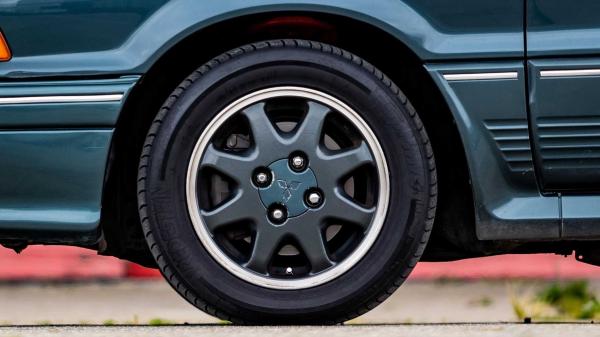
Mitsubishi was quietly revolutionizing performance with a hidden gem that integrated cutting-edge technology years ahead of its time.
The Mitsubishi 3000GT VR-4 Was Ahead of Its Time

Long before active aerodynamics and four-wheel steering were the norm, the Mitsubishi 3000GT VR-4 burst onto the scene with these features equipped as standard. Its mission was to serve as a rolling showcase of Mitsubishi’s engineering prowess, and it was the brand’s cushy, tech-crammed response to JDM greats such as the Toyota Supra Turbo and rotary-powered Mazda RX-7.
The mad scientists at Mitsubishi threw everything into their bubbling glass beaker. The suspension was electronically controlled to adjust to driving conditions in real time, a feature that many newer cars have only recently adopted. The cutting-edge active aero automatically adjusted the front air dam and rear spoiler based on the car’s speed, and the exhaust system featured an active valve that opened at higher rpms. The climate controls could be adjusted automatically and were displayed digitally, which was highly advanced for the early 1990s. The 3.0-liter DOHC V6 engine was paired with two turbochargers to deliver a remarkable 300 hp, which was sent to all four wheels. The VR-4 was also among the first vehicles to implement four-wheel steering, which tightened its turning radius and improved stability at high speeds. Mitsubishi truly left no stone unturned.
However, the 3000GT’s extravagant amount of technology came with a few disadvantages. It was significantly weighed down, with a curb weight of between 3,737 and 3,810 pounds. The endless list of complex, avant-garde features also raised concerns that the sports car would eventually become riddled with failures.
A Japanese Coupe With American Muscle Roots

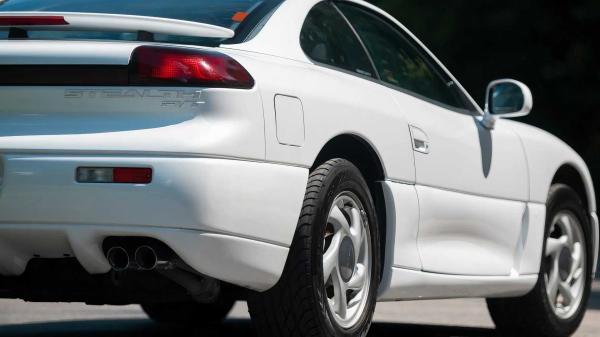
Underneath its unmistakably 1990s sheet metal, the 3000GT was actually a badge-engineered Dodge Stealth. In a rather fascinating relationship between the two companies, the 3000GT and the Stealth were built alongside each other at Mitsubishi’s Nagoya plant in Okazaki, Japan, even though the Dodge was strictly sold in North America. While many 3000GT units stayed in Japan under the GTO nameplate, the Stealth was promptly shipped to the western hemisphere alongside the U.S.-bound 3000GT.
|
Car |
Power |
Torque |
0-60 MPH |
|
Mitsubishi 3000GT VR-4 |
300 HP |
307 LB-FT |
4.8 seconds |
|
Dodge Stealth R/T Twin Turbo |
300 HP |
307 LB-FT |
4.9 seconds |
While both cars shared their chassis, all-wheel drive system, adaptive suspension, and powertrain with identical outputs, many of the cutting-edge features found in the top-tier VR-4 remained exclusive to Mitsubishi. The range-topping Stealth R/T missed out on the active aerodynamics trickery, as its bespoke front bumper and rear spoiler designs made it difficult to carry that feature over. Dodge had agreed to position the Stealth as a lighter, slightly simpler option for Americans, while the Mitsubishi served as its higher-end sibling.
Over the course of the 1990s, increasingly unfavorable exchange rates between the U.S. dollar and the Japanese yen made it too costly for Dodge to keep exporting the Stealth, especially considering its slow sales. The Mitsubishi 3000GT, however, soldiered on until the end of the decade.
The Greatest Discontinued AWD Cars That Deserve A Comeback
Sending power to all four wheels has some incredible driving benefits and we want to see these forgotten icons back on the roads.
Mitsubishi Gradually Waters It Down

As the 3000GT entered its later model years, Mitsubishi began to favor weight savings and mechanical simplicity at the cost of the advanced features that the VR-4 had initially launched with. Its active exhaust system was deleted after the 1994 model year, and the very complex, electronically-controlled suspension left the scene after 1995. Mitsubishi even removed the VR-4’s distinctive active aero after 1996. The absence of these features slowly stripped the 3000GT of its earlier status as a tech pioneer.
The 3000GT also underwent three major updates to its exterior design and mechanicals, though it never abandoned its original platform. The first refresh arrived for 1994, with a more robust six-speed manual replacing the older five-speed for the VR-4, and engine output was raised from 300 hp to 320 hp. Mitsubishi also removed the pop-up headlights in favor of a fixed design. The second update was released in 1997 with more subtle design tweaks and a new fixed rear wing, and the final 1999 model added a more aggressive “combat wing” and entirely redesigned lights and bumpers for the front and rear.
The New 3000GT VR4 Mitsubishi Should Make
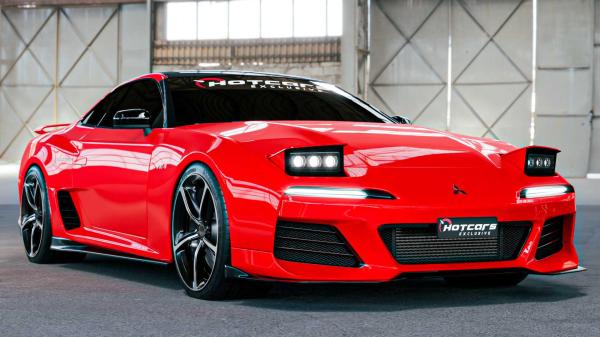
The Mitsubishi 3000GT VR4 was one of the quickest cars of the ’90s, and making a successor makes more sense than you think.
Why The 3000GT Is Still An Enthusiast Bargain

In today’s used market, ongoing maintenance concerns regarding the VR-4’s myriad technological features have managed to keep prices down while rivals from Toyota and Mazda reach six-figure highs. The market’s fears are not entirely invalid, as owners have consistently identified timing belt maintenance and neglected electronics as major money pits. However, among the relatively small batch of 16,416 VR-4s that ever reached the U.S., the level of electronics is highly variable depending on the model year. Since later models progressively grew simpler as Mitsubishi gradually cut out the debut model’s advanced features, VR-4 examples from 1997 onwards tend to be less costly.
In terms of the VR-4’s upfront purchase price, recent listings on Bring a Trailer average between $15,000 and $35,000. That means many listings are well below the Civic’s current starting price of roughly $25,000. Interestingly, prices depend more on mileage than model year, even despite the better reliability reputation of later examples. This means a less headache-inducing late-production model can still be had for the same reasonable price as an earlier, tech-laden model with similar mileage. But considering the skyrocketing price tags of the 3000GT’s more popular rivals, you’ll want to keep this bargain a secret.
Sources: Mitsubishi, Bring a Trailer

Related posts


Latest Post


No Comments