
The Hand-Built V12 Jaguar Shooting Brake Nobody Remembers Is Now A Six-Figure Unicorn
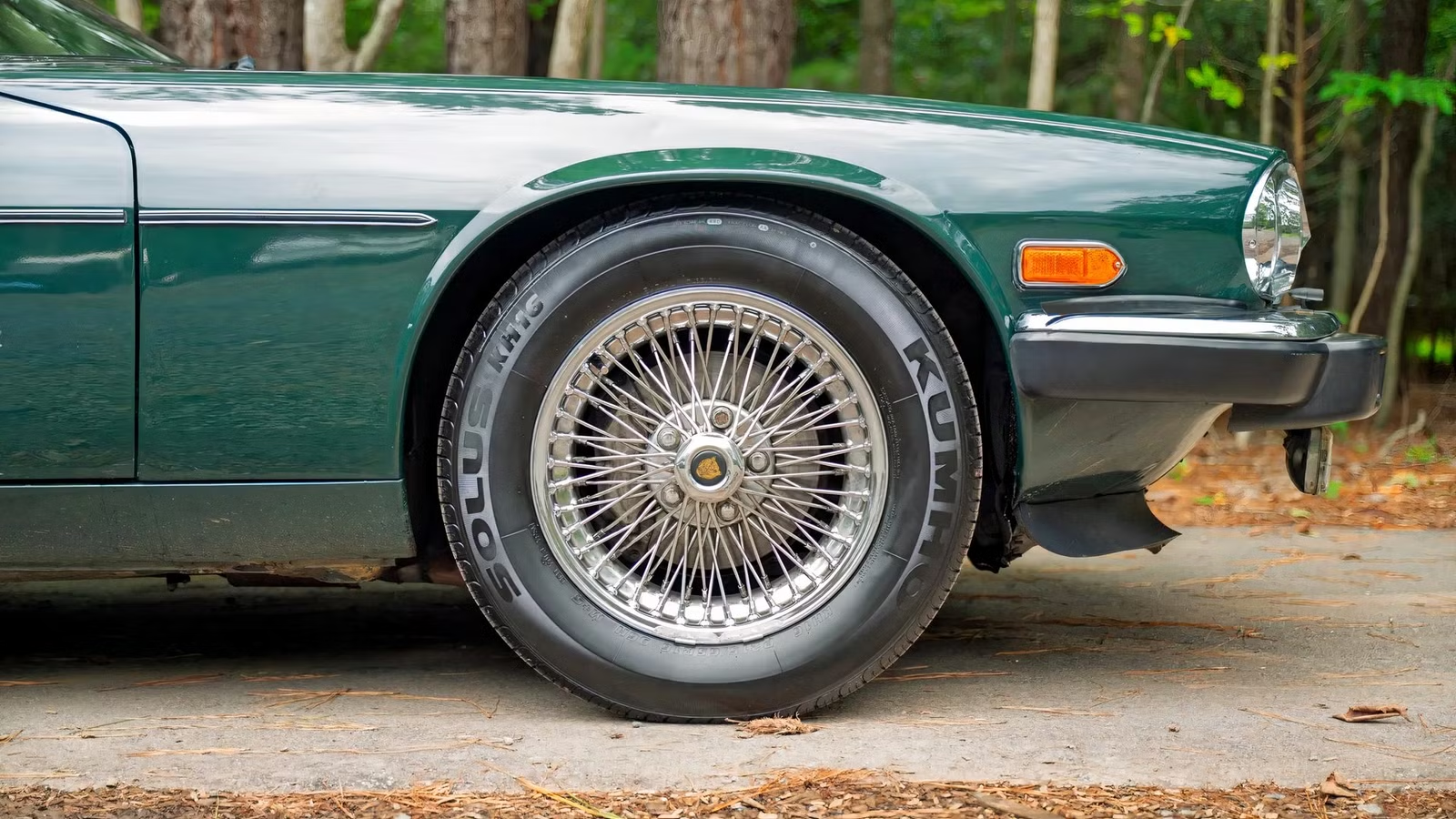
A small British workshop took a grand tourer everyone loved to mock and turned it into a hand-built estate car that nobody wanted to buy. Just sixty-seven were built in a nearly two-decade production run, hand-fabricated to order for buyers who saw what the rest of the world missed, and the rarest of them have now sold for six figures, several times what a clean standard example of the donor car brings today. This is the story of how a joke became a blue-chip investment, one V12 at a time.
The Shooting Brake Craze Has A Forgotten Original

Long-roof conversions of cars that were never meant to be wagons are having a moment right now. Collectors are paying serious money for machines that shouldn’t logically be worth more than the coupes they started life as, chasing a body style no factory bothered to build. One example did all of this decades before anyone had a name for the trend, and almost nobody noticed at the time.
The Donor Car Everyone Wrote Off As A Joke

Pininfarina built just seven Ferrari 456 GT Venice shooting brakes in the mid-1990s for a single customer, Prince Jefri Bolkiah of Brunei, so spotting one today is essentially winning the lottery. The BMW Z3 M Coupe took the opposite path entirely: a factory model nicknamed the ‘Clown Shoe’ that BMW barely bothered to market, and still over 6,000 were built, with roughly 2,850 crossing the Atlantic. Neither was built to be a status symbol, and both show collectors will pay a real premium for something that was never supposed to look this good with a hatchback bolted on.
Long before either of them existed, there was a donor car: a V12 grand tourer and successor to one of Britain’s most beloved sports cars, criticized at the time for styling that never lived up to the legend it replaced. Nobody pictured it as the basis for anything special, let alone a wagon. Under the skin it was genuinely quick for a comfort-focused grand tourer, a 150-plus mph cruiser with a V12 up front, but the reputation never caught up with the performance, and the factory itself never once considered building an estate version to go with it.

8 Total Automotive Flops That Cost A Fortune Now
From the Tucker 48 to the Corvette ZL-1, these cars went from flops to million-dollar collectibles.
One Coachbuilder Turned A Punchline Into A 14-Week Build

While everyone else saw the flaws, one small coachbuilder saw an opportunity that nobody else in the business wanted to touch. Within a couple of years they had built something that never should have existed on paper, a full estate car conversion of a coupe nobody thought needed one, done entirely by hand, one order at a time.
Why Almost Nobody Ordered One When It Was New

Each car was hand-built strictly to order, fourteen weeks from commitment to delivery, on a jig built specifically for the job. The conversion tore off the roofline everyone complained about and replaced it with an entirely new rear roof and hatch, relocated the fuel tank around the spare wheel well to keep the load floor flat, and stiffened the rear suspension to handle the shifted weight over the rear axle and whatever cargo owners actually loaded into it. The new tailgate glass was borrowed from a Citroën Ami estate and reshaped until it disappeared into the design, and despite all that extra metal bolted onto the back, the finished car reportedly weighed less than the coupe it started as, so it drove sharper, not softer.
None of that made it an easy sell when it was brand new, launching in 1983 at £6,950,or roughly $9,300, plus VAT, close to a third of the price of the donor car itself, for a conversion from a small workshop nobody outside the trade had even heard of. There was no badge, no dealer network, and no marketing budget behind it, just word of mouth among people who already owned the coupe, so just sixty-seven were built across the entire run. That scarcity, born from a slow sales pitch nobody wanted to hear at the time, is exactly what makes the story work now.
This Is The Jaguar XJ-S Lynx Eventer Shooting Brake

This is the Jaguar XJ-S, and the coachbuilder behind the conversion was Lynx Engineering, a name most drivers outside the marque’s owner clubs have never heard. Lynx started in 1968 as a Jaguar repair shop before graduating to hand-built C-Type and D-Type replicas still prized by collectors, and by the early 1980s it had already beaten Jaguar to a soft-top conversion of its own with the XJ-S Spyder, before the factory version arrived.

Once Jaguar’s own factory convertible was finally on the way, Lynx pivoted to something more ambitious still, a full shooting brake version of the XJ-S, a body style Jaguar had never offered and, by most accounts, never once planned to build itself. The first prototype broke cover in the summer of 1982, its interior not even finished for the reveal, fittingly enough for a car built around Jaguar’s own longstanding grace, space, and pace ethos taken literally. Lynx called it the Eventer, full production began the following year at the coachbuilder’s Hastings workshop with each customer specifying their own car from scratch, and decades later enthusiast registries are still trying to track down every single one of the sixty-seven.
Sixty-seven Eventers were built in total across the whole run, widely reported as 52 pre-facelift cars and 15 post-facelift cars built after Jaguar’s 1991 XJ-S redesign, with only eighteen of them left-hand drive, the rest staying right-hand drive for UK buyers and a scattering of continental European customers. Production ran all the way to 2002, with the final car built on a limited-run 6.0-liter Jaguarsport XJR-S base, almost two decades after the first prototype broke cover. Every single one was bespoke to its owner’s own specification, with a six-foot cargo bay and roughly 39 cubic feet of load space once the rear seats folded flat, something the standard coupe never came close to offering its own buyers.
The World’s Longest-Produced V12 Is Also One Of The Most Unreliable
This 12-cylinder engine ruled for over two and a half decades, powering iconic sports cars and luxury sedans. It was smooth and famously unreliable.
From $9,000 Conversion To A Gucci-Trimmed Unicorn

Then one Eventer went further than the other sixty-six ever did. Car number 35 was sent to Tom Walkinshaw Racing for a full engine rebuild before it ever reached Lynx’s workshop for its conversion, and it came back a completely different animal underneath the same handsome roofline.
The TWR Variant That Pushed The V12 To 380 HP

|
Displacement |
Power |
Torque |
|
6.1 Liters |
380 HP |
406 LB-FT |
TWR was already Jaguar’s own works racing partner at the time, running the marque’s touring cars and its Le Mans-winning prototypes, so sending an engine there was about as far from a backstreet tuning job as it gets. The team enlarged the V12 to 6.1 liters with forged pistons, machined combustion chambers, larger air intakes, high-flow filters, and high-lift camshafts, and Lynx’s own files recorded this specific engine’s output at 380 hp, well above TWR’s standard rating of 335 hp for the same upgrade package. It is believed to be the only Eventer ever fitted with period TWR upgrades, and it first belonged to Raymond Burton, son of Montague Burton, the man behind the Burton menswear chain.
That original £6,950 conversion fee had climbed to £49,500, or approximately $66,000, by the time the last Eventer left the workshop in 2002, roughly seven times the starting price for the same conversion two decades later. A one-off Paolo Gucci-trimmed Eventer, shown off at the 1990 Geneva Motor Show wearing a jaw-dropping £100,000 price tag, only stayed a one-off because a trademark dispute killed Gucci’s plan to sell a limited run under his own name for a small fortune. It eventually sold at Bonhams’ Goodwood Festival of Speed in 2016 for £84,380, something in the region of $114,000 at the time, and even a standard, unmodified 1988 car sold for £39,100 in late 2015, which is almost in the $58,000 ballpark, so the premium runs through the whole range, not just the headline-grabbing one-offs.
7 Shooting Brakes Real Wagon Fans Pay Crazy Premiums For
Enthusiasts will pay over the odds to have one of these awesome, quirky shooting brakes.
The Secret Benchmark Behind Today’s Shooting Brake Market

None of that money is about outright performance. The standard Eventer kept the donor car’s stock V12 and stock power output, essentially the same drivetrain as any other XJ-S on a used car lot down the road. Most of that premium is paid for scarcity and handcraftsmanship, and that is exactly why the story matters now.
What The Ferrari 456 Venice And BMW Z3 M Coupe Owe It

Confirmed sale prices for Eventers now run from around $52,000 for a standard car up toward $112,00 for the rarest one-off, well above what an ordinary XJ-S coupe commands on its own, since a standard coupe today typically changes hands for well under $20,000 in good condition. The TWR car sits right in the middle of that Eventer range at $80,000, another sign the premium scales with rarity and story, not just outright performance. That gap between an affordable donor car and a genuinely expensive coachbuilt one is most of the story here.
The Eventer’s best examples were touching six-figure money at auction years before “long-roof exotic” was a category anyone recognized, let alone actively chased. The Ferrari 456 GT Venice did not exist until more than a decade later, built just seven times for one very wealthy customer, and the BMW Z3 M Coupe’s own collector surge did not arrive until decades after its 1998 launch, long after enthusiasts had written it off as a cult oddity nobody wanted. Every coachbuilt shooting brake collectors chase today is, whether they know it or not, being priced against a car most of them have never even heard of.
Sources: Bonhams, Classic.com, Kelley Blue Book, Hagerty

Related posts

Latest Post


No Comments