
8 Italian Classics Still Cheaper Than A Brand-New Miata
There has never been a better time to ask a simple question: what if, instead of signing the paperwork on a new sports car, you spent that same money on something with genuine history behind it? The 2026 Mazda MX-5 Miata remains one of the purest driver’s cars you can buy today — honest, lightweight, and priced at $30,430 for the base Sport with a six-speed manual. For a brand-new roadster that puts a smile on your face every single time, that is genuinely hard to argue with.

But here is a thought worth sitting with. For less than that $30,430, you could put yourself behind the wheel of a piece of Italian automotive history — something with a bloodline, an iconic badge, and styling that turns heads for entirely different reasons than a new car ever could. You could buy a used Miata, but wouldn’t you rather have an exquisitely styled Italian roadster or coupe?
The myth is that Italian classics are expensive, and that is true for many of them — but not all. Italian cars from the 1970s and 1980s tell a very different story, and most people have no idea how attainable these cars actually are. Eight of them are still cheaper than a new Miata, and some are not even close.
Alfa Romeo Milano (1987–1989)
Average Used Price: $27,024

Most people walk straight past the Alfa Romeo Milano at a car show without a second glance, which tells you everything you need to know about why it is still affordable. It was officially sold in the United States for just three model years, and only 8,112 examples were sold across that entire run — making it a genuinely rare automobile on American roads today.
It carries the same Busso-designed 2.5-liter V6 as the GTV6, mounted in a rear-wheel-drive body with a transaxle layout for near-perfect weight distribution. It is the same mechanical philosophy that made the GTV6 one of the great driver’s cars of its era, packaged in a format that nobody else thought to build.

Classic.com puts the average across the Milano market at $27,024. A Busso V6, rear-wheel drive, and a sub-$30,000 price tag on a car that America mostly ignored the first time around.
Alfa Romeo GTV6 (1980–1986)
Average Used Price: $19,500

The Busso-designed 2.5-liter V6 is one of the most characterful naturally aspirated engines ever fitted to a production road car — a smooth, high-revving six with a sound that makes simply pressing the accelerator feel like an event. Nothing else on this list sounds quite like it.

The engineering goes deeper than the engine. A transaxle layout puts the gearbox at the rear axle for a weight distribution that most sports cars of its era could only dream about, and the GTV6 backed that up with a serious motorsport career in European and South African touring car racing.
Classic.com data from the last twelve months shows a high of $34,000 and a low of $5,000, putting the average at $19,500 — still under the Miata benchmark. The GTV6 is the driver’s choice on this list, and the one that rewards every dollar you put into finding a good one.
Maserati Biturbo (1981–1994)
Average Used Price: $13,522

The Maserati Biturbo has one of the most complicated reputations in the classic car world. Early examples had reliability problems that the press never forgot, and the name has carried that baggage ever since — which is precisely why prices are where they are. The Biturbo was the first production car in the world to use a twin-turbocharged engine, and the interior was genuinely luxurious by early-1980s standards, with Connolly leather and burr walnut trim that shamed more expensive contemporaries.

The later fuel-injected cars from 1986 onward are the ones to seek out. Reliability improved significantly once Maserati moved away from the carbureted setup, and a well-sorted example is a manageable proposition for an enthusiast who goes in with realistic expectations. Classic.com puts the average sale price at $13,522.
For that money you get a Trident on the grille, a twin-turbocharged V6 under the hood, and one of the most characterful cabins of the entire decade.
Fiat 124 Sport Coupe (1967–1975)
Average Used Price: $12,280

The Fiat 124 Spider gets most of the attention, but the Sport Coupe is the one that serious enthusiasts point to when nobody is listening. Pininfarina designed the body, and the fixed-roof proportions are arguably cleaner than the roadster’s — a proper Italian GT in miniature that looks more expensive than it is, and always has.

The twin-cam engine is the same unit that underpinned Abarth’s rally cars, giving the Sport Coupe a motorsport pedigree that its price tag does not advertise. Rear-wheel drive, a five-speed gearbox, and a chassis that rewards commitment make it a more serious driver’s car than the numbers suggest.
Supply is healthy enough to keep prices honest. Classic.com records an average sale price of $12,280, with sales recorded as low as $2,440. For a Pininfarina-designed, twin-cam Italian coupe with genuine motorsport DNA, that is one of the better value propositions in the classic car market.
Fiat X1/9 (1972–1989)
Average Used Price: $12,129

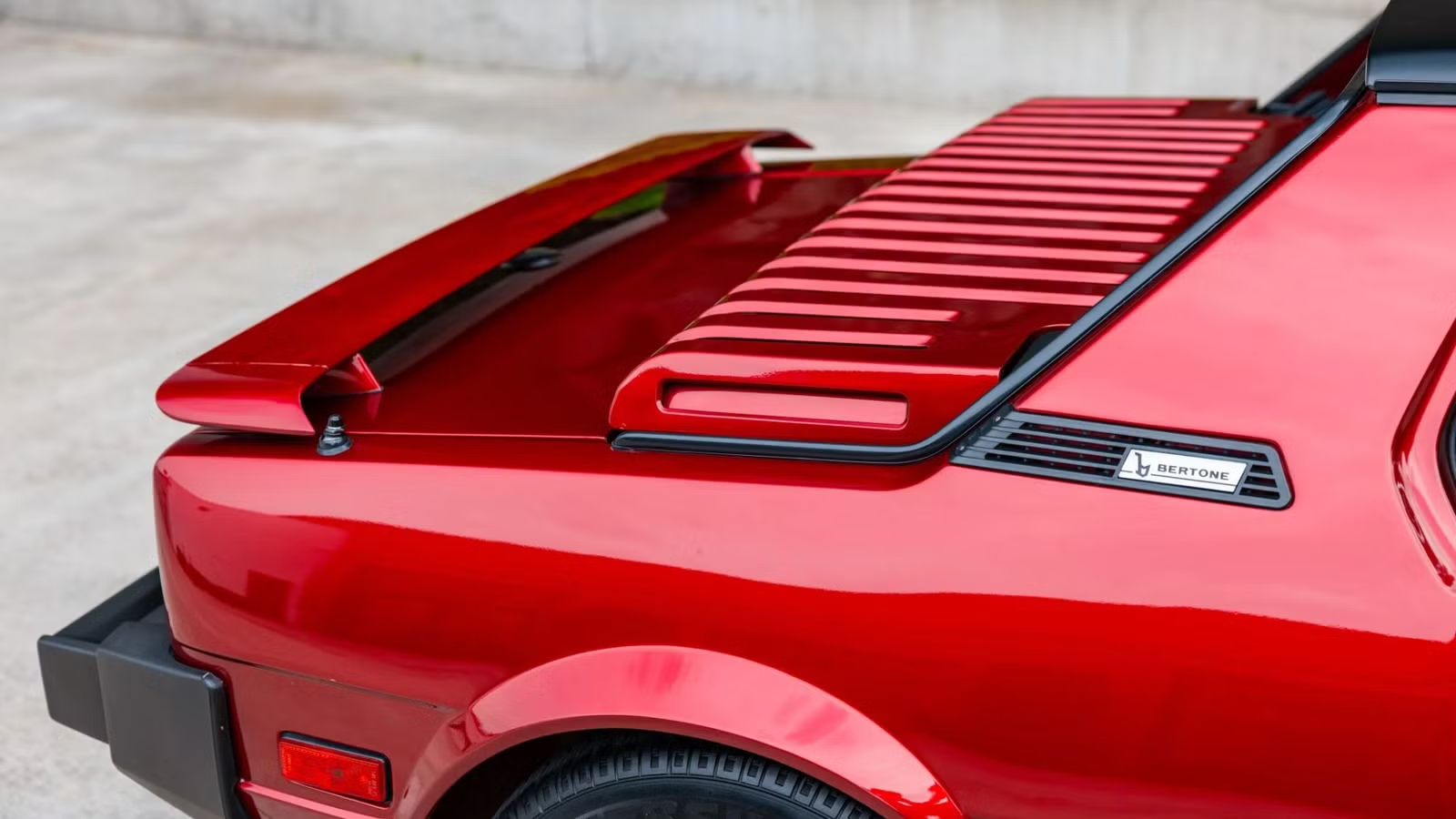
Bertone designed this one, and the result was something the world had never quite seen before. The X1/9 is a mid-engined, targa-topped sports car that was sold new for the price of a family hatchback. The pop-up headlights, the knife-edge bodywork, and the wedge profile gave it a silhouette that drew comparisons to the Ferrari Dino — and those comparisons were not entirely unfair.
The mid-engine layout delivers a balance that rear-engined and front-engined sports cars simply cannot match. It corners with genuine precision, communicates clearly through the steering, and rewards the kind of driving that makes a back road feel like a racetrack. The removable targa roof means you can have the full open-air experience without committing to a roadster full-time.

Production ran from 1972 all the way through to 1989, with the later Bertone-badged cars considered the most sorted and the most usable. Parts availability has improved significantly through specialist suppliers in recent years, which takes some of the ownership anxiety away. Classic.com puts the average sale price at $12,129 — a serious mid-engine sports car for considerably less than a new Miata, and one with a design that has aged far better than most of its contemporaries.
Alfa Romeo Spider Series 3 (1983–1990)
Average Used Price: $9,737

If there is one Italian car that needs no introduction, it is this one. The Alfa Romeo Spider appeared in The Graduate in 1967 alongside Dustin Hoffman and spent the next two decades becoming the definitive image of the open-top Italian roadster. It is the car that put Italian motoring on the cultural map for an entire generation of American enthusiasts.

The Series 3 cars from 1983 to 1990 represent the sweet spot for value. They are more modern than the earlier Duettos, fuel-injected, better equipped, and available in Veloce, Quadrifoglio Verde, and Graduate trims. The twin-cam engine is proven, parts are easy to source, and the owner and specialist community is one of the strongest of any Italian classic in the United States.
Classic.com puts the average Series 3 sale price at $9,737, with examples sold from as low as $1,500 and the highest recorded sale at $35,401. For one of the most iconic roadsters ever built, that average is a number that still has the power to surprise.
Fiat 850 Spider (1968–1973)
Average Used Price: $9,063

The Fiat 850 Spider is the smallest car on this list, and quite possibly the most charming. Bertone designed the body, and for a car built on a budget platform with a rear-mounted 843cc four-cylinder engine, the proportions are close to perfect. It looks like it should cost considerably more than it does.
The 850 Spider was about as simple as it gets. It produces around 52 horsepower, weighs just over 1,500 lbs, and has a top speed in the region of 90 mph. None of those numbers sound impressive until you are actually driving one — at which point the lightness, the open top, and the mechanical soundtrack conspire to make the whole experience feel genuinely special.

These cars were officially sold in the United States, which means parts and documentation are easier to trace than you might expect for something this old. The average sale price on Classic.com sits at $9,063 — well under the Miata benchmark for a car that turns more heads per dollar than almost anything else on the road. It is the entry point on this list in every sense, and not a bad place to start at all.
Lancia Beta Coupe (1974–1984)
Average Used Price: $2,488

Nobody talks about the Lancia Beta Coupe, and that is exactly why it belongs at the top of this list. Designed in-house at the Lancia Style Centre, the proportions are clean, the roofline is low, and nothing about it looks cheap. All four wheels had disc brakes, fully independent suspension, and a five-speed gearbox as standard — premium-car features in 1974.
The Beta has a corrosion reputation, and it is not entirely undeserved. But that is also why the surviving cars are so affordable — the market has never fully forgiven the rust, even on examples that have long since been sorted. The average sale price on Classic.com is just $2,488, making it the most accessible Italian classic on this list by a significant margin.

For that money you get genuine motorsport credibility. The Beta Montecarlo variant won the World Sportscar Championship in both 1980 and 1981. On the right road, it will make you feel like you paid ten times what you spent.
Sources: Classic, Bring a Trailer, Cars and Bids

Related posts
Latest Post


No Comments