
10 Kawasakis That Quietly Became Modern Classics
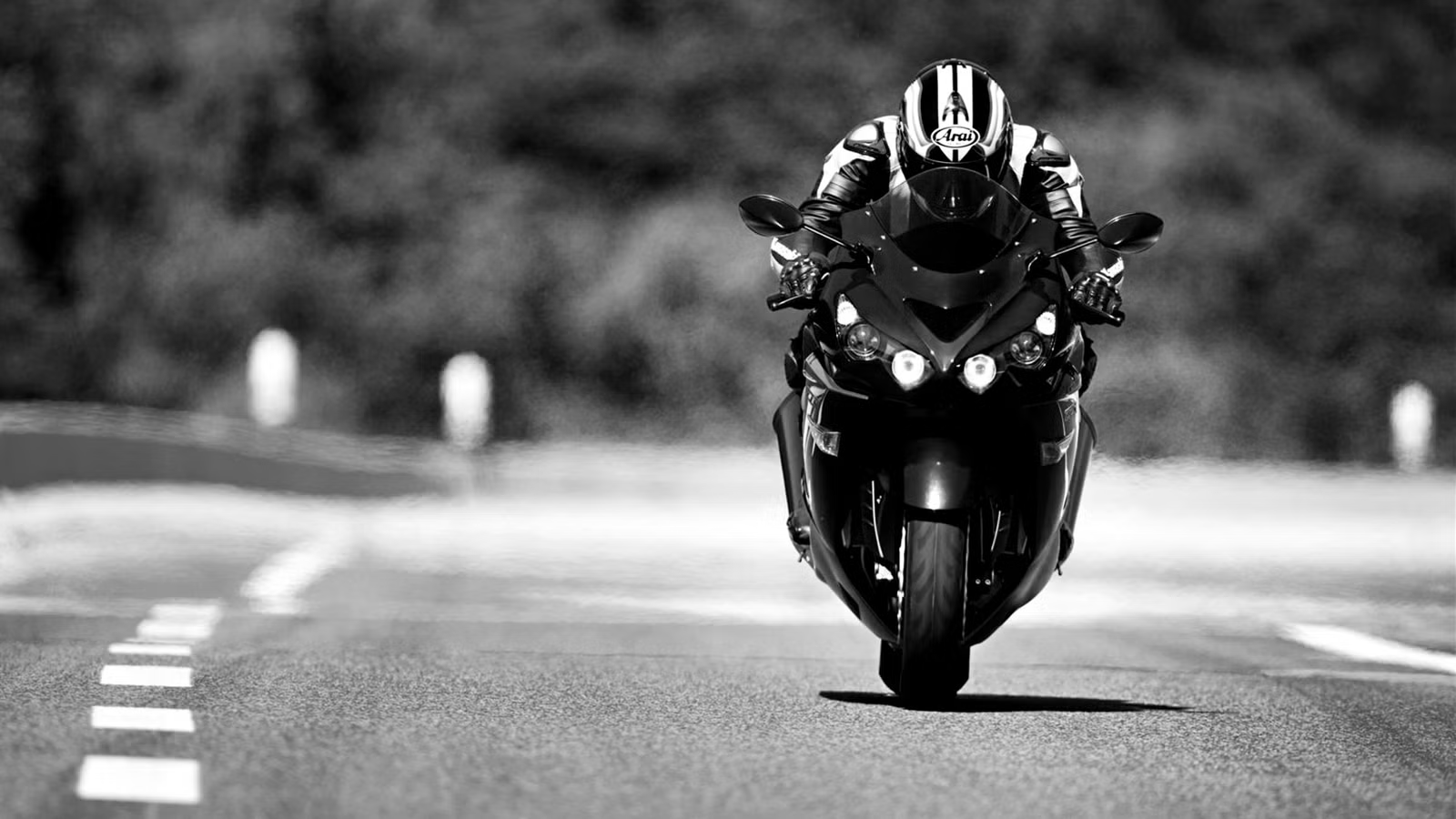
Kawasaki is known for its performance models, like the original 1972 Z1, its widow-making two-stroke triples, or the supercharged Ninja H2. If you look beyond these headline-grabbing machines, you realize that there are quite a few Kawasakis that are equally legendary, but without the fanfare. These weren’t instant hits when they launched; instead, they earned their followings with bulletproof engineering, distinctive character, and usability that often outlasted their model years. What’s more, these Kawasakis range from small dirt bikes to full-size streetfighters and even the largest-displacement twin-cylinder ever put into a production motorcycle when it launched. These are 10 Kawasakis that quietly became modern classics.
KDX200
Used Price: ~$3,000

*First-gen bike shown
In the 1980s, the KDX 200 started off as a great middle ground between the 125s and the 250s, with the lightness of the former coupled with the performance of the latter. By its fourth generation, this had been perfected. The KDX had already established that it was a dirt bike with legendary toughness, but it upped its game by utilizing a KX-inspired steel perimeter frame for the fourth-generation KDX 200. The improved torsional rigidity was coupled with a much slimmer bike.
However, Kawasaki resisted the urge to provide it with stiff, race-derived suspension, instead fitting it with regular telescopic forks and a Uni-Trak rear shock. This made it much more comfortable for riding around in the woods. It also had a USFS-approved spark arrestor as standard and had ironed out any dips in the powerband. The only reason it was phased out was that tightening emission norms made it impossible for two-strokes to survive.

Eliminator ZL900
Used Price: $4,130

Say “power cruiser,” and the Honda V65 Magna and, of course, the Yamaha VMAX come to mind, but what many people don’t know is that Kawasaki had also dipped its toes into the power cruiser market with the Eliminator ZL900. As the name suggests, it used the engine from the GPz900 as a foundation and built a cruiser around it. Of course, it was a little different.

It had slightly smaller carburetors, a lower horsepower figure of 105 horsepower, and it got the 63 pound-feet of peak torque earlier in the rev range. The rest of it wasn’t much different. It still had an 11:1 compression ratio, dual overhead camshafts, and a six-speed gearbox. Kawasaki also opted to give it a driveshaft, as it was a cruiser. It was not as successful as the Honda or the Yamaha, and Kawasaki quickly pulled the ZL900 in favor of the ZL 1000, which also faced the same fate; it was discontinued in two years.
W650
Used Price: $4,760

Kawasaki’s W series of motorcycles offers a neo-retro experience. For the most part, they offer an alternative to British parallel-twin standard motorcycles, and the legacy continues with the W 800 today. This can trace its legacy back to the W 650. The 650 was launched in 1999, and it had everything that made it appeal to markets like Europe because of how closely it aped old British twins.
People didn’t care about its 50 horsepower engine with the kickstarter and a drum brake. In America, though, the turn of the millennium had people obsessing over how large an engine they could put into their cruisers, and a small retro standard motorcycle didn’t have many takers. Today, though, people realize what a classic it is, and finding one on the used market can be quite difficult.
Vulcan VN2000
Used Price: $7,260

Kawasaki’s Vulcan series has been very popular for over 40 years, and it once had Kawasaki’s largest twin-cylinder engine ever. In the mid-2000s, there was an arms race between cruisers to see who could develop a product with the biggest displacement engine, and for a brief period before the Triumph Rocket III launched, the Vulcan VN2000 held that title. It had a 52-degree V-twin that was liquid-cooled, with four valves per cylinder, displacing 2,053 cc (125 cubic inches!) to produce103 horsepower and an immense 130.5 pound-feet.

It used a five-speed gearbox and belt drive to send the power from those giant pistons to the wheel. The Vulcan 2000 was so large that it dwarfed bikes like the Fat Boy, with a length of 8.25 feet and a curb weight of over 800 pounds. The very thing that made it famous also made it unusable for a lot of people, which is why it was pulled from production very soon. Today, it costs less than a Honda Rebel 500, and fans appreciate the engineering that made it such a great motorcycle.
Z1000
Price: $7,270

Kawasaki’s ‘Sugomi’ design philosophy debuted with this Z1000. This was a watershed moment not just for Kawasaki, but for naked bike design. It is supposed to look like a predator crouching to strike. While the design polarized opinion, what was undeniable is that it definitely made everyone take notice. Today’s aggressively styled streetfighters all have the Sugomi Z1000 to thank.

Also, it went as analog as possible in a market where liter streetfighters were turning to rider aids. This Kawasaki had a cable throttle, no traction control, and the only assistance it offered was ABS. Paired with 142 horsepower, 81.9 pound-feet of torque, and a midrange that could pull up the front wheel in most gears, it rode as it looked. It was also equipped with Showa SFF-BP forks and race-spec Tokico radial monobloc brakes. This remains one of the most popular Japanese bikes that are no longer on sale.
Vulcan S
Price: $7,649

We go from the largest Vulcan ever to the smallest in the current lineup. Like the Z1000, the Vulcan S was a new concept at the time: a cruiser that shared its driveline with a naked and a sportbike with barely any changes to its tuning. That meant it liked to be ridden hard, and it could be hustled through the corners as well with some enjoyment.

It does that with a trellis frame that uses the engine as a stressed member, and a 180-degree parallel-twin engine that displaces 645 cc and generates 61 horsepower and 46.5 pound-feet. This is mated to a six-speed gearbox with a final chain drive, and ABS is a $500 option. It still needs a TFT display to truly match the competition in the segment, but what it is is a cruiser that is extremely fun and yet makes long-term ownership affordable.
Ninja ZX-4RR
Price: $9,999

If we told you that you could get your hands on a small-displacement inline four engine that could scream to an incredibly high redline, you’d be forgiven for assuming that it would be something from the late ‘80s or ‘90s. Kawasaki has resurrected the segment with the ZX-4R. The variant with the bells and whistles is the ZX-4RR, and it might be a slow inline-four sports bike, but it teaches you to ride like a pro.

Both variants offer 56 horsepower and 26.5 pound-feet from a 399 cc inline four, and dual front brake discs with radial calipers, but the RR adds better suspension and a two-way quickshifter. At the front, there are Showa SFF-BP forks with preload adjustment, while at the rear there is a BFRC-Lite piggyback shock with full adjustability.
Ninja ZX-6R
Price: $11,599

The 600 cc supersport class has seen the market shift away to more practical options, with owners wanting a product that is quite usable on the street as well. The ZX-6R has stood steadfast in this change, offering thrills without the corresponding financial pain. It does this by offering rock-solid reliability and a great specific output from its engine. The engine displaces 636 cc and generates a solid 127 horsepower and 52.1 pound-feet of torque.

You still have to work the engine and the gearbox to extract the maximum from it, but the midrange isn’t completely gutless. It also has a few electronics, like an upshift-only quickshifter, fully adjustable suspension, and four-level traction control that can be switched off. ABS is an optional extra, but it makes every dollar count with features like a 4.3-inch TFT display. Since it comes across as ‘last gen’ right now, it gets largely ignored, but expect demand for it to grow once wannabe racers and enthusiasts learn exactly how affordable one of these is to maintain!
Ninja ZX-14R
Price: $17,599

Kawasaki has another displacement record with the Ninja ZX-14R: this is the largest-displacement inline four-cylinder engine ever in a production motorcycle. And the reasons for it are quite the same as the Vulcan 2000, namely, performance. In the ZX-14R’s case, it was designed in the mold of the Suzuki Hayabusa, to be a sport tourer by day, and a dragstrip terror by night. It is safe to say that Kawasaki exceeded expectations and this will become a future classic.

By all reasonable measures, the biggest Ninja is smoother and has better handling than the Hayabusa. Even on the dragstrip, it has made history in the hands of Rickey Gadson. If you need more convincing, well, its peak torque figure of 113.2 pound-feet is more than that of the supercharged Ninja H2 SX, and it is generated lower in the rev range. It will probably be killed off by the next round of emission regulations, but should you ever want a jolt without sticking a fork in a socket, the ZX-14R should do nicely.
Ninja H2 SX SE
Price: $29,999

It seems like only yesterday Kawasaki was making headlines for launching the first production supercharged motorcycle in history, and here we are over a decade later, wondering when the next forced induction motorcycle will launch. Kawasaki hasn’t rested on its laurels, though, putting this engine into various types of motorcycles, including a naked bike and a sport tourer that gets the comfort-to-performance formula exactly right.

In theory, forced induction should work well for a tourer: the extra torque at low revs should make it easier to ride with load, but Kawasaki hardly turned down the wick for the Ninja H2 SX SE, extracting 207 horsepower and 101 pound-feet from its 998 cc engine. And it packed it with features like a 6.5-inch TFT display, semi-active suspension, blind spot detection, forward collision warning, self-healing paint, and our favorite, launch control. As far as we are concerned, this is already a modern classic!
Source: Kawasaki Motorcycles, KBB, Mecum Auctions

Related posts



Latest Post


No Comments