
1990 Corvette ZR-1 LT5 V8: Why GM Hid Its Lotus Engine
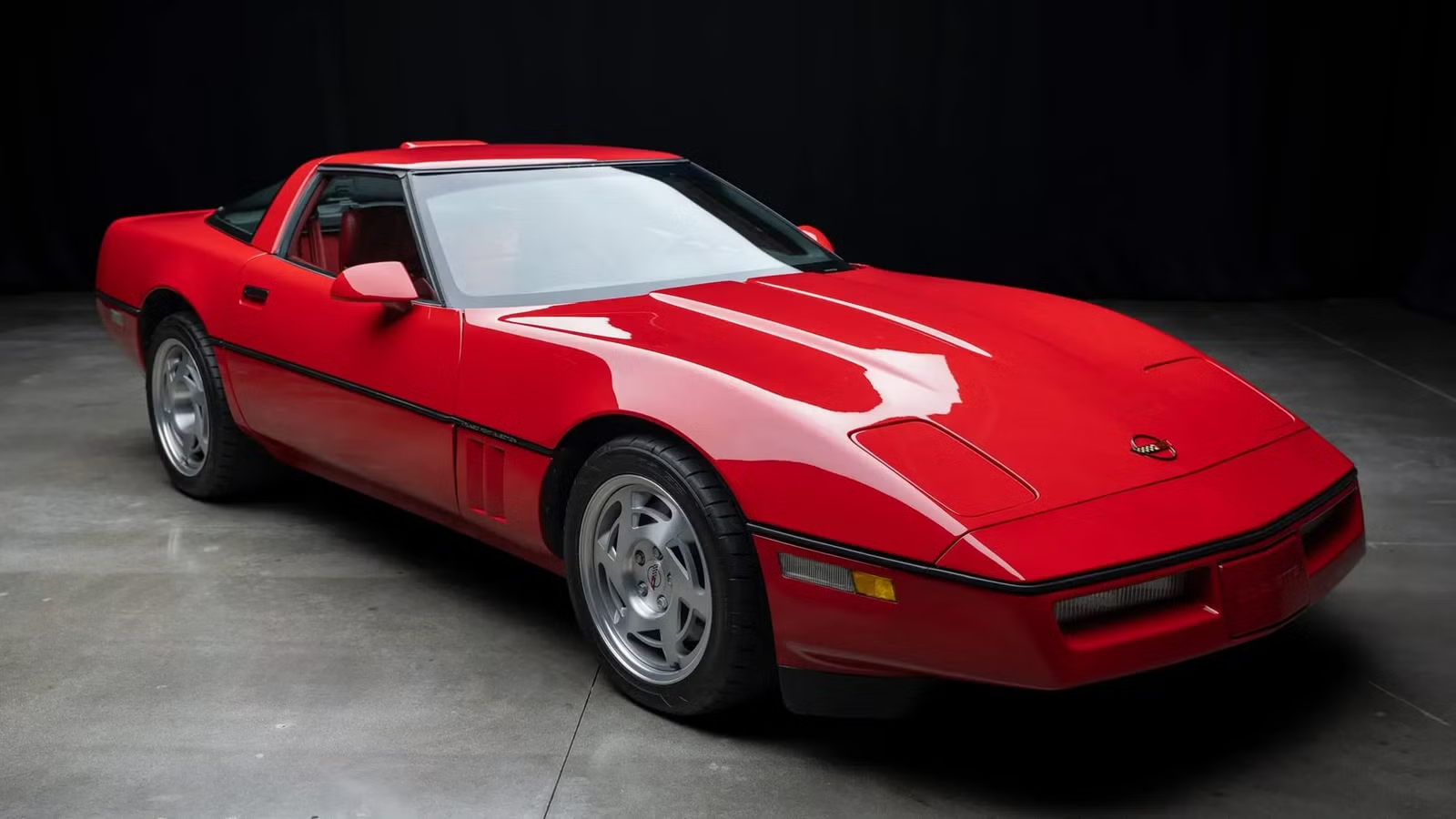
A red-on-red 1990 Corvette ZR-1 with just 18,000 miles on the odometer is back on Bring a Trailer for its third appearance on the platform — and the engineering story under that hood is worth revisiting. The car is currently bidding just shy of $20,000 with five days remaining, no reserve, and over $2,000 in recent maintenance including a new clutch, resurfaced flywheel, fresh spark plugs, and a transmission fluid service.

But the real story isn’t the auction. It’s what GM went to unusual lengths to keep quiet: the LT5 V8 sitting beneath a deliberately misleading engine cover, built not by Chevrolet but by a boat-engine manufacturer in Oklahoma, designed not in Detroit but in Norfolk, England. Three and a half decades later, that secrecy is a big part of why collectors still care.
Why GM Disguised Its Own Engine
When the ZR-1 launched for 1990, Chevrolet faced an awkward problem. The LT5 V8 had been designed by Lotus Engineering — a British firm GM had acquired in 1986 — and was being hand-assembled at Mercury Marine’s MerCruiser facility in Stillwater, Oklahoma. Neither of those facts fit neatly into the American muscle narrative Chevy wanted to sell.

So GM fitted the LT5 with a cover designed to look like a conventional small-block. To a casual observer peering under the hood, nothing looked out of the ordinary. The disguise was deliberate: GM didn’t want competitors reverse-engineering the architecture, and it didn’t want the press fixating on the foreign pedigree of what was supposed to be America’s answer to European exotics. The engine cover wasn’t an oversight — it was a policy.
What Made the LT5 Genuinely Different

The LT5 shared almost nothing with the L98 V8 in the base C4 Corvette. Where the standard engine used pushrods and two valves per cylinder, the LT5 was an all-aluminum 5.7-liter unit with dual overhead camshafts and 32 valves — architecture more common in contemporary European Sports Cars than anything rolling out of a GM plant. It was factory-rated at 375 horsepower and 370 lb-ft of torque, figures that were genuinely exotic for a production American car in 1990. For the 1993 model year, cam-timing and porting changes pushed output to 405 horsepower.
Mercury Marine was chosen specifically because the production volumes were too low for GM’s own manufacturing lines to handle efficiently. MerCruiser’s expertise in building high-performance aluminum engines for demanding marine environments made it a logical fit — and the finished product earned GM’s most rigorous quality certification, GP3 Level 1. Each engine was hand-built, which is exactly the kind of detail that resonates with collectors today.

The LT5’s credentials extended beyond the spec sheet. In 1991, a mildly modified ZR-1 running a stock LT5 broke three world endurance records at a test track in Fort Stockton, Texas, covering 4,221 miles in 24 hours at an average speed of 175.885 mph. Period road tests put the ZR-1’s 0–60 time at around 4.5 seconds with a top speed of 175 mph — numbers that held their own against European benchmarks of the era.
The BaT Example and What Serious Ownership Looks Like

The car currently on Bring a Trailer has been on the platform twice before, selling in 2022 and again in 2024. Its March 2026 service visit covered the clutch, flywheel resurfacing, transmission fluid, oil pressure switch, camshaft position sensor, spark plugs, air filter, and drive belt — a comprehensive refresh that signals an owner who understood what they had. Carfax shows no accidents and 31 detailed records, with the most recent odometer reading at 18,324 miles.
The ZR-1 wears staggered 17-inch wheels wrapped in Nitto NT555 G2 tires and rides on the three-mode Selective Ride and Handling Package with Bilstein shocks. The red-on-red interior is intact, with the expected C4 equipment — sport seats, automatic climate control, onboard computer — though some power seat controls aren’t functioning and the Delco-Bose stereo is currently locked. The seller notes the car includes the original “pizza box” owner’s kit, though not the glass top panel. It passed California smog in October 2025.
Why the Engineering Story Drives the Collector Value

The ZR-1 was never just a horsepower exercise. The Lotus-Mercury Marine partnership produced something genuinely rare for its era: a hand-built, DOHC, 32-valve American V8 that could credibly challenge European sports cars on their own terms. GM’s decision to hide that partnership under a fake engine cover only deepened the mystique — and mystique, in the collector market, compounds over time.
Gearheads who know the backstory understand that a well-maintained LT5 is irreplaceable. There’s no crate-engine substitute, no easy path to a rebuild if corners are cut. That’s exactly why documented service history matters on these cars, and why a thoroughly refreshed low-mileage example draws attention every time one surfaces. The engineering secrecy that GM built into the ZR-1 in 1990 has become, three decades on, the very thing that keeps collectors hunting for them.

Related posts






Latest Post


No Comments