
10 Cadillac V-Series Models You’ll Regret Not Buying Used
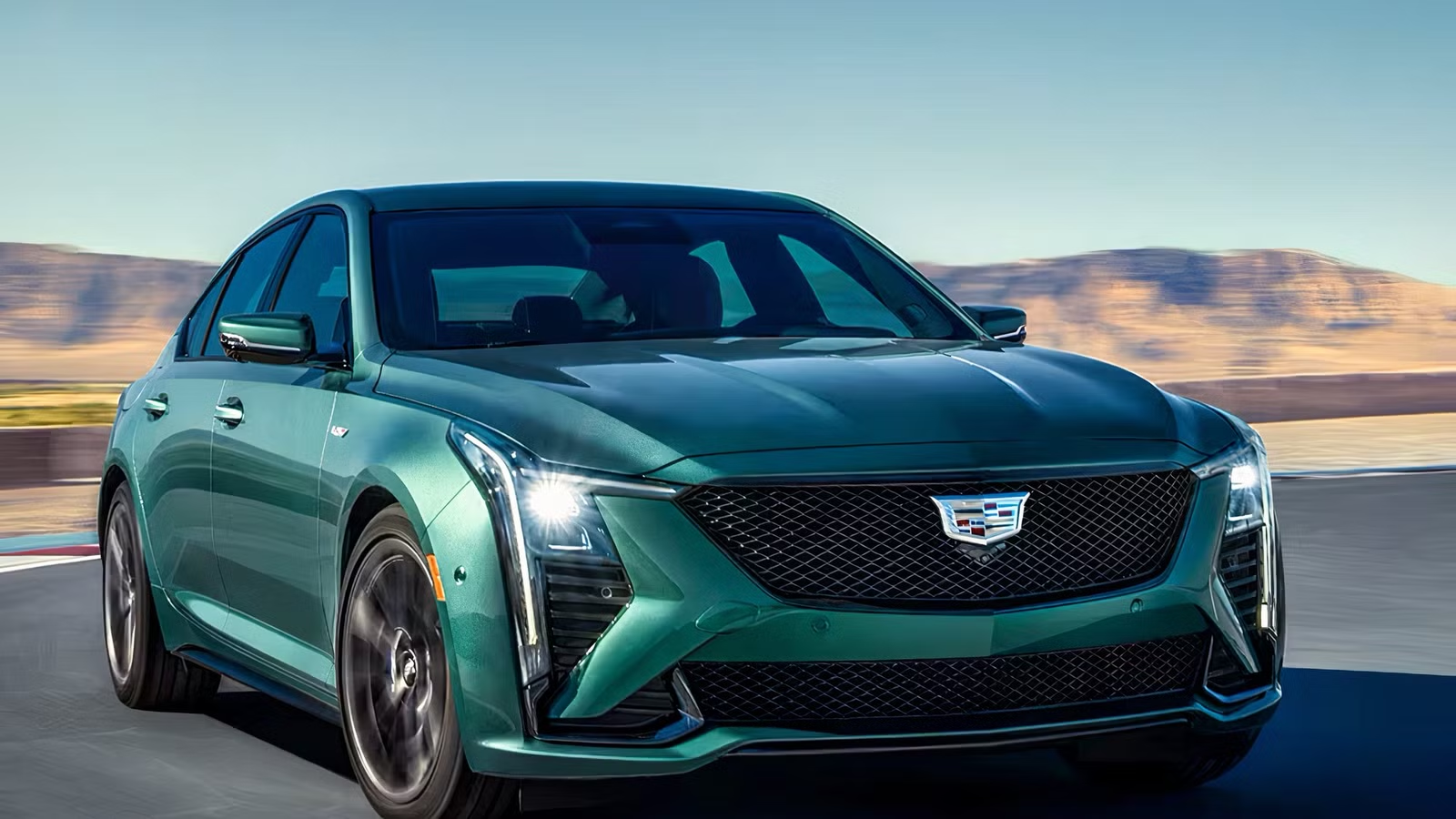
Cadillac’s V-Series spent years living in the shadow of BMW M and Mercedes-AMG, but the used market is beginning to correct that oversight. Cars that were once dismissed for carrying the wrong badge now combine supercharged V8 power, RWD layouts, available manual transmissions, and genuine rarity, often for less than their European competitors. However, that does not make every used V-Series a smart purchase. Some have endured years of modifications, hard launches, neglected maintenance, and track use, while rarer models can become painfully expensive when specialized components fail. The opportunity is real, but it is shrinking: the best-preserved examples are becoming harder to find, and several models have already started moving from depreciated performance cars into legitimate collectibles.

The prices below are rounded Kelley Blue Book Fair Market Price ranges, based on national-average figures across the applicable model years. KBB values change with mileage, condition, location, body style, and equipment. It can also undervalue unusually collectible configurations, particularly manual CTS-V Wagons.
2004–2007 Cadillac CTS-V
KBB Fair Market Price Range: Approx. $14,000–$22,000
The original CTS-V remains the list’s clearest value sleeper. Cadillac installed a 400-horsepower LS6, and later an LS2, behind a mandatory Tremec six-speed manual. That effectively made it a four-door Corvette at a price now comparable to an ordinary used compact sedan. It also created the V-Series formula: Corvette-derived V8 power, RWD, understated styling, and enough luxury equipment to function as a daily driver.
Reliability Callout

The first-generation car’s primary inspection concern is the rear driveline. Wheel hop and repeated hard launches can damage the differential, axles, mounts, and bushings. GM’s limited-slip differential bulletin also includes these early cars. A stock example with service records is generally preferable to a cheaper car wearing drag tires and extensive power modifications.
2009–2014 Cadillac CTS-V Sedan
KBB Fair Market Price Range: Approx. $27,000–$41,000

The second-generation CTS-V Sedan offers nearly everything enthusiasts want in a sedan: 556 horsepower, RWD, Magnetic Ride Control, and an available six-speed manual, without the five-door collector premium. Its supercharged 6.2-liter LSA V8 shares its basic architecture with the Corvette ZR1’s LS9, although Cadillac used different internal components and a smaller supercharger. The automatic is easier to find; clean manuals deserve a premium over generic pricing-guide estimates.
Reliability Callout

Rear-differential chatter is documented in a GM service bulletin, although Cadillac separately described some tire stick-slip or binding during full-lock maneuvering as a normal characteristic that does not hurt reliability. A careful inspection should distinguish those conditions from failing mounts, bushings, or differential hardware.
2016–2019 Cadillac ATS-V Coupe
KBB Fair Market Price Range: Approx. $29,000–$36,000

The ATS-V Coupe may be the most overlooked modern Cadillac performance bargain. Its 3.6-liter twin-turbo V6 produces 464 horsepower and 445 lb-ft of torque, along with the reflexes to challenge contemporary BMW M cars. Cadillac also offered a six-speed manual.
Reliability Callout

No single major defect defines the ATS-V, but the small sample of specialized cars makes service history particularly important. Check for cooling-system leaks, differential noise, damaged underbody panels, and evidence of track use. Verify every recall by VIN through NHTSA’s recall database, rather than assuming a model-year recall applies to every example.
2011–2015 Cadillac CTS-V Coupe
KBB Fair Market Price Range: Approx. $30,000–$43,000

Cadillac gave the CTS-V Coupe the same 556-horsepower supercharged LSA V8 used in the sedan and wagon, but wrapped it in one of the strangest shapes ever to wear a Cadillac crest. Its tiny rear quarter windows, nearly horizontal back glass, and center-exit exhaust make it unmistakable. The coupe never earned the wagon’s cult following, which is precisely why it remains interesting. You receive essentially the same performance without paying the largest collector premium.
Reliability Callout

GM published a bulletin covering rear-axle clunking or chatter in CTS models equipped with the limited-slip differential. The prescribed repair involved replacing the differential fluid with the specified lubricant. Buyers should determine whether the noise occurs only during tight turns or also under acceleration, as the latter can indicate a more serious driveline problem.
2006–2009 Cadillac XLR-V
KBB Fair Market Price Range: Approx. $31,000–$46,000

The XLR-V was not merely an XLR with a cosmetic package. Its exclusive 4.4-liter supercharged LC3 Northstar generated 443 horsepower, while Magnetic Ride Control and a Corvette-derived structure gave Cadillac a legitimate Mercedes-Benz SL competitor. Its original price reached six figures. The downside is that Cadillac built relatively few XLR-Vs, and some retractable-roof, body, lighting, and interior parts are now difficult to replace. Rarity creates collectability, but it also complicates ownership.
Reliability Callout

The power-folding roof must complete several hydraulic and electronic operations in sequence. Test it repeatedly and inspect the trunk for moisture. Magnetic Ride Control dampers, adaptive lighting, electronic modules, and model-specific trim can also be expensive or difficult to source. These are age-and-complexity risks, not proof that every XLR-V will experience the same failures.
2011–2014 Cadillac CTS-V Wagon
KBB Fair Market Price Range: Approx. $37,000–$51,000

The CTS-V Wagon earns the top spot because the market has already shown buyers what regret costs. Cadillac built a 556-horsepower, RWD station wagon and offered it with a six-speed manual. Nothing in Cadillac’s current lineup directly replaces it. Automatic examples are valuable, but manuals occupy a separate collector market. KBB’s standard valuation may therefore fall well below the price of an exceptional manual car with low mileage and desirable options.
Reliability Callout

Mechanically, the wagon shares most of its major concerns with the second-generation sedan and coupe: differential chatter, aged Magnetic Ride Control dampers, worn mounts and bushings, and supercharger-related noise. Wagon-specific glass, body panels, and interior trim add another concern because replacement parts can be difficult to find.
2022–2026 Cadillac CT4-V Blackwing
KBB Fair Market Price Range: Approx. $48,000–$61,500

The CT4-V Blackwing is effectively the ATS-V Cadillac was never allowed to finish the first time. It retains a 3.6-liter twin-turbo V6 but raises output to 472 horsepower. RWD and an available six-speed manual distinguish it from the increasingly all-wheel-drive, automatic-only competition.
Reliability Callout

These cars are still relatively young, and the available evidence does not establish a single dominant powertrain defect. Concentrate on accident repairs, track use, differential leaks, tire condition, and brake wear. Carbon-fiber aero pieces can also be expensive to replace. Confirm recall completion using the VIN.
2019–2020 Cadillac CT6-V
KBB Fair Market Price Range: Approx. $49,000–$53,800

The CT6-V is powered by the engine people often mistakenly associate with the newer Blackwing sedans. Its hand-assembled 4.2-liter twin-turbo Blackwing V8 produces 550 horsepower and sends power to all four wheels. Supply dried up because the CT6-V lasted only two model years, and Cadillac never installed that engine in another production model.
Reliability Callout

The engine’s uniqueness is the ownership risk. A failure involving Blackwing-specific turbocharging, cooling, or internal-engine components may require scarce parts and specialized knowledge. Demand a complete service history, inspect for coolant or oil leaks, and confirm that a Cadillac dealer can still obtain critical components before buying.
2016–2019 Cadillac CTS-V
KBB Fair Market Price Range: Approx. $52,000–$71,400

Cadillac installed the Corvette Z06-derived LT4 in a four-door luxury sedan and rated it at 640 horsepower. The result could reach a claimed 200 mph while carrying four adults and their luggage. The third-generation CTS-V is automatic-only, which may limit its collector appeal compared with manual Blackwings. Nevertheless, it offers more power than the previous CTS-V and considerably more performance than most new luxury sedans in its price bracket.
Reliability Callout

Check the automatic transmission for shudder, harsh shifting, or delayed engagement during a long test drive. Cooling-system condition also matters on the supercharged LT4. Buyers should budget for Magnetic Ride Control dampers, large Brembo brakes, and performance tires even when the powertrain is healthy.

Related posts



Latest Post


No Comments