
The Yamaha Engine That Makes 100,000 Miles Look Easy
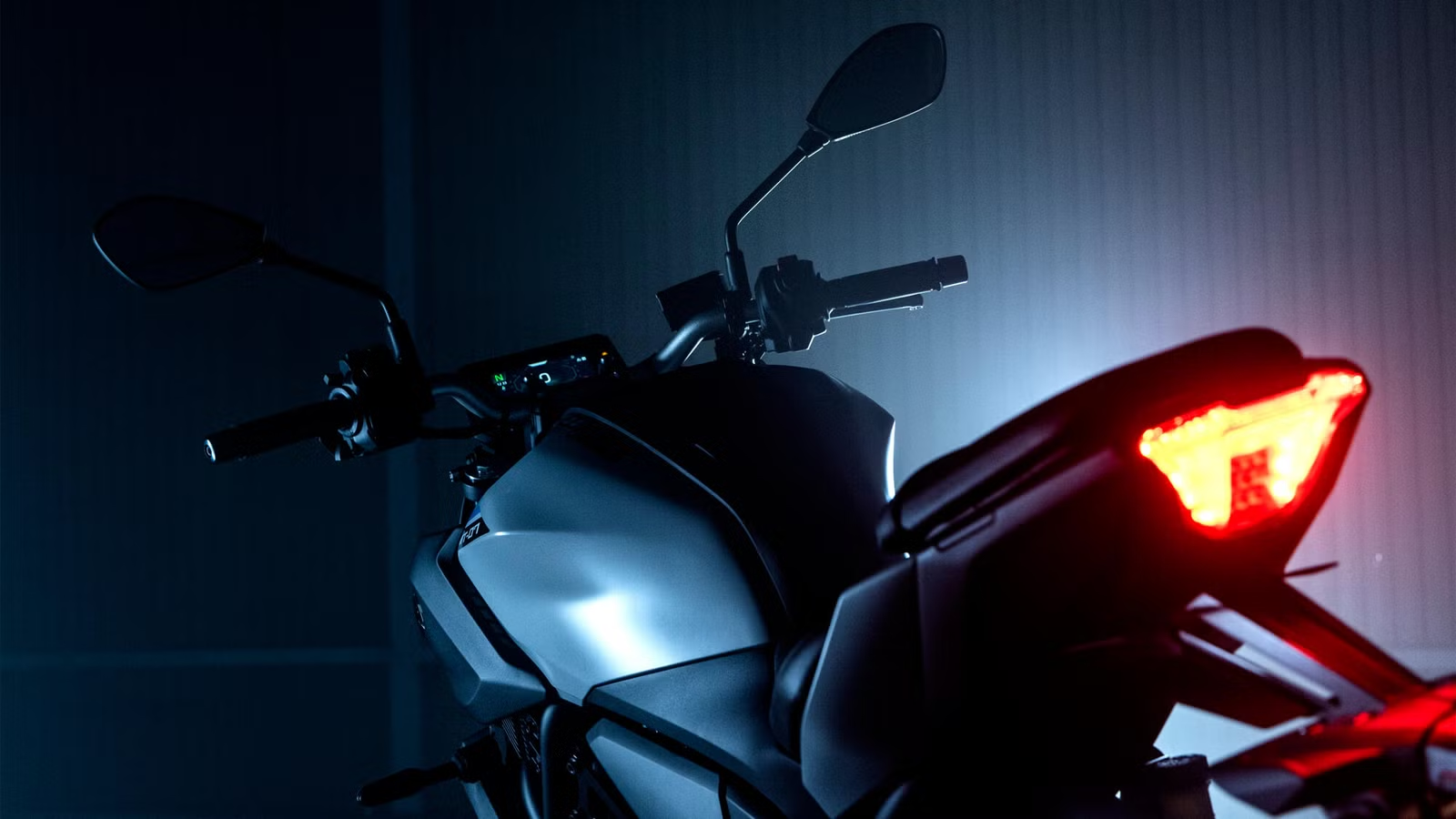
The power-dense nature of motorcycle engines would lead you to believe that they’re engineered for far less mileage compared to a car’s engine. A six-figure odometer reading on a Toyota barely raises an eyebrow; such is the brand’s reputation, but on a motorcycle, a used buyer would immediately start factoring in the costs of an impending engine rebuild even before evaluating the rest of the bike.

Then again, it’s often forgotten that motorcycle engines, too, have to be remarkably durable to produce that level of performance from a physically smaller unit. And Japanese manufacturers have been at the forefront of producing several convincing examples of legendary, reliable engines over the years.
How Yamaha Has Been Building Reliable Engines For Decades
Yamaha has a particularly strong history, not just because of its iconic motorcycles and motorsport victories, but also because some of its longest-lived motorcycles were designed to cover serious distances right from their inception. The FJR1300 is the obvious example. Yamaha brought the FJR1300 to the U.S. for the 2003 model year, pairing a 1,298cc fuel-injected inline-four with ceramic-composite-plated cylinders and shaft drive. More than two decades later, owner forums contain enough FJRs that have run beyond 100,000 miles for that number to look less exceptional than it normally would on a motorcycle.


It’s no wonder that the FJR has built an “unkillable” reputation that still lures buyers to it. But the durability story isn’t confined to this unusually successful touring platform. Yamaha has repeatedly favored relatively straightforward engine architectures, conservative service requirements, and long production cycles that give its powerplants time to prove their competence in the real world. This approach, of course, doesn’t guarantee six-figure mileage, but it does help explain why so many of its engines build their reputations gradually through years of owner use rather than isolated endurance claims.

What makes the story more interesting today is that Yamaha’s newer high-mileage evidence isn’t coming from another large-displacement sport-tourer. In fact, the company’s biggest engine in 2026 is under a liter. And the reliability comes from an even smaller engine used across motorcycles with very different jobs. Naked bikes, retro roadsters, sport bikes, and adventure motorcycles have all put the same basic powerplant through considerably different duty cycles. And that engine has now been around long enough for owners to vouch for its reliability rather than simply speculate about it.
Yamaha’s CP2 Has Developed A Serious High-Mileage Record

The engine in question is Yamaha’s 689cc CP2 parallel-twin, first introduced with the MT-07 family before spreading across much of Yamaha’s middleweight range. You see, a high-mileage engine used exclusively in a relaxed touring motorcycle setup can reasonably be accused of having an easy life. The CP2 has instead spent its career doing commuter duty, being revved through sport bike gears, and carrying adventure bikes across highways and unpaved terrain. Its reputation has therefore been built across a much broader range of operating conditions.
The 689cc Parallel Twin Keeps Its Fundamentals Straightforward

Today, variants of the same basic engine architecture power different motorcycles, including the MT-07, XSR700, YZF-R7, and Ténéré 700. The CP2 is a liquid-cooled, DOHC parallel twin with four valves per cylinder, an 80.0mm bore, 68.6mm stroke, and a 270-degree crankshaft. Yamaha also uses offset cylinders, positioning the cylinder axes slightly forward relative to the crankshaft centerline to reduce frictional losses between the pistons and cylinder walls during combustion.
As has become an industry favorite, the 270-degree crankshaft’s uneven firing intervals contribute to the engine’s distinctive sound and power delivery. A geared counterbalancer manages the additional vibration inherent to this 270-degree layout. But none of this is unusually exotic engineering. The CP2 combines relatively conventional hardware with a moderate state of tune and enough performance for several very different motorcycling intentions.
Yamaha Has Added Technology Around It, Not Reinvented It

The motorcycles surrounding the CP2 have changed much more dramatically than the engine itself. Recent MT-07 and YZF-R7 versions have gained electronic throttle control and increasingly sophisticated rider aids, while the Ténéré 700 has evolved with improved electronics and instrumentation. Yet the basic 689cc architecture remains closely related to the engine that established the CP2 family more than a decade ago.
The continuity also has practical advantages. Yamaha has been developing the same fundamental engine for years rather than repeatedly replacing it with an all-new design. More importantly for the used buyer, there is now enough real-world mileage behind it to judge its durability from something considerably more useful than owner optimism.
Long Haul Paul Put More Than 200,000 Miles On One

The standout example is Paul Pelland, better known as Long Haul Paul, a long-distance rider and Multiple Sclerosis advocate whose Chasing the Cure campaign has been documented through his own site and motorcycle media. Yamaha Motor USA began supporting him in 2018 and later supplied the 2021 Ténéré 700 he called Curechaser IV.
That bike eventually passed 200,000 miles, with Pelland recording 208,502 miles by April 2025. He described it as his most dependable motorcycle and said it never left him stranded. It wasn’t untouched over that distance, but the important point is that the CP2 itself remained serviceable through an exceptionally hard life that included travel across all 48 contiguous states and Canada.
The CP2 Makes 100,000 Miles Look Increasingly Ordinary

The FJR1300 arguably remains Yamaha’s strongest historical proof that a motorcycle engine can shrug off six-figure mileage. It has a larger pool of owners, a longer production history, and numerous documented motorcycles that have crossed 100,000 miles without major internal engine work. The CP2, however, makes the reliability history of the brand and the FJR stronger evidence for today’s buyer, some of whom may not be as well-versed with the brand’s history.

The 700cc CP2 remains central to Yamaha’s current middleweight lineup, so this is a buyer who may be cross-shopping across genres for their first bike. Experienced counterparts may be moving to a different genre. Both of which will find that high-mileage examples of the same engine in various machines are already proving that its modest displacement doesn’t mean a modest lifespan. More than 200,000 miles on Pelland’s Ténéré 700 is an extreme example, but it firmly establishes how far beyond normal motorcycle mileage the basic engine can be pushed.

A used CP2-powered Yamaha showing 40,000 or 50,000 miles still needs to be evaluated on maintenance history, valve servicing, oil changes, corrosion, and the condition of the chassis and consumables. The overall condition of a motorcycle should still be factored in when putting money down on a used one, but mileage alone, however, is becoming a poor reason to dismiss one. The CP2 looks increasingly capable of being passed on from one generation to the other.
The FJR1300 Shows This Isn’t New Territory For Yamaha

The CP2’s mileage record becomes easier to believe besides the FJR1300. Yamaha’s 1,298cc inline-four has more than two decades of ownership history behind it, and the Yamaha FJR Motorcycle Forum contains numerous six-figure examples to back it. One 2004 owner reported 107,000 miles with the valves still within specification, another 2003 model reportedly covered 100,000 trouble-free miles, and a separate 2004 FJR reached 167,000 miles before being sold. There are also examples beyond 150,000 miles.

Despite the seemingly bulletproof reliability, the FJR isn’t immune to age-related issues, including documented cam-chain-tensioner and electrical concerns on some bikes. Even so, its history shows that Yamaha already had a proven six-figure engine long before the CP2 arrived. The difference is that the newer parallel-twin achieves similar mileage across a much broader range of motorcycles and riding conditions.
Source: Yamaha

Related posts




Latest Post



No Comments