
The 1960s Custom Corvettes Drivers Could Lease For $1 A Year
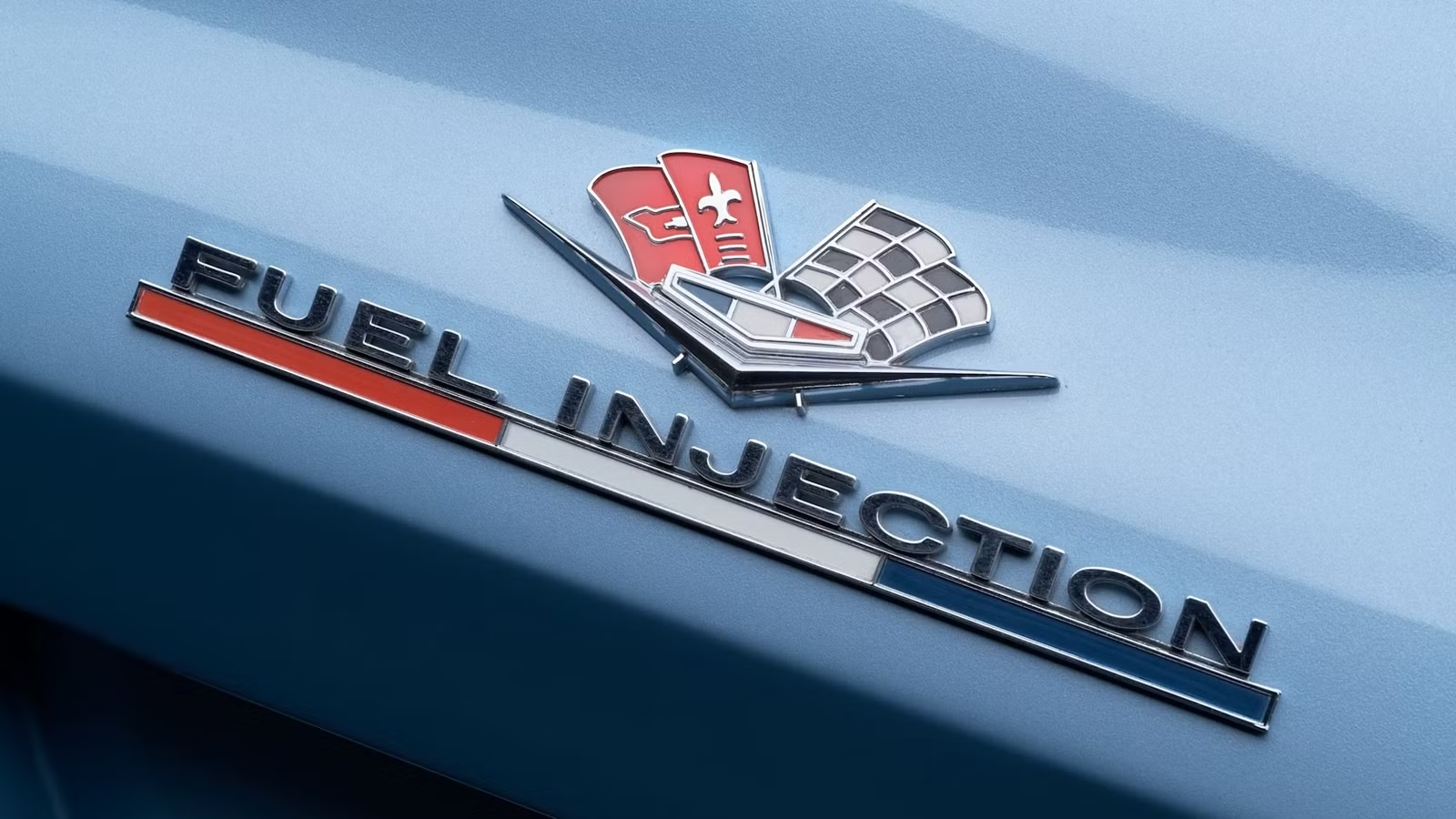
The space race and the golden era of muscle cars go hand-in-hand as popularity for both exploded in the late 1950s and early 1960s. Suddenly, the space age aesthetic was booming across multiple industries as astronauts were celebrated as national heroes. Chevrolet didn’t waste any time taking advantage of the trend with a wild marketing scheme, while other automakers focused on coming up with space-themed monikers and interior designs that imitated aircraft cockpits. But the controversial move did result in serious backlash.
The Astronaut Aesthetic Was Perfect For The Golden Era Of Muscle Cars

If you think about it, astronauts and muscle cars go together like peanut butter and jelly as the perfect combination. During the golden age of muscle cars, astronauts were elite military test pilots who pushed experimental aircraft past their limits. Like muscle car fans, they were thrill seekers, and speeding down the highway provided a wild adrenaline rush, similar to flying.
So, of course, automakers wanted to highlight the association between muscle cars and the space race by doing things like designing cars with massive angular tail fins, round jet-shaped taillights, and plenty of chrome trim to mimic rockets and orbiting satellites. Even bubble-top canopies influenced the shape of windshields and rooflines to draw similarities to aircraft cockpits and astronaut helmets.
Designers like General Motors’ Harley Earl modeled car bodies after the shape of fighter jets and space capsules to emulate a sense of high-speed dynamic motion. Of course, the interiors were heavily inspired by aircraft too. Instrument clusters and gauges were set back in the dashboard to mimic airplane controls, and ribbon-style speedometers matched radar displays.


Think about all the space-related monikers too. There was the Ford Galaxie, Plymouth Satellite, Oldsmobile Jetfire, Mercury Comet, Pontiac Firebird, Oldsmobile Rocket 88, and Dodge Polara. But the Chevy Corvette managed to steal the show by going in a unique marketing direction.
Chevrolet Claims Alan Shepard Started Astronaut Corvette Connection

If you ask Chevrolet, Alan Shepard is responsible for sparking the collaboration between astronauts and Corvette models. He quickly rose to fame as an international hero after becoming the first American in space, but he also became famous for his love of Corvette models that started years before the space race took off.
He bought his first Corvette, which was a used 1953 model from his father-in-law in 1954. Then five years later, when Shepard was one of the seven men selected for NASA’s Mercury program, he bought a used 1957 Corvette model. Then he arrived for his first day of astronaut training with NASA in 1959 behind the wheel of his beloved 1957 model.
He often bragged that the car drove like a “bat out of hell” and even managed to get clearance from the tower at Langley Air Force Base to speed down that runway at over 100 miles per hour to show off what the car could do. Once Shepard became a sensation as the first American in space, even General Motors corporate recognized the publicity that was being brought to the Corvette.

So, it’s no surprise that Shepard struck up a friendship with General Motors engineer, Zora Arkus-Duntov. Shepherd’s new best friend convinced General Motors to give him a brand new 1962 Chevy Corvette model. This was an extremely rare move, as General Motors typically never gave away free cars, but they made an exception for the space man.
Chevrolet Piloted A Clever Marketing Scheme

Also, it turns out that the Florida man has been cooking up wild ideas and schemes for decades. Jim Rathmann, an Indianapolis 500 winner and the owner of a Chevrolet and Cadillac dealership in Melbourne, Florida, wanted to take things further. But NASA ethics rules prohibited astronauts from accepting expensive gifts and commercial endorsements.
So Rathmann met with General Motors’ president, Ed Cole, and negotiated a special arrangement withChevrolet to allow Astronauts to legally lease top-of-the-line Corvette models for $1 per year. This was incredibly wild because these models cost roughly $3,872 to $4,257 when equipped with high-performance features and packages. Plus, they could lease up to two new Chevrolet models a year, allowing them to consistently upgrade to the newest models.
Alan Shepard went on to own about 10 Corvette models during his life. Neil Armstrong famously drove a Marine Blue 1967 Chevrolet Corvette Stingray with a 427 cubic-inch V8 engine through the AstroVettes program. Also, Buzz Aldrin famously loved his 1969 Corvette Stingray. He fondly described it as being fast, mean, and sleek while wishing he still had it.

Alan Bean, Pete Conrad, and Richard Gordon of the Apollo 12 mission ordered matching customized gold-and-black Corvette cars that were styled to mimic their lunar module. Then Dave Scot, Jim Irwin, and Al Worden of the Apollo 15 crew were photographed by Life Magazine while standing by their red, white, and blue Corvettes.
But the $1 Corvette Program Faced Tons of Backlash
Chevrolet faced immense pressure to end the $1-a-year astronaut lease program, which ended in 1971. Some argue that it didn’t end until 1972 after the final participating crews returned their vehicles. There was a shift in NASA regulations to strictly enforce federal rules and regulations around government employees accepting gifts and special promotional deals.
Observers and critics were raising questions about federal employees receiving the expensive sports cars for a $1 annual fee. This led to concerns and conflicts of interest related to gifts for government workers. Government and military rules forbade active-duty military members and NASA employees from profiting off of their fame, accepting valuable gifts, and endorsing commercial products.
Chevrolet started using images of astronauts with their Corvettes in promotional marketing material, causing NASA to worry that it looked like an official paid endorsement. The program was facing public scrutiny and media complaints. There were ethical concerns over whether General Motors was benefiting from improper free advertising.
Those who participated in the program from 1961 until 1971 or 1972 probably never stumbled across a muscle car deal as good as a $1 lease ever again. But the association between Corvettes and astronauts continues today. Retired astronauts Scott Kelly and Mae Jemison revealed the radical mid-engine C8 Corvette with matching NASA flight suits, and the National Corvette Museum proudly showcases surviving models owned by Neil Armstrong, Jim Lovell, and Alan Bean.
Source: Rush Experts, Smithsonian Magazine

Related posts




Latest Post


No Comments