
Suzuki Built A 1,340cc Muscle Bike With Hayabusa Power And Outrageous Styling
Suzuki has never been particularly shy about building motorcycles with outrageous performance, but one of its most unusual creations took things in a different direction. Instead of wrapping a powerful engine in aerodynamic bodywork, the Japanese bikemaker decided to build a Naked motorcycle around its flagship sportsbike’s powertrain. The result was a muscular machine with an enormous rear end, unconventional bodywork, and enough performance to make most naked bikes look tame.

It also carried over some of the engineering that made Suzuki’s fastest production motorcycle so formidable. What started as an ambitious concept eventually became a production motorcycle.
Suzuki’s 1,340cc Engine Delivered Serious Hayabusa Performance
The heart of this unusual muscle bike came from Suzuki’s flagship sportsbike, the Hayabusa. Its 1,340cc, liquid-cooled, inline-four was introduced for the 2008 model year, replacing the first-gen model’s 1,299cc engine. Suzuki increased displacement through a longer 65mm stroke while retaining the 81mm bore. A 12.5:1 compression ratio, revised internals, and dual fuel injectors helped the updated engine deliver stronger performance throughout the rev range.

In the naked-bike application, the engine produced around 181 horsepower and 107 lb-ft of torque, making it an exceptionally potent powerplant for a motorcycle without a full fairing. It also received Suzuki’s Drive Mode Selector, allowing riders to choose between different power delivery characteristics.
The naked motorcycle wasn’t just about straight-line acceleration. Fully adjustable suspension, powerful radially-mounted front brakes, and a substantial chassis gave it the hardware needed to handle its considerable performance.
The Suzuki B-King Started Life As A Supercharged Concept Bike

The motorcycle was the B-King, a production result of a concept that Suzuki unveiled at the 2001 Tokyo Motor Show. It was designed around the idea of creating an uncompromising naked motorcycle with the performance of a superbike and the visual presence of a futuristic muscle machine.
The original concept took things considerably further than the production version. It featured a supercharged Hayabusa-derived engine, extremely aggressive bodywork, and an enormous 240-section rear tire. According to Suzuki, its name represented three ideas: Boost, Beauty, and Brains. The Boost part was particularly important because the supercharged promised performance beyond what the stock, naturally aspirated Hayabusa could deliver.
Suzuki eventually confirmed a production version, which arrived for the 2008 model year after nearly seven years since the concept bike broke cover. Sadly, the supercharger never made it to production. Instead, the B-King got the larger naturally aspirated 1,340cc engine from the updated, second-gen Hayabusa, with revised intake and exhaust setups.
Despite losing its most ambitious mechanical feature, the production motorcycle retained much of the concept motorcycle’s distinctive appearance. Its wide tank extensions, exposed mechanical components, compact headlamp, and massive rear section made it instantly recognizable.
The Suzuki B-King’s Enormous Exhausts Became Its Most Controversial Feature

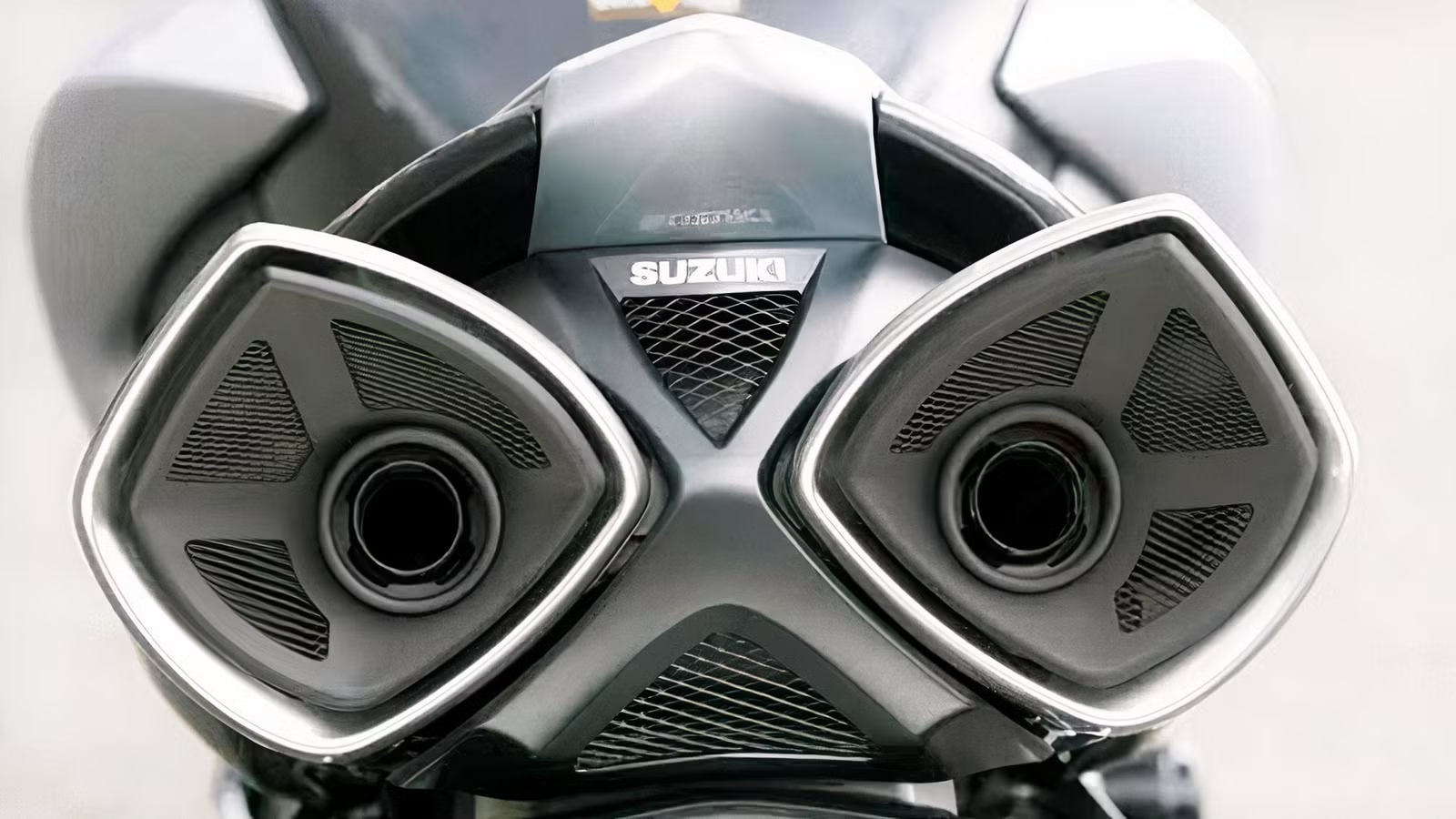
Few production motorcycles have attracted as much attention for their exhaust systems as the B-King. Suzuki fitted it with enormous twin underseat mufflers that looked more like oversized artillery barrels than conventional motorcycle silencers. They dominated the rear profile and gave the motorcycle a distinctive, almost exaggerated appearance.
The design was clearly intended to complement the B-Kings’ muscular proportions, but it divided opinion. Some riders appreciated its futuristic styling, while others thought the mufflers were unnecessarily bulky. Their size also made the already substantial rear section look even heavier.
The exhaust arrangement wasn’t simply a styling exercise. The production motorcycle used a four-into-two-into-one-into-two (4-2-1-2) exhaust layout, routing gases through a complex system before splitting them into the two underseat silencers. The system was also more restrictive than the Hayabusa’s arrangement, contributing to the difference in engine output.
The exhausts remain one of the B-King’s most recognizable features, although they are also a big reason why its styling continues to divide motorcycle enthusiasts.
The Suzuki B-King Was More Than Just A Straight-Line Muscle Bike

Despite its enormous proportions, the B-King was engineered to be a usable road motorcycle rather than a showpiece. It weighed 518 pounds dry, had a 60-inch wheelbase, and used a 200-section rear tire. Those numbers made it a substantial machine, but Suzuki equipped it with a fully adjustable KYB suspension at both ends and twin 310mm front disc brakes with radially mounted four-piston calipers.
Its upright riding position was another important distinction from the Hayabusa. The wide handlebar offered more leverage and a relaxed riding position, making the motorcycle considerably less demanding on longer journeys. Contemporary road tests also praised its smooth power delivery and surprisingly accessible handling for such a large, powerful naked motorcycle.
For American buyers, the 2008 Suzuki B-King carried an original MSRP of $12,899, putting it close to the second-gen Hayabusa’s $11,999 starting price. This $900 premium did not bode well with American buyers, resulting in the B-King being discontinued from US markets by the end of the year. Its limited production run helped the B-King achieve a cult following today, with clean used examples being exceedingly rare. Used prices are between $6,000 and $10,000 depending on the condition and modifications.

Related posts



Latest Post


No Comments