
GMC’s Two-Year SUV Experiment Invented The Crossover-Pickup Two Decades Too Early
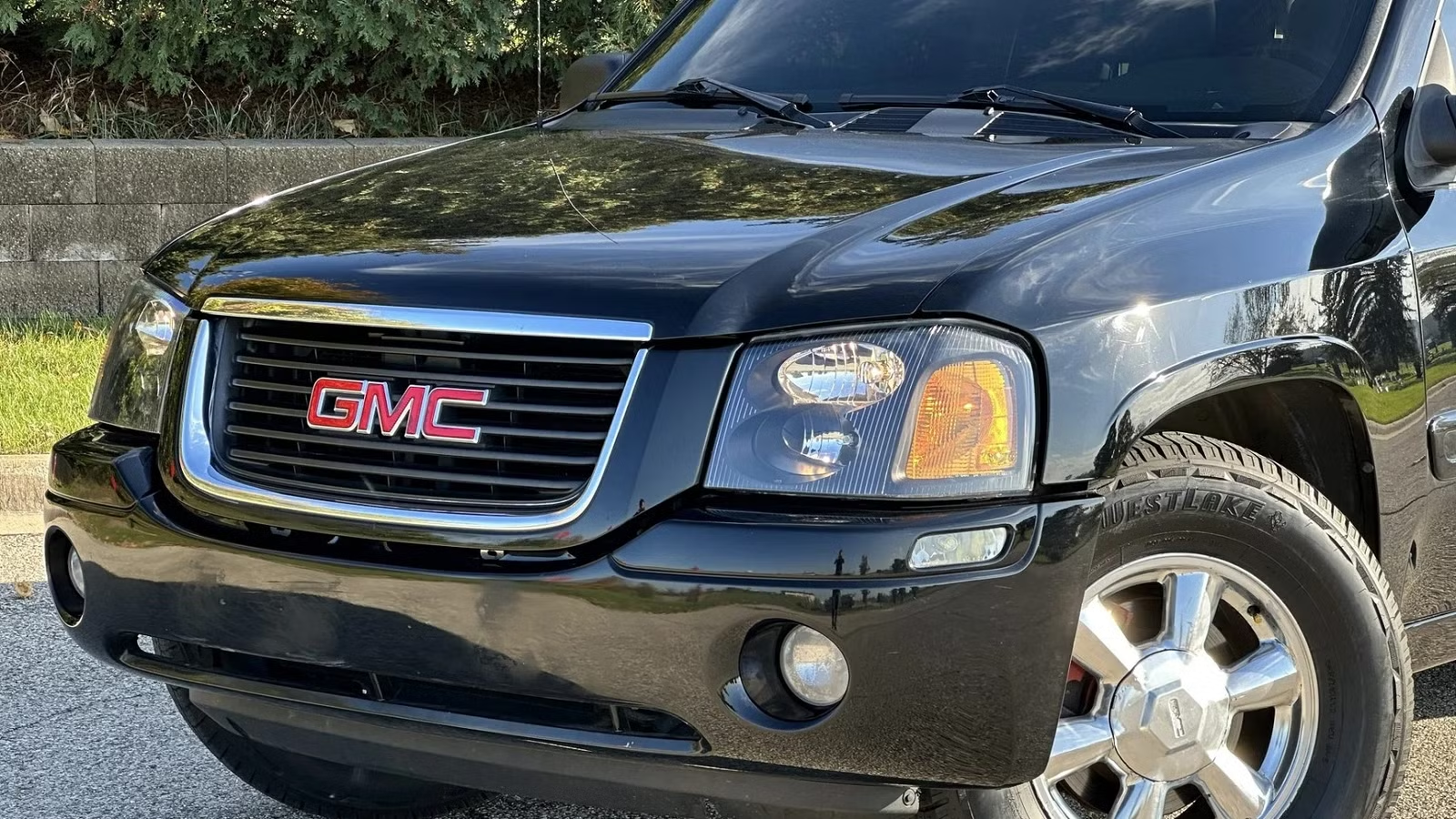
GMC spent two model years proving that a smart automotive idea can still fail when engineers turn it into a mechanical puzzle. In the early 2000s, the brand built an SUV whose cargo area could shed its roof, swallow its rear glass, lower a cabin divider, and give its tailgate two different jobs. The goal made sense: combine the security and comfort of an SUV with occasional pickup utility, but buyers stayed away.
Automakers Spent Decades Trying To Combine An SUV And A Pickup

SUVs and pickups solve opposite cargo problems. An SUV keeps luggage, tools, groceries, and expensive gear locked inside a dry cabin. Its roof also gives passengers the quiet, finished feel expected from a family vehicle. A pickup trades that protection for freedom: dirt can land in the bed without ruining carpet, tall furniture can stick above the cab, and lumber, bikes, muddy equipment, and awkward loads do not have to squeeze through a liftgate opening. Buyers who need both kinds of utility usually have to decide which compromise will annoy them less.
Automakers have spent decades looking for a loophole. Car-based pickups such as the Ford Ranchero and Chevrolet El Camino put an open bed behind a car cabin. Other designs tried to make enclosed vehicles more flexible. The 1963 Studebaker Wagonaire, for example, offered one of the cleverest early answers: part of its rear roof slid forward so owners could carry tall cargo upright in what otherwise looked like a station wagon. The idea worked, although early sealing problems gave Studebaker an unwanted lesson in the difficulty of putting a moving joint in the middle of a roof.
That old problem never disappeared. A family might need secure luggage space for 350 days of the year, then suddenly need an open bed for a new water heater, a tall plant, or a load of filthy landscaping supplies. Owning a second vehicle for those few jobs makes little financial sense. The challenge comes from building one vehicle that changes roles without making its everyday role worse. Every hinge, motor, seal, latch, and movable panel that adds flexibility also adds weight, cost, packaging demands, and another item that may eventually decide it has worked enough Mondays.

GM Turned One Cargo Area Into A Mechanical Puzzle

GM’s answer went far beyond cutting a hole in the roof. The vehicle had six power window regulators: four for the doors, one for the glass behind the passengers, and another for the glass at the very rear. Pressing a switch could create a 32-by-32-inch opening over the cargo compartment, and that opening gave tall objects a route toward the sky, but the hardware came with a penalty. The conversion added nearly 200 pounds compared with the donor SUV, with much of that extra mass sitting high around the complicated retractable-roof structure. That was hardly the ideal place to add weight to a tall truck-based vehicle.
The roof represented only part of the trick. GM also needed powered rear glass, a movable midgate behind the second row, position switches, safety interlocks, and a tailgate that could either drop like a pickup gate or swing to the side like an SUV door. The owner’s guide shows how tightly the systems depended on one another – the rear glass had to move before certain roof functions could happen, the instrument display could warn that the roof or midgate sat in the wrong position, and both the roof and tailgate glass had reset procedures if the control system lost track of where they were. GM had essentially taught several large body panels to check one another’s homework before moving.

Then came water. GM knew that opening the rear compartment to rain and dirty cargo meant owners might treat it like a real truck bed, so engineers gave the floor its own drainage system. GMC literature described five drains plus two troughs near the midgate, with one-way valves intended to let water escape while keeping exhaust gases out. The QuickDrain system was rated at 95 liters per minute, or about 25 U.S. gallons. A garden hose could clean the synthetic cargo floor without turning the SUV into an aquarium. GM had gone off the deep end, quite literally, and at least the drains could keep up. Supplier Inalfa also spent a reported $5 million on a dedicated Oklahoma City roof plant, and tooling, engineering, and development may have pushed its total investment closer to $10 million.
2004-2005 GMC Envoy XUV Was A Pickup-SUV Hybrid Before That Was Cool

That machine was the GMC Envoy XUV, sold for the 2004 and 2005 model years. GMC based it on the long-wheelbase Envoy XL, so underneath the strange roof sat a traditional body-on-frame SUV rather than what enthusiasts today would call a crossover. It kept the Envoy’s enclosed five-passenger cabin and truck chassis, along with a 275-horsepower 4.2-liter inline-six or an available 290-hp 5.3-liter V8. A four-speed automatic handled shifting.
The rear half supplied the party trick. A power-operated section of roof traveled forward above the cargo area. The tailgate glass could retract out of sight, while another powered glass panel lived in the midgate behind the second-row seats. Owners could leave that divider upright to protect passengers from weather while the cargo area stayed open, or lower it with the rear seats to make room for longer items. The tailgate had two personalities because one apparently looked lonely: it dropped down like a pickup’s or swung to the side for easier access.

With the roof open, the XUV could carry loads that no normal enclosed SUV could accept upright. Lowering the midgate and folding the rear seats expanded maximum cargo volume to about 95.2 cubic feet, with a flat load floor more than six feet long. The washable rear compartment could handle soil, wet equipment, muddy boots, or other cargo that would make a carpeted SUV owner reach for several old blankets and a prayer. When owners did not need any of that, the roof and glass closed and the rear became weatherproof enclosed storage again. On paper, the idea sounded almost unbeatable: commuter, family SUV, secure hauler, and occasional open-bed truck, all without permanently giving up the roof.

The showroom told a different story, though. GM’s internal sales pitch called for roughly 90,000 XUVs per year and reported only around 13,000 were sold, while supplier accounts from the period point to even higher planned volumes. Demand clearly missed expectations by a wide margin, and pricing did not help. Early figures started around $31,890 including destination, while heavily equipped versions could climb past $40,000. Worst of all, the ordinary seven-seat Envoy XL offered 107.4 cubic feet of maximum enclosed cargo room, while the five-seat XUV, after all that moving hardware, topped out at 95.2. That may be the most perfect summary of the entire project.
Ford Maverick And Hyundai Santa Cruz Proved GMC’s Idea Wasn’t The Problem

The market eventually found a cleaner answer. The Ford Maverick and Hyundai Santa Cruz combine a five-passenger cabin with an open cargo bed and a footprint much easier to live with than a full-size pickup. Ford calls the Maverick a unibody compact pickup, while Hyundai launched the Santa Cruz by openly targeting buyers who wanted SUV comfort and maneuverability plus a bed for gear that did not belong inside the cabin. That customer sounds remarkably familiar. The important change sits under the skin: modern crossover pickups build the compromise into their basic body shape instead of asking the body to transform after leaving the driveway.
That choice removes a spectacular amount of complexity. A Maverick does not need a 32-inch powered hole to appear in its roof because its 54.4-inch bed already sits outside. Neither modern truck needs six window regulators just to make the cargo concept work. They avoid a heavy sliding roof, powered cargo partitions, elaborate moving roof seals, roof-position reset procedures, and a drainage network engineered to deal with an SUV suddenly becoming open to a thunderstorm.

Sales make the point harder to dismiss. Ford sold 155,051 Mavericks in the United States during 2025, according to its annual results. That means Ford moved almost six times the commonly cited total XUV production in one year. Hyundai sold another 25,499 Santa Cruz models in 2025, almost as many as the entire XUV run by itself. The Santa Cruz remains a much smaller player than the Maverick, but both show that a real market exists for vehicles that offer a useful bed without the size and hardware of a traditional full-size truck.
The modern formula also understands how these customers use trucks. Many do not need an eight-foot bed, heavy-duty frame, giant towing figure, or the turning circle of a small county. They need space for bicycles, home-improvement supplies, camping gear, plants, dirty tools, and the occasional bulky purchase that will not fit through an SUV’s hatch. They also want easy parking, a comfortable rear seat, decent fuel economy, and road manners closer to a crossover than a work truck.
Hyundai‘s original research for the Santa Cruz specifically identified urban buyers who wanted open-bed utility while keeping the comfort, efficiency, security, and parking ease of a compact SUV. Ford’s hybrid-powered Maverick pushed the same logic even further. GM had identified much of that need years earlier; it just attacked the problem from the hardest possible direction.
Envoy XUV Failed Because GM Engineered Too Much Of A Good Idea

None of the Envoy XUV’s headline features were silly by themselves. A sliding roof solved the tall-cargo problem, moving glass opened the cargo compartment completely, and the midgate protected passengers or expanded load length. Each feature answered a sensible question. The trouble came when GM stacked all of those answers into one vehicle and connected many of them with motors, switches, seals, and electronic logic. The result looked brilliant in a demonstration because a demonstration lasted a few minutes, but ownership lasts years.
That complexity also damaged the basic value equation. Buyers paid more for extra hardware that added weight high in the body, removed the Envoy XL’s third row, created more sealing challenges, and still delivered less maximum enclosed cargo room than the simpler XL.

That is why the Maverick and Santa Cruz make the XUV look more interesting with age, not less. Modern compact pickups keep the part of GMC’s idea that mattered: comfortable everyday transportation with useful open-bed cargo space when life gets messy. They throw away most of the transformation hardware. The customer GM imagined was real, and the massive Maverick sales numbers make that clear. GMC reached that customer roughly two decades early, but it arrived carrying six window regulators, a sliding roof, multiple pieces of moving glass, a movable cargo wall, complicated seals, and enough drainage capacity for a very determined garden hose. The Envoy XUV simply brought too many moving parts with the future it imagined.
Source: GMC, Ford, Hyundai

Related posts



Latest Post


No Comments