
Chrysler’s Hemi Coupe Kicked Off Detroit’s Horsepower War Alone
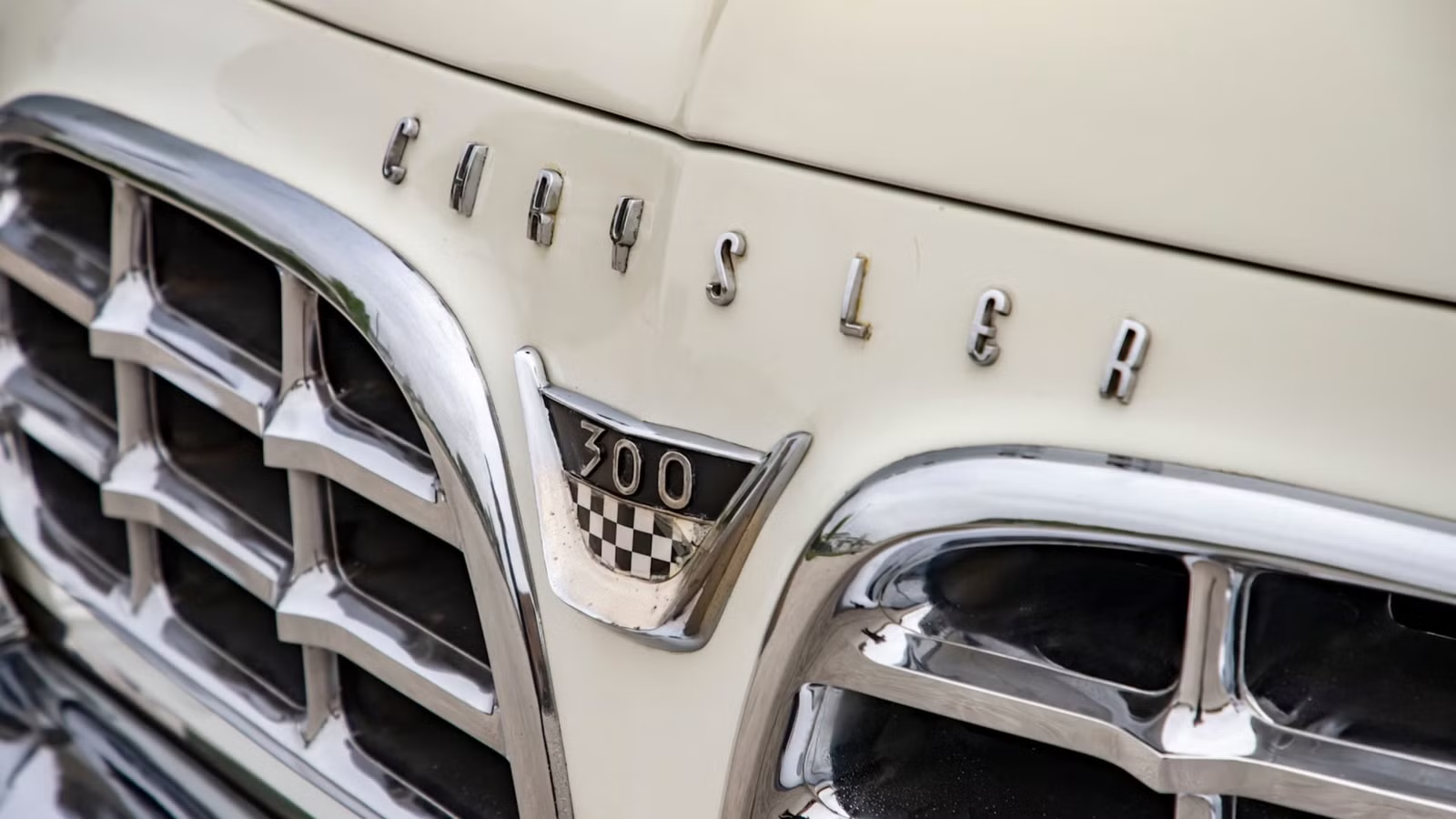
The wave of prosperity that hit this country in the post-WWII era had American automakers engaging in a style war to deliver the fanciest and flashiest cars they could. Then, in the mid-1950s, Chrysler fired the first shot in an all-new conflict to dominate the streets, known as the Horsepower War. With a brief ceasefire for most of the ’70s and ’80s, this fight for power has been raging on for generations, with no end in sight. Mopar has held its ground for most of this clash and even gained some territory on the strength of its secret weapon, the Hemi V8. It’s kind of hard to believe, but all these hostilities started with a 1955 Chrysler coupe, which laid out the battle plans for Mopar supremacy.
Chrysler’s Hemispherical FirePower V8s

It’s not a coincidence that we’re using armed conflict as a metaphor because the Hemi engine was literally born from war. Chrysler had developed a V16 engine with hemispherical combustion chambers for the Republic P-47 Thunderbolt fighter aircraft that was rated at 2,500 horsepower at the tail-end of WWII. They also made a V12 Hemi for the M47 Patton battle tank. Chrysler sat on this radical technology for a while until someone had the bright idea of adapting it to passenger vehicles. Hemi heads allow for better airflow, more efficient combustion, and more power potential, all of which are great things for a car. In 1951, Chrysler launched its FirePower series engines, which were the first Hemis, with a 331 cubic-inch V8. Initially producing 180 hp with a two-barrel carburetor, the FirePower 331 would get a dual-quad 300 hp beast in 1955 that would set a course for Mopar performance into modern times.
Putting Ford and Chevy to Shame

The most powerful thing Ford had in 1955 was a 193 hp 292 Y-Block V8 that could get a Fairlane crawling from 0-60 in 11.0 seconds. The ’55 Chevy was slightly more powerful with its 195 hp 265 small-block, but it wasn’t measurably faster. When the 300 hp FirePower 331 came along, it put Blue Oval and the Bowtie on notice, and within a few years, they both had V8s with similar power. This was predicted by Chrysler as they were playing 3-D chess and already had an engine to beat the imitators. In 1957, Chrysler let the 392 FirePower V8 loose on the streets with an astounding-for-the-times 375 hp. The rising tensions of the late ’50s led directly to the Muscle Car Melee of the 1960s.
Proto-Muscle Chrysler Letter Series

During the Golden Age of American Muscle, Dodge launched its “Scat Pack” line of cars, which were guaranteed to perform straight from the factory, and that was an idea borrowed from the Chrysler Letter Series cars. Kicking off in 1955, Chrysler began building performance cars with an eye on NASCAR racing, but also the luxury segment. The most famous of these is the 1957 Chrysler 300C, with a 375 hp dual-quad 392 V8, which many people cite as the first true muscle car. It was, in fact, not the first muscle car because it was an expensive luxury ride that was nearly twice as pricey as the average car that year. It did, however, plant the seed for ridiculously powerful cars with which Mopar would dominate the streets in the coming muscle car era.

1955 Chrysler C-300 Kicks Off Mopar Performance Legacy

In the same way that the 426 Hemi engine, which was introduced in 1966, seems like it was meant for the 1968 Dodge Charger R/T, the 1951 331 FirePower V8 was destined for the 1955 Chrysler C-300. The first Hemi engine and the debut Letter Series car were a match made in Mopar Heaven that provided the blueprint for performance that’s still working 70+ years later. The two-door coupe had some understated styling compared to other models, and by being less garish, it was maybe the first set of American wheels that looked aggressive. The fact that it had the most powerful engine produced until that point, combined with its bold stance, makes for a better argument that the C-300 was the first muscle car, but, again, it wasn’t cheap.
It was, however, impressively quick, with a 9.0-second 0-60 time that was two seconds quicker than anything else in ’55, and a top speed of 130 MPH that nothing could dream of catching. The C-300 derived its name from the fact that it was a Chrysler with a 300-hp V8, which seems like a no-brainer as the other Letter Series cars are not so simple or logical. The 300 hp, 345 lb-ft 331 FirePower V8 with dual Carter four-barrel carburetors was clearly the star of the show and deserved to be on the marquee in the same way the Plymouth Hemi ‘Cuda celebrated its celebrity engine.
NASCAR’s First Superstar

Carl Kiekhaefer is considered to be the first professional race team owner, and he made a name for himself with the awesome power of Mopar muscle. In 1955, driver Tim Flock notched 22 victories, including Daytona, and 47 top-ten finishes to win the NASCAR Grand National championship behind the wheel of a ’55 Chrysler C-300. There had never been a car so dominant in motorsports, and it was the first time the vehicle got as much recognition as the driver. The next year, Buck Baker did even better in a ’56 Chrysler 300B, which is almost the same car, equipped with a 340 hp 345 FirePower V8, taking 30 checkered flags and 92 top-tens en route to another championship. Unfortunately, we couldn’t find pictures of either car, but some members of Kiekhaefer’s team did drive 1956 Dodge D-500s like that one pictured above.
Rare Luxury Speedster

Like the 1957 Chrysler 300C, the 1955 C-300 can’t truly be considered a muscle car because it was expensive, with a $4,109 base price, which is $51,381 adjusted for inflation. That’s not actually an outrageous price for a high-performance car today, but people were a lot thriftier back then when the average price for a new car was $2,200 or $27,510 in today’s bucks. Realistically, most Golden Age muscle cars were under the inflation-adjusted $30,000 threshold, which meant the people who would enjoy them the most could also afford them. It probably didn’t matter that the C-300 was so steep price-wise, because they were also extremely rare, so even if someone with a fat wallet wanted one, they were hard to come by. Chrysler never intended the C-300 to be a mass-market ride, but rather to showcase their performance chops and so only 1,725 ever rolled off the factory floor.
It Wasn’t Just Cars That Got 331 FirePowered Up

In addition to powering the C-300 to glory, the mighty FirePower 331 was available in Chrysler’s full-size lineup, Dodge C-Series pickups, as well as weird stuff like the 1956 Facel Vega FV2B and 1958 Hongqi CA72. Possibly the most unexpected use for the engine was for the Chrysler Air-Raid Siren. The Cold War relic was deployed in cities across America to warn the public of a Soviet Union nuclear attack and, thanks to being Hemi-powered, blasted out 138 decibels, which is reputed to be the loudest siren ever made. Amazingly, several cities still have operational Hemi Horns, including Pittsburgh, Pennsylvania with as many as eight and Los Angeles with a few that they let rip annually to honor the Battle of Los Angeles, which was the biggest false alarm of WWII and a strange thing to commemorate.
Tracing the Hemi Family Tree

The Chrysler Hemi engine began as the 331 FirePower in 1951 and, at the time, nobody could have guessed that it was the single most important engine in automotive history, one that literally defined American performance for generations. After the FirePower V8s were retired in the late ’50s, Chrysler revived the hemispherical combustion chamber engine in 1964 with the 426 Race Hemi V8 that powered Richard Petty to his first of many NASCAR championships. Ford complained to NASCAR that the Hemi was too fast and got it temporarily banned until Chrysler could sell a certain number to the public to meet homologation requirements. Chrysler could have come out with a limited edition to hit the goal, but instead made the 426 Street Hemi available to every Dodge and Plymouth intermediate, which proceeded to decisively outperform all Fords for the remainder of the Golden Age.
The 425 hp, 490 lb-ft 426 Street Hemi was the defining engine of the classic muscle car era, but it was short-lived, existing only from 1966 to 1971, before the Malaise Era of detuned engines forced its cancellation. There were some lean Hemi-less years for Mopar until 2003, when Chrysler made a 5.7-liter Hemi V8 for the Dodge Ram 1500. Within a couple of years, the Charger was reborn and there was a 425 hp 6.1-liter Hemi V8, which was the first time a Dodge muscle car had that much power in 35 years. In 2011, a 6.4-liter Hemi 392 came out, paying homage to the classic FirePower engine but cranking out up to 485 hp. Then, finally, the 6.2-liter supercharged Hellcat Hemi took things from 707 hp all the way to 1,025 in the 2023 Challenger SRT Demon 170, which is a truly amazing place to end up after a journey that began with the comparatively modest ’51 FirePower 331 Hemi.
Resurrecting the Chrysler Hemi-Powered Letter Series

The 1955 331 Firepower C-300 wasn’t quite done influencing modern Mopar performance, as Chrysler wisely rebooted the Letter Series cars in 2005 with the 2005 300C. As the top trim for the 300, the 300C was never better than with the SRT8 package that featured a 425 hp, 420 lb-ft 6.1-liter Hemi V8. Like its predecessors, the C-300 and 300C, and we do realize that’s a bit confusing, the modern 300C was a luxury ride that destroyed everything else on the road. With an MSRP of $39,370, which is the equivalent of $67,556 today, the 2005 300C continued the Letter Series tradition of high-performance luxury rides that aren’t in everyone’s budget. Still, when compared to other luxury cars from Europe and Japan that didn’t have nearly the performance, the next-gen 300C was a steal.
’55 C-300 Collectibility

Considering the historical significance, overall awareness, and rarity of the ’55 Chrysler C-300, it’s actually not a bad car for frugal collectors. Logging a Hagerty value of a fair condition project car at $26,100 to a flawless Concours condition show car at $103,000, this is a car worth investing in. It’s clearly undervalued and sooner or later there will be a market correction giving this ride nothing but upside. Or, you could pick one up on the cheap and just enjoy the hell out of it as it is a guaranteed conversation starter simply because it’s a cool-looking classic that almost nobody has ever seen or even heard of. We mentioned earlier that only 1,725 C-300s were ever built, and it is estimated that approximately 6% still exist, which means around 104 of them are still kicking, making them Hemi-powered Mopar unicorns.
Mopar’s OG Auction Bargain

Considering how few 1955 Chrysler C-300s still exist, and factoring in their inherent Hemi-powered greatness, this should be a million-dollar ride, but that’s not even close to how affordable they are. We found a fully restored, numbers-matching car that sold for just $22,000 in 2015 and several others in terrific all-original shape between $38,500 and $51,700. These are not prices you would expect for a historic 1-of-104 remaining Hemi car with NASCAR heritage, and it should seem remarkable to not only the Mopar crowd but all classic car enthusiasts. The most we could find a C-300 sold at auction is that red body-off resto pictured above that sold for $83,600 at Mecum Austin 2014. The most recent auction was for a car previously owned by MLB Hall of Famer Enos Slaughter, which went for less than $50,000 in 2025, so even provenance doesn’t add value to these undervalued classics.
Sources: Chrysler, Hagerty, Mecum

Related posts




Latest Post


No Comments