
10 Naturally Aspirated V8s Modern Engineers Cannot Replicate
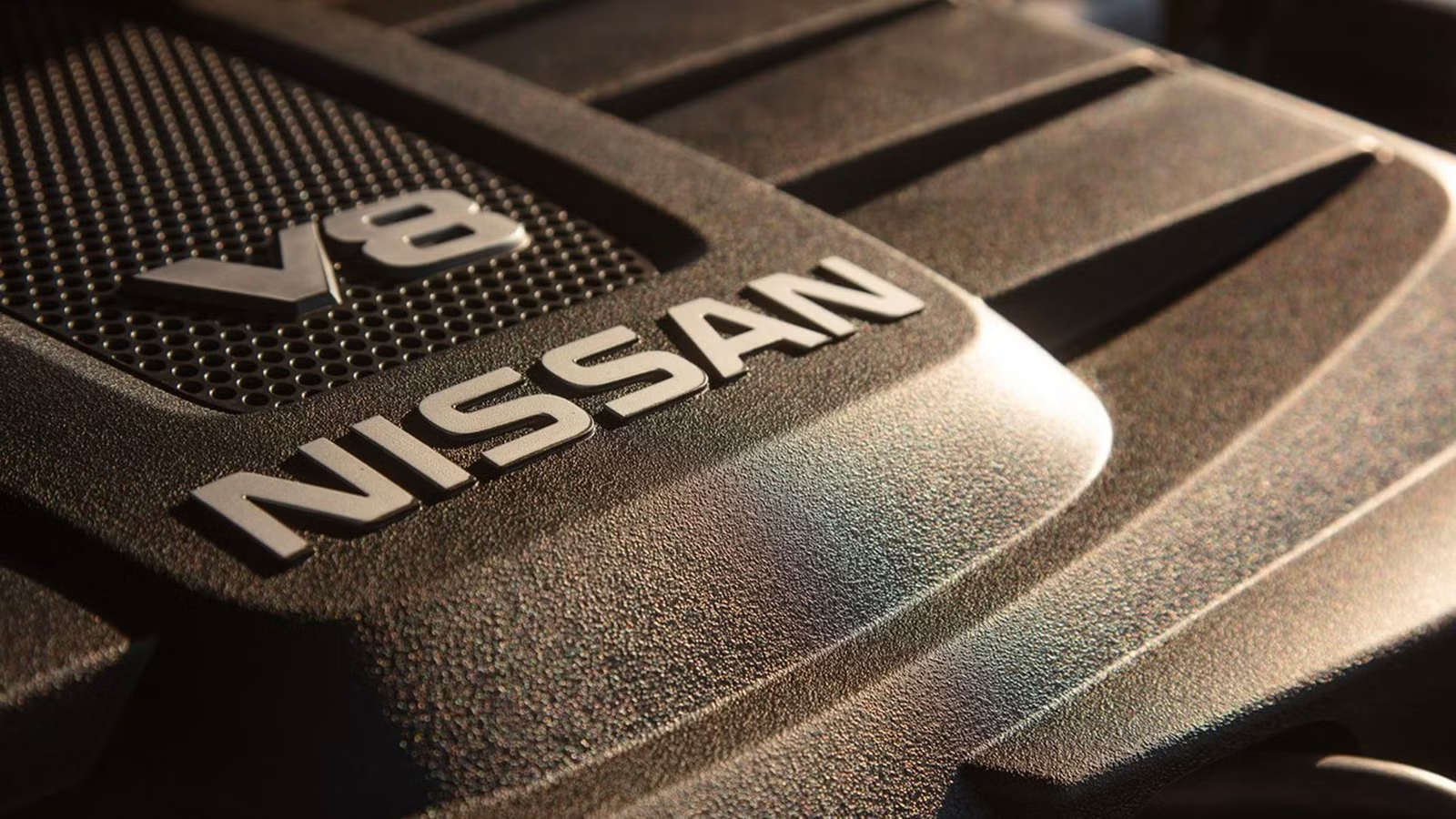
Big naturally aspirated V8s will be no more in the near future. It isn’t because modern automotive engineers have lost their talent. If anything, what they achieve today with hot-V turbochargers and mild-hybrid systems is nothing short of engineering excellence. But if you sit down with a powertrain engineer off the record, they will admit a painful truth: the glorious era of the big-displacement, free-breathing, high-revving naturally aspirated (NA) V8 is dead. And it is never coming back.

This is because modern emissions have systematically outlawed engines like these. To meet modern fleet averages, an engine must curb its cold-start emissions, slash particulate matter, and optimize thermal efficiency at low RPMs. High-revving NA V8s do none of these things. They are mechanical gladiators optimized for a singular, glorious purpose: moving air as fast and as aggressively as possible while making the best sounds possible. Let’s take a look at naturally aspirated V8s that defined a golden era of internal combustion and why we may never see them again.
10
BMW S65
4.0-Liter V8
|
Engine |
 80 autotech 7.0-liter V8 |
|---|---|
|
Horsepower |
414 hp |
|
Torque |
295 lb-ft |
|
Cars |
BMW E90/E92/E93 M3 |
The S65 in the E9X series BMW M3 has to be one of the highlights of the M3 lineage. To understand why this V8 is no more, you have to look at how it breathes and makes power. The S65 uses eight individual throttle bodies (ITBs) managed by an incredibly fast engine control unit (ECU). When you buried your right foot in an E92 M3, those eight butterflies snapped open simultaneously, creating near-instantaneous throttle.
Individual throttle bodies are an emissions nightmare. At partial throttle or during sudden deceleration, managing the exact air-fuel ratio across eight separate ports to satisfy ultra-strict modern particulate limits is virtually impossible. This engine makes its 414 horsepower with no assist at all while screaming all the way to an 8,300 rpm redline. This car is the joy of an enthusiast, but high RPMs equal massive friction, and massive friction equals high carbon dioxide emissions. Modern regulations demand peak torque down low—usually via small turbos—forcing cars like these out of the market.

10 Factory Sleepers That Came With Engines From Supercars
These carmakers shoehorned their very powerful supercar engines into average family haulers.
9
Audi 4.2 FSI
4.2-Liter V8

|
Engine |
4.2-liter V8 |
|---|---|
|
Horsepower |
414 hp |
|
Torque |
317 lb-ft |
|
Cars |
B7 RS4, First-Gen Audi R8 |
The 4.2-liter FSI V8 was a mechanical masterpiece that successfully paired Audi’s direct injection technology with a high-revving, all-aluminum engine. It featured a dual-chain drive system at the back of the engine to keep its packaging compact, and it used a dry-sump system in the Audi R8 to withstand extreme lateral G-forces experienced during spirited driving.
The 4.2 FSI was an engine that loved to rev, topping out at 8,250 RPM and making a very distinct V8 noise while doing so. This engine creates a lot of heat and noise at these high speeds. Under modern test cycles, the cold-start emissions of a high-revving 4.2-liter V8 took too long to heat up the catalytic converters. Today, Audi achieves similar power figures using hot-V twin-turbo V6s that manage heat and power better, so out with the V8.
8
Nissan VK45DE
4.5-Liter V8

|
Engine |
4.5-liter V8 |
|---|---|
|
Horsepower |
340 hp |
|
Torque |
333 lb-ft |
|
Cars |
Infiniti FX45, Q45, M45 |
Most people forget that Infiniti made a V8 like this. While often overlooked by the casual enthusiast, the VK45DE is legendary among engineering purists. This aluminum block V8 was designed to take absolute punishment. It was so inherently robust that modified versions formed the backbone of Nissan’s sports prototype and Super GT racing programs for years. It was most notable in the Infiniti M45 and FX45 but completely transformed the driving experience of that SUV.
The VK45DE used large, heavy internal components optimized for durability and torque rather than efficiency. Modern regulations require ultra-low viscosity oils (like 0W-16 or even 0W-8) to reduce internal drag. The bearing clearances and oil galleries inside the VK45DE were engineered for heavier-weight lubricants. Redesigning this engine to run on modern, water-thin oils while maintaining its high-load durability would require a total ground-up re-engineering that simply cannot be justified. So Infiniti switched to more efficient twin-turbo V6 engines.
7
Ferrari F136
4.5-Liter V8

|
Engine |
4.5-liter V8 |
|---|---|
|
Horsepower |
562 hp |
|
Torque |
398 lb-ft |
|
Cars |
Ferrari 458 Italia / Speciale |
If there is a holy grail of naturally aspirated engines, the F136 FB found in the Ferrari 458 takes the crown. This flat-plane crank masterpiece produced an astonishing 125 horsepower per liter—a world-record for a naturally aspirated production car at the time. It used a scavenge-pump dry sump system, variable intake geometry, and a 12.5:1 compression ratio to scream all the way to a hair-raising 9,000 RPM.
A flat-plane crank V8 inherently suffers from secondary high-frequency vibrations. To get an engine like this to survive at 9,000 RPM, engineers have to tolerate massive NVH (noise, vibration, and harshness) and loose mechanical tolerances when cold. Modern Euro 7 regulations strictly limit drive-by noise pollution, and the mechanical sound of a cold F136 trying to warm up its cats would fail current acoustic and tailpipe tests instantly. Ferrari had to pivot to turbocharging with the 488 GTB just to keep their fleet emissions legal.

10 NA V8 Sports Cars Real Driving Purists Refuse To Sell
These V8 legends represent the peak of analog performance and pure driving engagement that purists refuse to give up.
6
Aston Martin 4.7 V8
4.7-Liter V8

|
Engine |
4.7-liter V8 |
|---|---|
|
Horsepower |
430 hp |
|
Torque |
361 lb-ft |
|
Cars |
Aston Martin Vantage (2009-2017) |
Originally developed as a 4.3-liter and later bored and stroked out to 4.7 liters, this dry-sump, all-aluminum V8 was assembled by hand in Germany. It was a traditional 90-degree cross-plane V8, meaning it had that classic, deep, rhythmic British V8 rumble. It used hollow camshafts to save weight and a highly tuned intake manifold that gave the Vantage a wide power band.
The 4.7-liter was a relatively low-efficiency engine by modern standards. It required a large displacement to make decent power, resulting in a high carbon footprint per horsepower. Modern legislation requires engines to feature cylinder deactivation and ultra-fast variable valve timing (VVT). Retrofitting this Aston block, which was already based on an older Jaguar block, with these technologies would destroy its iconic exhaust note and crisp throttle response. It would also be very expensive, forcing Aston Martin to source twin-turbo AMG units instead.
5
Lexus 2UR-GSE
5.0-Liter V8

|
Engine |
5.0-liter V8 |
|---|---|
|
Horsepower |
472 hp |
|
Torque |
395 lb-ft |
|
Cars |
Lexus IS F, RC F, LC 500 |
The 2UR-GSE is a fascinating anomaly because Lexus managed to keep it alive well into the 2020s. Developed in partnership with Yamaha’s motorcycle division, this engine features high-flow cylinder heads, titanium intake valves, and a unique dual-injection system (D-4S) that uses both port and direct injection to optimize combustion across the entire rev range.
The 2UR-GSE is a heavy, mechanically complex piece of iron and aluminum. This V8 was quite big physically, making it incredibly difficult to package alongside modern pedestrian impact structures. More importantly, it cannot survive impending emission updates without heavy restrictions. It represents the absolute limit of what old-school engineering could achieve in the modern era, and its retirement marks the definitive end of the Japanese luxury NA V8.
The Sports Car With Lexus Reliability And Porsche Handling
Reliability and razor sharp handling rarely meet like this.
4
Jaguar AJ-V8
5.0-Liter V8

|
Engine |
5.0-liter V8 |
|---|---|
|
Horsepower |
380 hp |
|
Torque |
380 lb-ft |
|
Cars |
Jaguar XK, XF, Range Rover Sport (NA variants) |
Before Jaguar supercharged this engine into submission for its “SVR” products, the AJ-V8 was a beautifully smooth, naturally aspirated 5.0-liter engine. It was designed to deliver effortless, seamless torque from idle to redline. But big cross-plane V8s inherently produce high thermal inertia. This means they take a long time to warm up from a freezing start. Modern emissions testing prioritizes the first 60 seconds of an engine running. If an engine cannot light up its catalytic converters almost instantly, it fails. To fix this, modern engineers use tiny, integrated exhaust manifolds surrounded by turbochargers to trap heat. This V8 fails because its design philosophy cannot support this tech.
3
Ford Voodoo
5.2-Liter V8

|
Engine |
5.2-liter V8 |
|---|---|
|
Horsepower |
526 hp |
|
Torque |
429 lb-ft |
|
Cars |
Shelby GT350 / GT350R |
The Voodoo V8 is an absolute outlier in American muscle history. Ford took their modular Coyote architecture, bored it out, and slapped on a flat-plane crankshaft. To maximize airflow, they used massive valves and a 12.0:1 compression ratio, allowing this 5.2-liter beast to rev all the way to an astonishing 8,250 RPM. It sounds less like a Mustang and more like a demonic Ferrari at full throttle. However, the Voodoo is a casualty of secondary engine vibrations.
The flat-plane design shakes itself so violently that Ford had to engineer specialized, heavy-duty oil filter housings and accessories just to keep them from spinning loose. These intense harmonic vibrations make it impossible to implement modern cylinder-deactivation tech (like Ford’s cylinder-deactivation systems found on smaller engines), which requires perfect balance. Without the ability to shut off cylinders to save fuel during highway cruising, the Voodoo stands zero chance against modern CAFE fuel economy targets.
2
Mercedes-AMG M156
6.2-Liter V8

|
Engine |
6.2-liter V8 |
|---|---|
|
Horsepower |
451-507 hp |
|
Torque |
443 lb-ft |
|
Cars |
C63 AMG (W204), E63 AMG (W211/W212) SLS AMG (as the M159) |
The M156 was the first engine designed entirely from scratch by AMG in Affalterbach, and it remains an absolute legend. With a massive displacement of 6.2 liters, this monster featured a rigid closed-deck crankcase design, a variable intake manifold, and a revolutionary wire-arc sprayed cylinder coating (LDS) to reduce friction. It delivered power with the subtlety of a sledgehammer, accompanied by a signature V8 bark.
Big displacement is the ultimate enemy of modern emissions testing. A 6.2-liter engine has massive combustion chambers. Every time a cylinder fires, a large volume of air and fuel must mix, creating a larger surface area where unburnt hydrocarbons can cling to the cylinder walls. Modern emissions testing measures things like this closely. No matter how advanced your software is, you cannot overcome the pure math of a 6.2-liter footprint. AMG was forced to drop to a 4.0-liter biturbo, and eventually, a 2.0-liter four-cylinder hybrid in the current C63.

The Biggest Displacement Production V8 You Can Still Buy New
The usual suspect for a large displacement V8 is either an American pickup truck or a muscle car, but this HEMI-powered off-roader is neither.
1
Chevrolet LS7
7.0-Liter V8

|
Engine |
4.0-liter V8 |
|---|---|
|
Horsepower |
505 hp |
|
Torque |
470 lb-ft |
|
Cars |
C6 Corvette Z06, fifth-generation Camaro Z/28 |
The LS7 is the ultimate refinement of the classic American pushrod design. Displacing a massive 427 cubic inches (7.0 liters), Chevrolet used titanium connecting rods, titanium intake valves, and hand-assembled blocks to create a pushrod engine that could safely rev to 7,000 RPM. It was incredibly light, remarkably compact due to its overhead-valve (OHV) design, and offered a direct mechanical connection to the driver’s right foot that has never been matched.
The LS7 uses a two-valve-per-cylinder setup. While this keeps the engine small and light, it means the valves have to be absolutely massive to move enough air for 505 horsepower. Large valves mean heavy moving parts and less precise control over the combustion at low speeds. Modern emissions laws require precise control over valve timing and lift via dual overhead cams (DOHC) to minimize emissions during idling and light cruising. A 7.0-liter pushrod engine simply cannot control its fuel and air precisely enough at idle to pass modern, stringent global air-quality standards.
Sources: Ford, Chevrolet, Ferrari, BMW, Audi, Lexus, Mercedes-Benz, Aston Martin, Nissan, Jaguar

Related posts


Latest Post


No Comments