
The Wildest Shelby Creation Ever Built And How Much It Is Worth Today
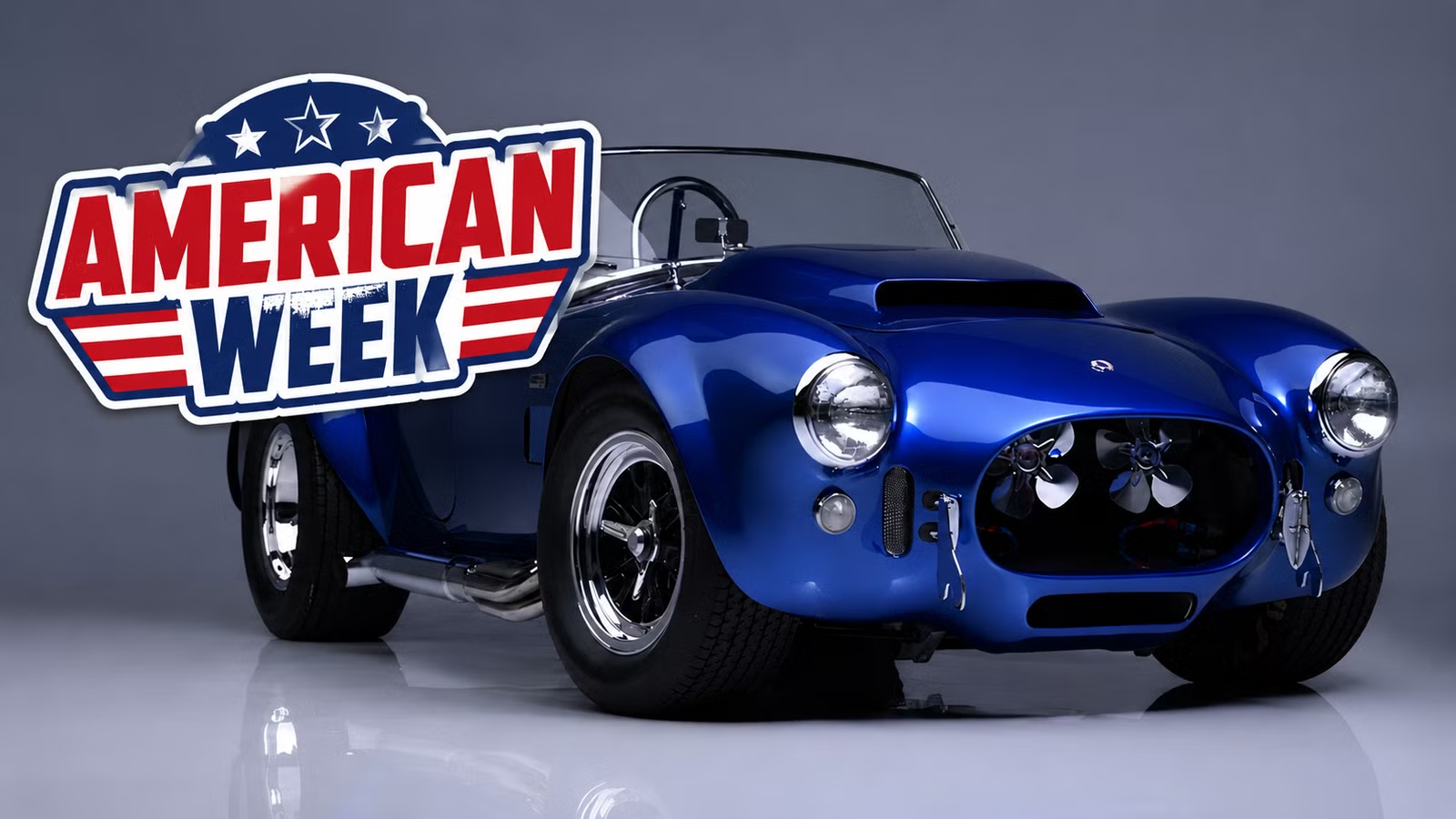
From a simple farming background to being one of the greatest legends in the automotive world,Carroll Shelby has undoubtedlycaptured the hearts and imagination of gearheads and motorsport enthusiasts across the world. The man had a gift for making cars go fast in ways that, in his time, were unthinkable and sometimes downright scary.

When it comes to legendary vehicles built by Shelby, there is no shortage. His close ties with Ford Motor Company gave him unfettered access to resources that would otherwise only exist in someone’s dreams. While some of this is captured in the 2019 film, Ford v Ferrari, the list of achievements is far too great to list.
The Cobra Evolution: From Track To Street
Before the tire-shredding madness of the late sixties took over Venice Beach, the Shelby Cobra was already a known commodity on international racing circuits. It started as a relatively simple British AC Ace chassis, which Shelby stuffed a Ford small-block V8 into. Essentially, it was designed to beat European lightweight sports cars at their own game. It didn’t take long for the automotive world to realize that Carroll Shelby was changing the automotive world.

As the program evolved from a local racing experiment into a factory-backed program, Shelby realized that domestic muscle was quickly outgrowing the narrow-fender constraints of the early 202- and 289-cubic-inch platforms. The car needed to grow wider and drastically heavier in the horsepower department if it wanted to maintain its dominance on the global stage.
The Big-Block Gamble

To stay ahead of competing factory teams, Shelby made the radical decision to drop Ford’s massive 427-cubic-inch “FE” big-block V8 into a completely redesigned coil-spring chassis. The sheer size of the new engine would require heavily flared rear fenders, a gaping radiator mouth, and a reworked suspension capable of handling a massive increase in torque. The new 427 Competition models were purpose-built racing machines, without windshields, mufflers, or other street legalities.
However, the racing landscape shifted quickly, and a failure to meet strict production numbers left Shelby American with an excess of unused competition chassis sitting around the shop floor. Unwilling to let high-performance engineering collect dust, Shelby decided to retroactively fit a handful of these raw race cars with crude windshields, basic bumpers, and minimal exhaust baffles. Thus, the mythical Semi-Competition, or “S/C,” line was born, creating the fastest street-legal production cars of their generation.
10 Rare Limited-Edition Mustangs That Have Skyrocketed In Value
Any Ford Mustang is a solid investment, but these special editions are early retirement accounts with mag wheels and V-8s.
The Super Snake: The Philosophy of Absolute Overkill

It was within this climate of unhinged performance that the wildest car Carroll Shelby ever built was born: the 1966 Shelby Cobra 427 “Super Snake,” cataloged under chassis number CSX 3015. Built specifically as Carroll Shelby’s personal daily driver, this vehicle surpassed the already-terrifying baselines of the standard 427 S/C.
The baseline 427 big-block was already pushing out roughly 425 naturally aspirated horsepower, a figure that was pushing the limits of 1960s bias-ply tire technology. But Carroll wasn’t satisfied with merely being fast. He and his team bolted not one, but two Paxton superchargers straight onto the top of the massive V8, pushing the total output to an absurd 800 horsepower.
Driving The Un-Driveable

Piloting CSX 3015 on public roads was less about driving and more about survival. With 800 horsepower motivating a featherweight aluminum body, the power-to-weight ratio defied standard road car logic of the era. This was before modern electronic traction and stability control could reduce the power sent to the rear wheels. Without an impeccable amount of throttle control from the driver’s right foot, the rear tires would instantly vaporize into smoke at the slightest touch of the accelerator, turning any casual cruise down the highway into an adrenaline-fueled exercise in boundary-pushing physics.
Because manual transmissions of the era would simply shear their gears and shatter like glass under the torque delivered from such an overpowered engine, Shelby’s team had to get creative. They installed a Ford C6 heavy-duty three-speed automatic transmission to handle the engine’s power output. It was a strange configuration for the time that turned the Super Snake into an automatic cruiser that possessed enough volcanic force to outrun purpose-built dragsters on any given afternoon.
This Was The Most Powerful Muscle Car Of The 2000s
This is the pinnacle of muscle from the start of this century, when supercharged V8 power was still king.
The Tale Of Two Snakes

The legacy of the Super Snake line is defined by extreme exclusivity, as Shelby American only ever applied this twin-supercharged treatment to two specific chassis. The first was Carroll’s personal toy, CSX 3015, which served as a rolling laboratory for his wildest engineering whims. The second car, built under chassis number CSX 3303, was built to satisfy a high-profile order, bringing a brief moment of Hollywood glamour to the ultra-high-performance program.
The Unlucky Snake

This secondary build was commissioned for disgraced comedian Bill Cosby, who was an avid performance enthusiast. However, the car’s extreme power delivery proved to be too much for him to handle. After a single, terrifying drive, he returned the unmanageable vehicle to Shelby American. The car was subsequently resold, setting off a sequence of events that would ultimately leave CSX 3015 alone in the world.
Following its brief stint in celebrity hands, the second Super Snake was shipped to S&C Motors in San Francisco before eventually finding its way to a private owner named Tony Maxey. Unfortunately, the car’s volatile blend of massive horsepower and primitive 1960s chassis dynamics proved fatal. Maxey lost control of the twin-supercharged roadster, driving it over a cliff and directly into the Pacific Ocean.
The catastrophic wreck resulted in the total destruction of CSX 3303, completely erasing it from existence as an intact vehicle. This tragic event fundamentally shifted the history of the Super Snake line, transforming Carroll Shelby’s personal CSX 3015 into an irreplaceable survivor.
Restoring A Legend

As the sole survivor of the pair, CSX 3015 became a monument of American automotive history, requiring meticulous care to preserve its mechanical integrity. Over the decades, the car underwent a thorough restoration process designed to keep it in its exact 1967 road-legal specification.
Remarkably, the car preserves an astounding amount of its original factory components. It still retains its original 427 Competition-spec aluminum body shell, the distinct 1967 dual-snout Super Snake hood, and the date-coded 1965 engine block. Even the heavy-duty Girling brake calipers and the specialized rear-end oil cooler remain exactly as they were when Shelby’s mechanics bolted them together in the California shop.
10 All-American Classics That Still Steal The Show
Some iconic American classics are so visually stunning that they literally bring traffic to a halt.
What Is The Super Snake Worth Today?

When a vehicle combines absolute mechanical rarity with direct personal provenance to a legendary figure like Carroll Shelby, the traditional pricing rules of the collector car market cease to apply. CSX 3015 doesn’t only trade on its performance specifications, but also remains a piece of an unrepeatable era of American motorsports. As a result, its appearances at high-profile auctions are treated as major historical events.
After pulling in $5.5 million in 2007, it managed to repeat history at the 2021 Barrett-Jackson Scottsdale auction, hammering at that exact same $5.5 million mark, which, when adjusted for inflation, represents a slight loss, but remains a figure no one can sneeze at. In a market where historical significance dictates value, this one-of-one twin-supercharged beast remains one of the most financially formidable and sought-after pieces of American iron on earth.
The Ultimate Collector’s Trophy
Owning the CSX 3015 isn’t merely about possessing an expensive asset; it’s about holding the keys to Carroll Shelby’s personal automotive crown jewel. Blue-chip collectors view the car as the definitive centerpiece of American muscle car history, a vehicle that transcends standard brand hierarchies. It represents the absolute pinnacle of high-stakes automotive curation.
The value of the Super Snake is obviously insulated by the fact that it can never be truly replicated or replaced. While modern continuation series and high-horsepower restomods attempt to capture its spirit, there is simply no way to replace the historical significance of owning the greatest creation of one of the most influential automotive designers of the 20th century.
How An American Supercar Outperforms Pricey Rivals Against All Odds
This American supercar may cost less than some of its European counterparts, but that doesn’t mean it is any less of an adrenaline-inducing weapon.
The Wildest Legacy

Ultimately, the 1966 Shelby Cobra 427 Super Snake remains a testament to an era that will always be highly regarded by automotive enthusiasts. It’s easy to look at the impressive numbers it was capable of and equate them to modern automotive horsepower stats. However, doing so disregards the absolute insanity of a time when people like Shelby were testing creations of this magnitude themselves and pushing engines and cars to do things far beyond what technology could protect them from.
The CSX 3015 in many ways represents the 1960s as a whole: a decade without airbags and a decade when America transported people to the moon with a computer that only had 4KB of RAM. The Super Snake was built with that exact same audacious spirit. Today, its multi-million-dollar value stands as a reminder of that era, leaving the Super Snake as the ultimate high-water mark of Carroll Shelby’s career.
Source: Shelby American, Hemmings, World Registry of Cobras and GT40s

Related posts
Latest Post


No Comments