
The Lexus Hybrid Flagship You Can Only Buy Used Now
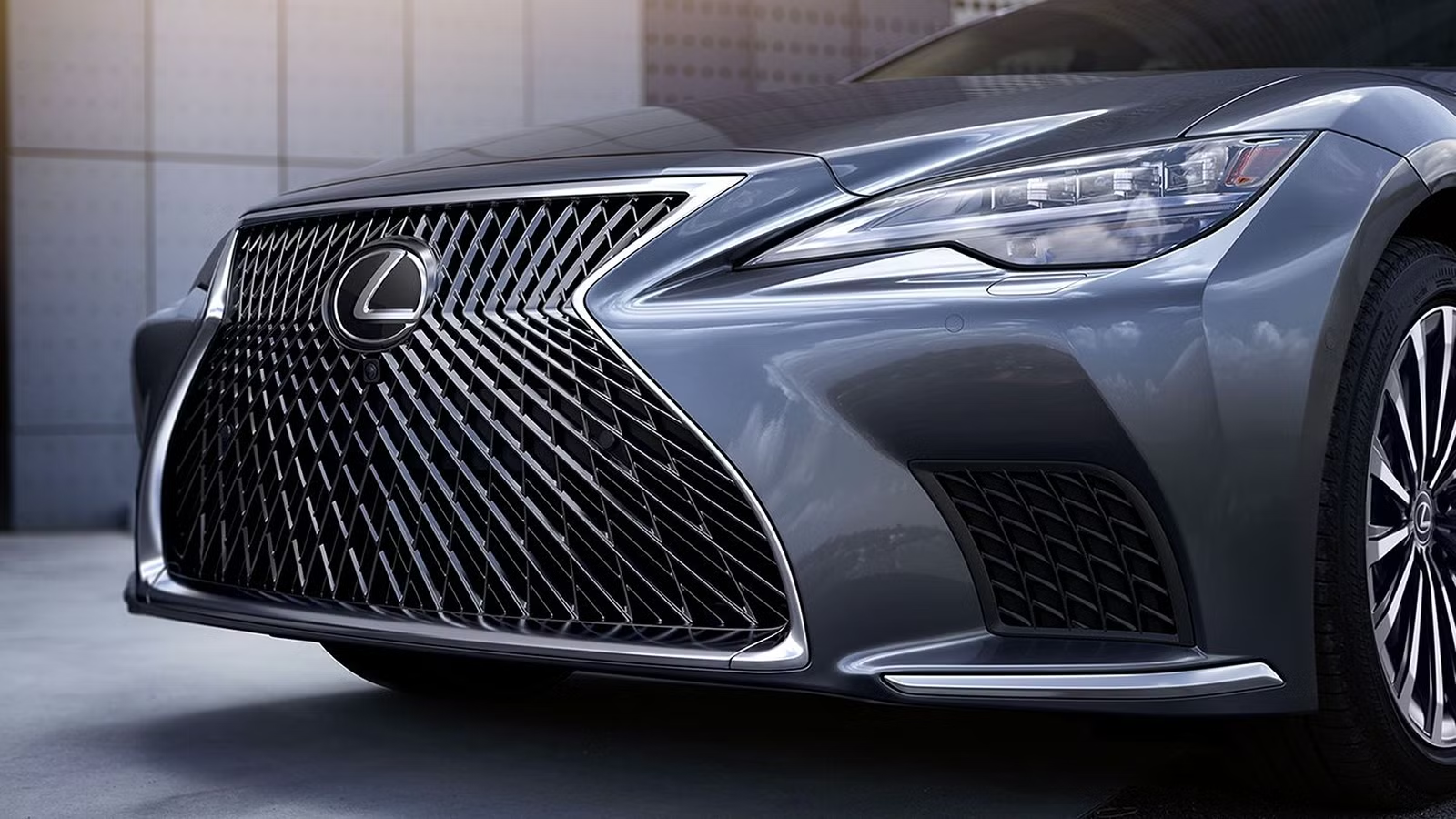
Full-size luxury sedans may not sell as strongly as full-size luxury SUVs, but it is this segment that still defines a brand’s prestige and technological advancements. Just for comparison, in the full-year 2025, the full-size luxury sedan segment’s sales leader is the BMW 7 Series with 11,303 units, but 31,575 units of the X7 were sold in the same period.

In other news, the Mercedes-Benz S-Class, which has historically been the segment’s best-selling model, is now second with 7,072 units. Falling far behind among the German triumvirate is the Audi A8, which, without any major update for nearly 10 years now, sold 1,396 units last year. And then there are others who are trying to beat the Germans at their own game in the full-size luxury sedan segment with varying degrees of success.
Lexus is one such example. When Toyota’s luxury brand entered the American market in 1989, it showed the world that Japan could also engineer a vehicle that was luxurious yet reliable. This leads us to its flagship model, which also happened to be its first model in 1989. It set the tone for what the brand is all about. Today, however, Lexus is a lot different from where it was in 1989. The model that kickstarted the brand’s success today is no longer in production. What’s the reason behind it, and is it worth looking for used examples? That’s exactly what this article will investigate.
How Lexus Evolved Over The Years

Lexus is Toyota’s answer to the best of European prestige. As a company on a mission to show the world what a luxury sedan should be, it created the LS in 1989.
Luxury That’s Easy To Own Long Term

European luxury cars are the pinnacle of prestige, but they’re also the pinnacle of complicated long-term ownership. The Germans love solving automotive problems with complex solutions—often yielding mixed results. For Lexus, their mission was to show the world that luxury should be easy to own. At the time, German brands were in a horsepower race to see who could create the most powerful full-size luxury sedan. The ’80s to ’90s were an era when they came with obscenely powerful V-12 engines producing more than 300 horsepower and were packed with tech features that would make 007 proud (he did, after all, get an E38 BMW 7 Series in Tomorrow Never Dies).
The Lexus LS, meanwhile, had a 4.0-liter V-8 that pumped out 250 horsepower. That’s still a powerful output, but you know that Lexus could make the engine produce more. That was deliberate because Lexus wanted the 1UZ-FE engine to be under-stressed. This engine would help the LS earn a reputation for reliability, with well-cared-for examples easily surpassing 200,000 miles. The LS laid the foundation for Lexus and its technological advancements, including the debut of the LS hybrid in 2007. Since then, hybrids have become a fundamental part of the brand’s identity, even more so in 2026 as it now has a hybrid-dominant lineup.
Now A Brand That’s More Open And Radical

That reputation for reliability and quality, however, meant that Lexus wasn’t exactly an exciting brand. It was virtually unimaginable that someone shopping for a BMW M3 would consider an equivalent Lexus. So in 2007, the V-8-powered Lexus IS F was revealed, and it also led to the creation of the Lexus F division. Then, in 2009, the ultra-rare and highly exotic V-10-powered LFA was introduced as the brand’s halo supercar. Its legacy would be solidified by its tactile driving experience, the howling V-10 tuned by Yamaha, and, as one would expect, the bulletproof reliability that an equivalent Ferrari or Lamborghini could only dream of.
Since the rise of F, Lexus has become a bolder and more adventurous brand, particularly with current Toyota Chairman Akio Toyoda heavily influencing the brand’s trajectory. With Century now being spun off as Toyota’s ultra-luxury Rolls-Royce fighter, Lexus is now being pitched as the more adventurous brand in Toyota’s stable. Lexus aims to be a premium brand that welcomes bolder ideas, hence the rakish profile of the new Lexus ES and its recent string of boldly designed concepts.
Everything Lexus Does Differently And Why Buyers Love It
Lexus proved that luxury could mean practical in a way no other brand has been able to replicate.
Today, The LS Is Only Available Used

Unfortunately, the Lexus LS has officially been discontinued for the North American market. For the 2026 model year, only the non-hybrid Heritage Edition was offered, and all 250 units have already been sold. Whether you want either the hybrid or the pure gas version, the used market is your only option.
Two-Year-Old Models Are A Good Deal
And since you have no choice but to go the used car route, a two-year-old Lexus LS is our recommendation. Full-size luxury sedans are notorious for rapid depreciation, especially since these vehicles represent the pinnacle of technological advancement for these brands. Unsurprisingly, Lexus bucks that trend with the LS in both hybrid and non-hybrid versions. The LS 500h will lose 14 percent of its value in two years, or a savings of $16,353, according to CarEdge. For the non-hybrid LS 500, the difference is only slightly less, losing 14.3 percent of its value, or $12,257, likewise according to CarEdge. Though similar in percentage, the difference in residual values is due to the LS 500h having a higher selling price when new versus the non-hybrid version.
A two-year-old LS 500 or LS 500h represents excellent value, because wear and tear is still largely minimal, while having enough depreciation to make it a value-packed used purchase. For reference, CarEdge says that a BMW 7 Series will have twice the depreciation rate. A base 740i, for example, is expected to lose 32.8 percent of its value in just two years—twice the value loss of the Lexus LS. There is a reason for that depreciation, and it is the vehicle’s sheer complexity in its powertrain and cutting-edge motorized features, which will become a liability to maintain in the long run. Want the plug-in hybrid 750e? CarEdge says that this version fares slightly worse with 33.6 percent two-year depreciation.
Scarcity Is Helping Its Values

The battle for full-size luxury sedan supremacy has almost always been reserved for the three German brands. As such, there’s no shortage of used examples of the BMW 7 Series, Mercedes-Benz S-Class, and Audi A8. These cars are complicated to own as they age, which makes them popular as three-year leases, just before the mechanical headaches begin. The LS in gas or hybrid form, on the other hand, will remain easy to own in the years to come.
But it isn’t just reliability that’s helping its values. The German rivals outsell the LS by a considerable margin, which means there are fewer used examples of the LS compared to its German rivals. In fact, scarcity is a common reason for some of the most desirable Lexus models in the used market today—the other one being the GS F.
|
LS 500 |
LS 500h |
|
|---|---|---|
|
Powertrain |
3.4-liter twin-turbo V-6 |
3.5-liter V-6 hybrid with two electric motors |
|
Horsepower |
416 hp |
354 hp |
|
Torque |
442 lb-ft |
257 lb-ft |
|
Transmission |
10-speed A/T |
Multi-Stage Hybrid (eCVT + 4-speed A/T) |
|
Driveline |
RWD, AWD |
AWD |
|
Fuel Economy (Combined) |
22 MPG |
25 MPG |
With that in mind, the LS 500h is actually very scarce in the used market. Unlike the pure gas-powered LS 500, which lasted until the 2026 model year with the 250-unit Heritage Edition, the LS 500h was discontinued a year earlier due to lower sales. Apart from its six-digit starting price, there was nothing wrong with the LS 500h, reliability or otherwise. As such, its scarcity is helping its residual values. By the fifth-year mark, the non-hybrid LS will lose 53 percent of its value. For the hybrid? CarEdge says it will only lose 41 percent of its value—the lowest in the full-size luxury sedan segment.
The Future Of The Lexus Flagship

While the LS has been discontinued for the North American and European markets, it remains on sale elsewhere in small numbers. Unfortunately, the future of the Lexus LS is unknown, and that’s what makes the recently discontinued flagship worth considering if you’ve been longing to own this luxury sedan.
For Now, The ES Becomes The Flagship

That’s where the newly redesigned 2026 Lexus ES comes into the picture. If you’re shopping for a flagship Lexus luxury sedan, the ES now fills in that role. That’s why the new ES has grown significantly in length, now measuring 202.4 inches, or about seven inches longer than the previous model. For reference, the discontinued LS is only about four inches longer than the new ES. The extra length is coupled with a more luxurious and cutting-edge interior. Two large screens may dominate the dash, but the interior has plenty of interesting materials, such as bamboo with 3D-printed detailing, genuine wood and/or metal trims, and embedded LED ambient lighting in some of its bamboo panels.
The higher and more premium positioning of the new ES is also reflected in some of its available features. When you opt for the Executive Package, the rear seats feature power recline and even an ottoman (footrest), which are controlled through touch-sensitive controls on the center armrest. These are features you’d normally expect in an LS, but not an ES, reflecting the brand’s intent in making the ES its current flagship. However, if you want that level of luxury, you’ll have to go for the fully-electric ES 350e Luxury only. If you want the hybrid ES 350h or the dual-motor fully-electric ES 500e, this option won’t be available.
The LS Has Three Future Paths

In a prediction that sounds far-fetched, there is a possibility, albeit a very slim one, that the LS might become a six-wheeled luxury minivan. Perhaps it could become a coupe-styled crossover, too. How about a microcar with single seats? Well, one of these three paths could be true, as Lexus has shown the LS Coupe Concept, the LS Concept, and the LS Micro Concept at last year’s Japan Mobility Show.
As with many concept cars, the chances of these three vehicles reaching production in the state in which they were revealed are very slim. There’s no way that a six-wheeled luxury minivan could be feasibly produced, while the LS becoming either a coupe-styled crossover SUV or a microcar would take the LS nameplate into a very different trajectory. Nevertheless, these three concepts showcase the positioning of Lexus in 2026 and beyond as a brand that embraces new and radical ideas. Whether these ideas will come to fruition is unknown, but we can expect some of these three concepts’ design flourishes or ingenious features to make their way into future Lexus production models.
Sources: Lexus, CarEdge, RepairPal

Related posts



Latest Post


No Comments