
The Cheaper SUV That Feels More Luxurious Than A Cadillac Escalade

The U.S. full-size luxury SUV segment is shifting toward unprecedented price inflation, leaving entry-level buyers behind. The Cadillac Escalade illustrates this trend through dramatic price restructuring. Recent price increases and the elimination of cheaper base configurations have pushed the entry barrier past six figures for retail models.

Cadillac widened the premium over its platform siblings, charging tens of thousands of dollars more than equivalent Chevrolet models. High-tier variants like the Escalade-V now approach $180,000. These escalating price brackets turn an iconic American luxury standard into an increasingly inaccessible asset for traditional buyers.
How Kia Is Approaching Affordable Luxury
Kia has fundamentally redefined its identity in the U.S. automotive landscape, evolving into a serious contender within the mainstream and semi-luxury SUV segments. Central to this transformation is a design philosophy called Opposites United, which contrasts sharp geometric angles and technical LED signatures against smooth, organic body surfaces. This aesthetic approach gives the brand’s larger utility offerings a muscular, commanding road presence characterized by upright silhouettes, wide stances, and distinctive lighting elements. Inside the cabin, modern architectural layouts feature expansive curved display screens and premium tactile materials, delivering a sophisticated environment that directly challenges traditional luxury marques.
Kia targets a broad demographic of modern American consumers, ranging from value-conscious suburban families needing versatile three-row capability to tech-forward professionals seeking sleek, electric mobility. These buyers prioritize premium features, comprehensive safety suites, and upscale styling without paying luxury-brand markups. By pairing bold styling with high-end convenience technologies, Kia successfully merges practicality with elevated prestige. This strategic balance captures drivers who desire an assertive, feature-rich SUV experience, solidifying the brand’s standing as a formidable player in the North American market.
The 2027 Kia Telluride Makes For An Accessible Luxury SUV

The Cadillac Escalade and Kia Telluride occupy entirely different vehicle classes, meaning they do not compete directly as head-to-head rivals. As a full-size, body-on-frame luxury truck, the Escalade offers a substantial V-8 engine option, superior towing capacities, and aggressive road presence. However, its starting price clears six figures easily. In contrast, the midsize, unibody 2027 Kia Telluride operates in the mainstream family segment at a fraction of that initial cost.
Despite this market distinction, the Telluride presents a compelling budget alternative for buyers seeking maximum practical utility without full-size luxury pricing. It delivers three spacious rows of seating, sophisticated digital tech displays, and high-end interior trimmings. Furthermore, the Telluride features vastly superior fuel efficiency through its turbo-hybrid powertrain, dramatically undercutting the Escalade’s steep ongoing operational and maintenance expenses.
The Telluride Gets Visual Refinement Right

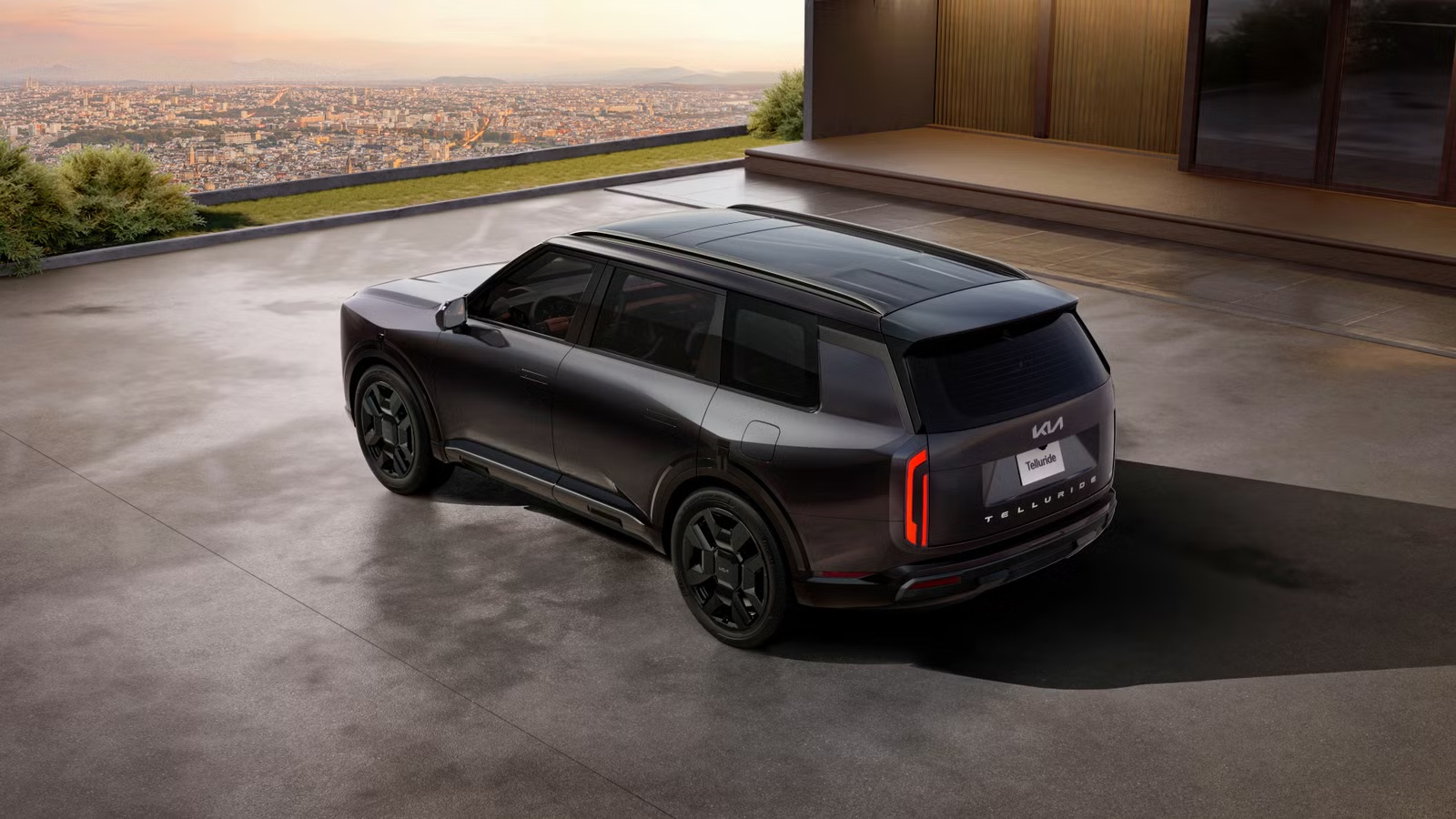
The 2027 Kia Telluride starts at an MSRP of $39,190 for the entry-level LX, scaling up past $58,000 for top-tier configurations. Grounded in the aforementioned Opposites United design direction, the flagship three-row crossover features a boxy silhouette, vertical LED headlights, upright taillights, and a commanding front grille. Exterior specifications vary significantly across the lineup. Core trims like the LX and EX-sport subtle body-color accents and 18- to 20-inch alloy wheels.
The rugged X-Line and X-Pro models feature blacked-out trim, unique 21-inch wheels, raised roof rails, and standard all-terrain tires on the X-Pro. Inside, the cabin elevates material quality through each trim tier. Base variants use durable cloth and SynTex synthetic leather upholsteries. Upper SX and SX-Prestige models upgrade to premium Nappa leather, wood-inspired dashboard textures, ambient cabin lighting, and optional first-row and second-row Relaxation Seats with power leg rests.
Comprehensive Specification Across The Range

Every 2027 Kia Telluride delivers a strong baseline of comfort, convenience, and entertainment features, ensuring exceptional value across all trim levels. Cabin comfort is anchored by dual-zone automatic climate control with dedicated rear passenger controls, alongside versatile eight-passenger seating via a sliding and reclining second-row bench. Convenience features include keyless entry with push-button start, remote engine start, a power-adjustable driver seat, dynamic welcome lighting, and USB-C charging ports embedded across all three rows.
Infotainment is centered around a 12.3-inch touchscreen display equipped with integrated navigation. Wireless Apple CarPlay and Android Auto come standard, allowing seamless smartphone integration without cables. Additionally, a six-speaker audio system, Wi-Fi hotspot capability, and a suite of 19 standard driver-assistance features complete the well-rounded standard tech package.
Two Competent Powertrain Options

The 2027 Kia Telluride offers two distinct powertrains depending on driver preferences for performance or efficiency. Standard models utilize a 2.5-liter turbocharged four-cylinder engine paired with an eight-speed automatic transmission, generating 274 horsepower and 311 pound-feet of torque. This setup accelerates the SUV from 0 to 60 MPH in 6.8 seconds, achieving an electronically limited top speed of 118 MPH, while delivering a maximum towing capacity of 5,000 pounds when properly equipped.
Alternatively, the first-ever Telluride Turbo-Hybrid introduces a 2.5-liter turbocharged hybrid system mated to a six-speed automatic transmission. Generating a combined 329 hp and 339 lb-ft of torque, the hybrid sprint from 0 to 60 MPH takes around 6.3 seconds. While its top speed remains electronically governed at 118 MPH, the hybrid setup maintains robust utility with a maximum towing capacity of 4,500 pounds.
For reference, the base Cadillac Escalade features a naturally aspirated 6.2-liter V-8 engine producing 420 hp and 460 lb-ft of torque, paired with a 10-speed automatic transmission.
The Benefit Of Appealing Fuel Consumption Figures

The 2027 Kia Telluride internal combustion engine models achieve EPA estimates of 22 MPG combined, 20 MPG city, and 26 MPG highway with front-wheel drive and 20 MPG combined, 18 MPG city, and 24 MPG highway with all-wheel drive. Paired with an 18.2-gallon tank, gas variants yield up to 400 miles of driving range. Based on regular gas at $3.50 per gallon, refueling costs roughly $63.70 per full tank, translating to $3.98 to drive 25 miles.
In contrast, the 2.5-liter turbo-hybrid delivers 35 MPG combined, 34 MPG city, and 36 MPG highway in front-wheel drive and 31 MPG combined in all-wheel drive, extending total cruising range to 637 miles. The hybrid requires only $2.50 to cover 25 miles, lowering complete tank fills to about $63.70 while expanding mileage significantly. Consequently, choosing the turbo-hybrid over the standard ICE powertrain generates approximately $3,725 in five-year fuel savings.
Sources: Kia, the EPA.

Related posts


Latest Post


No Comments