
This is The Fastest Muscle Car Of The ’60s
Few automotive eras command as much passion — or as many arguments — as the golden age of American muscle. Decades on, the cars born in that crucible of horsepower wars and factory rivalries still stop traffic at shows, shatter auction records, and ignite debates about which machine truly ruled the road. But strip away the nostalgia and ask a simple, quantifiable question — which ’60s muscle car was the fastest? — and the answer is more interesting than you might expect.

Traditionally, 0–60 sprints and tire-burning jaunts down the quarter-mile served as the main indicators of performance for that era, and official (as well as not-so-official) numbers served as fodder for car owners to state their case for which model was superior. Top speed was rarely reported by manufacturers and, for the end user, finding the space and freedom to get these behemoths up to well over 100 mph without grabbing local law enforcement attention wasn’t a common occurrence — and not nearly as easy as hitting the drag strip for a time slip or impromptu stoplight “testing.” Muscle Car Era HotCars searched for the ’60s-era American muscle car with the highest reported top speed — not taking into account classic V8-powered sedans or models like the Corvette or Shelby Cobra, which are sports cars rather than muscle cars. We relied on official manufacturer data for engine specs and production numbers. To find quarter-mile times and top speeds, we consulted a number of reliable automotive databases such as Automobile Catalog, Fastest Laps, and auction sites like Hagerty. Here’s what we found.
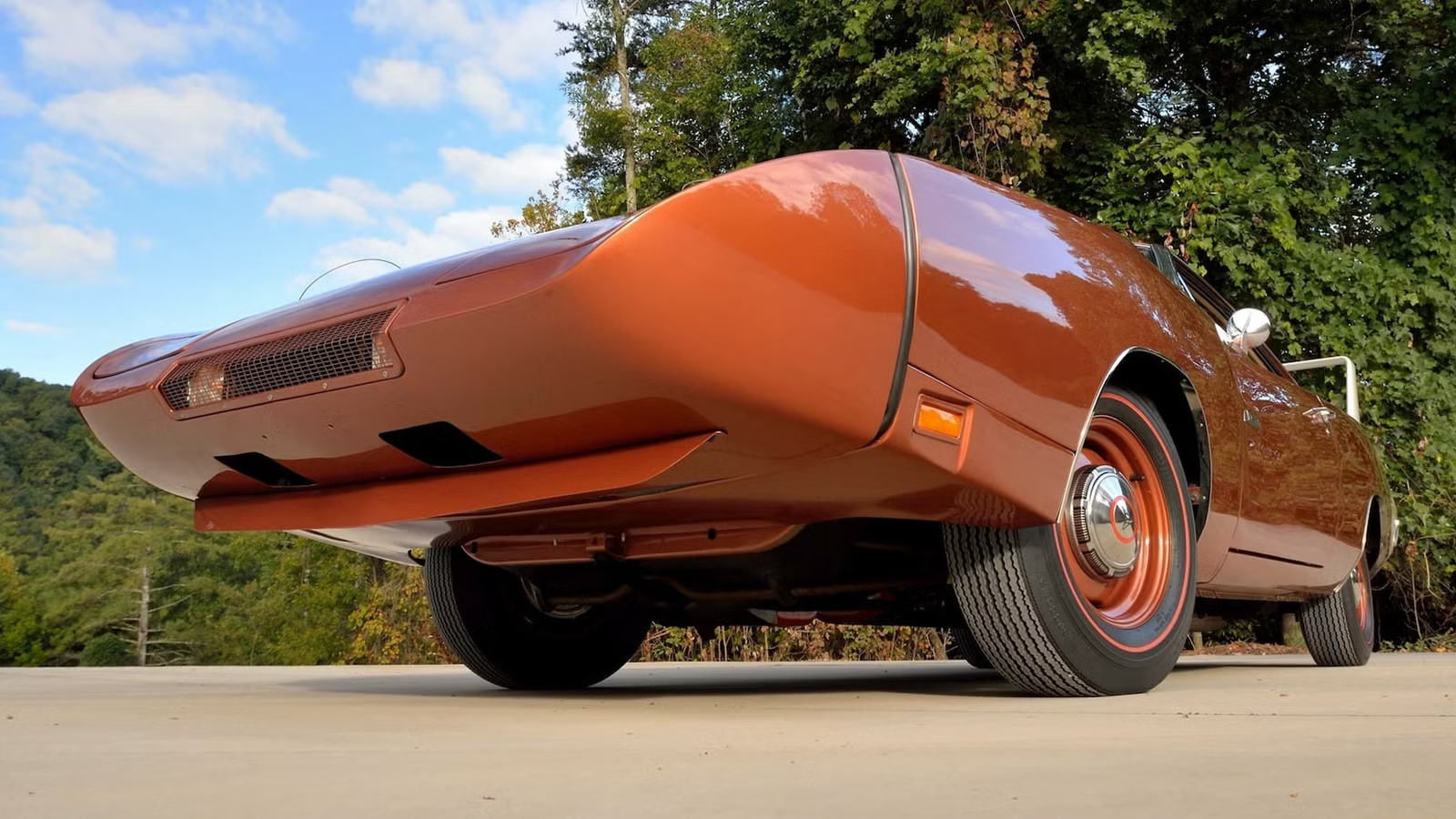
1969 Dodge Charger Daytona Hemi Was The Fastest Muscle Car Of The ’60s
Born From A Motorsports Icon
With Chrysler facing increasingly tough competition in NASCAR during the ’60s — including a win-hungry Mercury — the Daytona was developed as the ultimate track-ready evolution of the Hemi 426-equipped Dodge Charger. The brand turned to wind-tunnel development, which produced a massive square rear wing and a rounded nose cone. Engineers also eliminated the flying buttress rear window, which had created a high-pressure area at speed, and the result helped the 1969 version of the Charger adopt its Daytona persona become an unstoppable force.

However, before Chrysler could qualify the Daytona for motorsports, it had to homologate the model for street use. The result was the fastest true street-legal production muscle car not only of the ’60s, but for the remainder of the 20th century.
1969 Dodge Charger Daytona 426 Hemi Specs
|
Engine |
426ci Hemi V8 |
|
Power |
425 hp (underrated) |
|
Torque |
490 lb-ft |
|
1/4 mile |
13.5 seconds |
|
Top Speed |
185 mph |
|
0-60 MPH |
5.2 seconds |
Dodge
The Charger Daytona Became A Synonym For Speed
Today, most people remember the Charger Daytona for its legendary March 1970 Talladega run, where it became the first American car to break the 200-mph barrier, driven by Buddy Baker. That specific car — now displayed at the NASCAR Hall of Fame — was almost certainly capable of going even faster. It ran a special race-spec 426 Hemi EX-144 V8 with a Holley Dominator carburetor producing 575 hp, along with a stripped interior and additional aero components, all of which pushed it well beyond what the road car could achieve.
The homologated, street-legal Charger Daytona was no slouch, though. While its top speed was never officially rated, many sources agree it was well over 170 mph, with the common consensus settling around 185 mph. It can also cover the quarter-mile in just 13.5 seconds. This makes the Daytona faster than any other muscle car of the ’60s, including the ridiculously powerful 1969 Camaro ZL1, which was known to produce more than 500 hp at the dyno Dodge also offered the 1969 Charger Daytona with the more affordable 440 Magnum V8, which delivered a larger displacement and a stout 480 lb-ft of torque, but it made significantly less power than the Hemi (375 hp), resulting in a lower top speed.
The Engine Behind The Legend
The foundation of the Charger Daytona’s ability to muscle its way through short and long-distance displays of dominance was the great Hemi 426 — a big-block V8 that found its way under the hood of a number of iconic muscle cars in the 1960s. Heralded for its brute force, the Daytona’s 7.0-liter Hemi 426 produced a manufacturer-claimed 425 horsepower and 490 lb-ft of torque. However, it was also notoriously underrated — most sources and dyno tests agree that output was closer to 470 hp at the crank.
Much of the magic behind the engine’s output comes down to its heads, which are hemispherical (Hemi for short), meaning the upper portion of the combustion chamber resembles half a sphere. That unique geometry allowed engineers to position the exhaust and intake valves on opposing sides of each combustion chamber, leaving ample space for much larger valves that improved airflow and generated those impressive power figures.
The 1969 Dodge Charger Daytona Is Worth A Fortune Now

With just 503 units ever produced, the 1969 Charger Daytona is one of the most unique and recognizable muscle cars ever built. But if you’re looking to get great performance for your dollar, look elsewhere. The average auction price on a 426 Hemi Daytona over the last several years, according to Classic.com, is a staggering $1.5 million. The most pristine examples will easily fetch twice that — such as this 1-of-22 with just 1,825 miles on the odometer that brought $3 million at auction. Hagerty’s Valuation Tool puts a Hemi-powered Daytona in good condition at $541,000, meaning the recently auctioned cars represent especially desirable examples. Prices continue to climb.
Compared to those figures, the 440 Magnum V8 Daytona’s average auction price (per Classic.com) looks more approachable — but that’s precisely because the 426 Hemi is what made the Daytona an icon. Hagerty values good-condition 440 cars at around $228,000, though some nice examples have sold for under $200,000 recently.
1968 Dodge Charger R/T Outran The Competition
Performance Specifications
|
Engine |
Hemi V8 |
|
Power |
425 hp |
|
Torque |
490 lb-ft |
|
0-60 |
4.9 seconds |
|
Quarter-mile |
13.5 seconds |
|
Top Speed |
156 mph |
Dodge
Given the 426 Hemi’s legacy and impact on the American muscle car market in the ’60s, it should come as no surprise that the runner-up is also powered by this legendary engine. Another venerable Mopar, the 1968 Charger was what you’d buy if you wanted to drive the fastest muscle car before the Daytona arrived on the market. While there are a few ’60s muscle cars that could cover the quarter-mile and 0–60 mph runs faster than the 426 Charger, paired with a 4-speed manual transmission the Charger reached the highest top speed.
Though it was estimated to carry a top speed of 140 mph, placing it in the upper echelon of its competition, Car and Driver put a 1968 Charger Hemi to the test and found that it not only hit the suggested speed but went on to muster another 16 mph, recording a final 156 mph run. It’s a tall task for a vehicle better suited to 0–60 hits and comfortable freeway cruising than sustained wide-open-throttle runs in search of its absolute maximum speed.
In the realm of shorter passes from a dead stop, the Charger was among the best of the decade, covering the quarter-mile in mid-13-second territory after a jump from zero to 60 mph in a mere 4.8 seconds. That’s no easy feat for a chassis that tips the scales closer to 4,000 lbs. It should also be noted that the Charger would likely have seen even faster top-speed numbers had tire technology advanced as quickly as the muscle car era did.
A Whole New Look Won Over American Buyers
The Charger’s Coke-bottle shape helped propel it to impressive feats both on and off the track. While the first-generation Charger experienced dismal sales, the second-generation model — based on the Chrysler B-body — debuted a new look that was an instant smash hit with buyers. Though its full-length grille and hideaway lights were carried over from the previous model, the rest of the car was substantially updated and everyone took notice.
The familiar fastback design was replaced by a recessed rear window, while the single taillight treatment was ditched entirely in favor of a separate dual-element setup. Just above, a lip spoiler was added to the trunk lid, subtly stretching the car’s profile.
One Engine To Rule Them All
Though engine options like the 225 slant-six and 383 V8 were available for those who wanted them, the real hero was reserved for buyers seeking maximum grunt. The 426ci Hemi was the most powerful engine available for the ’68 Charger, and also the most expensive, pushing the Charger’s original MSRP from $3,014 to a premium $4,111.
Finding The Right One Will Cost You

Like any classic muscle car, the value of and interest in the classic Charger has only grown over the years, and the market’s supply-and-demand dynamics firmly favor the seller. If you’re not the DIY type — nor willing to invest in a thorough restoration with a trusted shop — a good-condition example pushes into the low six figures. Hagerty estimates $101,000, while auction prices on Classic.com average around $103,069. At that level, it’s a car you can drive and enjoy, but it isn’t likely to turn heads at a concours.
At the top of the collectible food chain is an excellent-condition model that’s been expertly maintained, carries low mileage, and requires no real restoration or significant work — essentially a show-ready vehicle all but guaranteed to appreciate if properly cared for. That kind of find will require over $175,000 to park in your climate-controlled garage, according to recent auctions.
Of course, there are always outliers so revered by automotive fans that they command astonishing prices, and with eager buyers trying to outbid one another, these stellar examples might earn a spot alongside the most expensive classic muscle cars ever sold at auction.
1967 Camaro SS 396 Is No Slouch Either
Performance Specifications
|
Engine |
396 V8 |
|
power |
325 hp |
|
Torque |
410 lb-ft |
|
0-60 |
6.0 seconds |
|
Quarter-mile |
14.5 seconds |
|
Top speed |
140 mph |
Chevrolet
While some might draw a sharp distinction between pony cars and American muscle cars, the 1967 Camaro SS seemed to blur that line. What began as an answer to Ford’s rapidly rising Mustang eventually morphed into an American icon — one that has remained a popular choice across six generations of development. Though it can’t outrun the Hemi-powered Charger Daytona, its top speed of 140 mph is impressive and, realistically, doesn’t trail far behind the top dog.
With a 396 V8 under the hood, 325 hp and over 400 lb-ft of torque were on tap, enough to push the svelte Camaro to 14.5-second drag times. Given enough space and safe conditions, 140 mph was achievable at full tilt. The power deficit compared to the Charger was offset by the Camaro’s lighter curb weight of about 3,300 lbs.
The Camaro SS Is Almost As Fast But At Half The Price

The price of a classic Camaro SS is far kinder to your savings account than a Charger, whether you’re after a fixer-upper or a picture-perfect example. If a long-term project is what you’re after, a rolling example with plenty of work needed will set you back around $13,000, according to J.D. Power.
Step up to something in good condition — fully functional and ready to enjoy the moment you take ownership, even if it’s not winning any trophies — and your starting point is in the neighborhood of $62,294, an average auction price according to Classic.com. Hagerty agrees, quoting around $62,500 for a good-condition model — roughly half the price of a comparable ’68 Charger. Even at the high end, the Camaro SS remains a relative bargain.
Sources: Classic.com, Road and Track, J.D. Power, Mecum, Hagerty.

Related posts



Latest Post


No Comments