
This Italian Middleweight Makes More Power Than A Ducati Panigale V2 And Costs Less
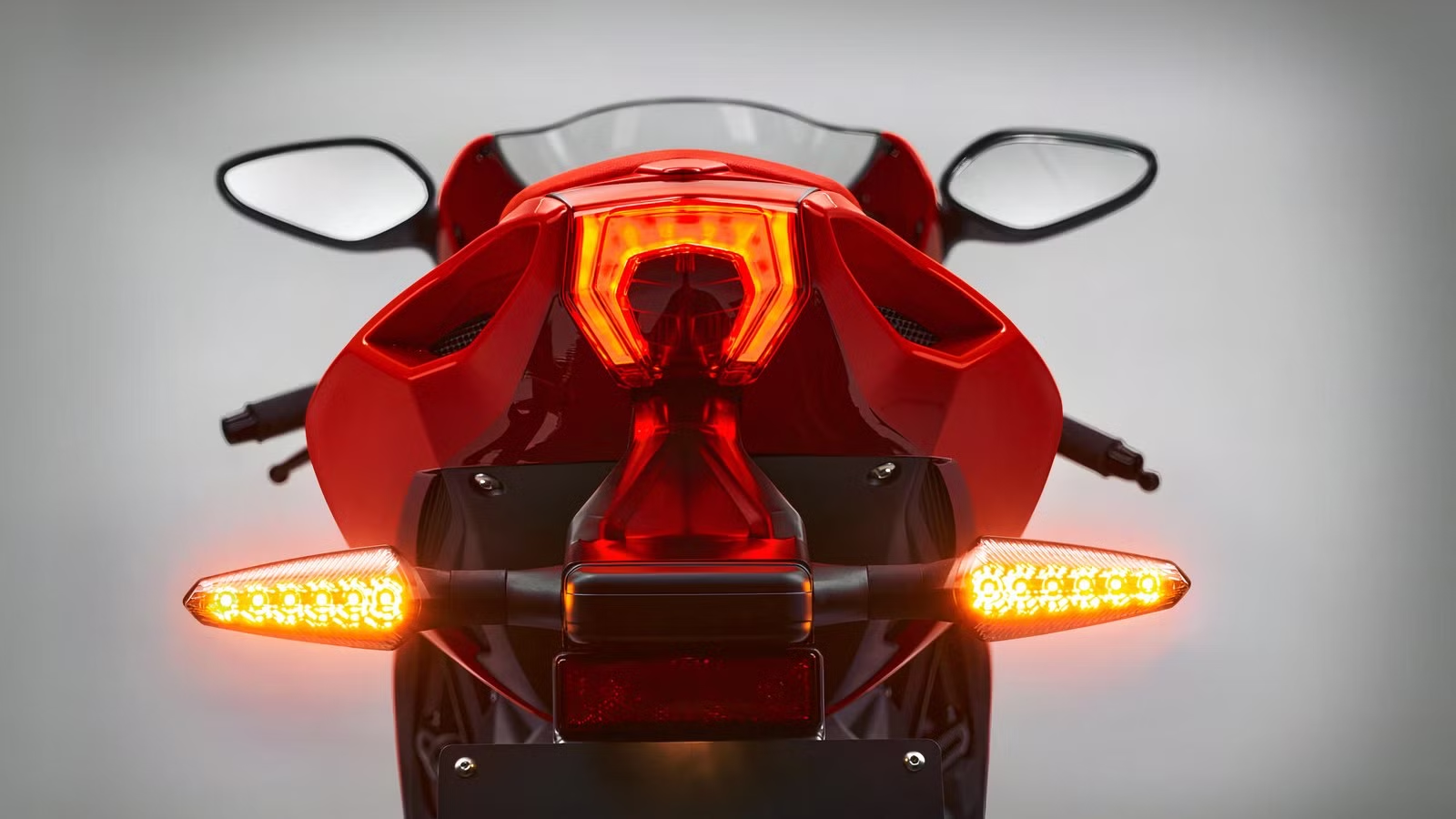
Modern midweights are easier to live with than ever, but they’ve lost some of their edge along the way. The high-revving inline-fours that once made this class so exciting are slowly being replaced by parallel twins. These engines are simpler, cheaper to build, and better suited to stringent emission norms, and they’re more affordable too. All that comes at the cost of spirited performance, something that once defined this class. Thankfully, a rare few middleweights haven’t lost their bite, and one Italian triple feels built especially for the job.
Serious Mid-Weights Have Become A Rare Deal

Serious midweights, the kind built around the racetrack instead of the road, are far fewer than they used to be. Blaming emission norms alone wouldn’t be fair, though. These motorcycles were brilliant on a circuit but far less pleasant everywhere else, so sales fell as riders lost patience, and manufacturers took the hint, shifting their focus to the road.

That shift is easy to spot in today’s lineup. The Suzuki GSX-8R puts road fun ahead of track fun, trading a high-strung inline-four for a flexible parallel twin and upright ergonomics. The Triumph Daytona 660 is far less aggressive than its predecessor and is happy to be ridden every day, while the Honda CBR650R E-Clutch has road-oriented ergonomics that suit life as an urban runabout. They’re all great at what they do, though outright thrill is no longer the priority. That leaves riders who still want a taste of superbike performance with very few places to go, and the most exotic of those few comes from Italy.
The MV Agusta F3 R Still Brings Superbike Thrill


That bike is the MV Agusta F3 R, and it clearly missed the memo about going easy. When MV launched the 800cc F3 back in 2013, the pitch was the excitement of a liter bike with the handling of a 600, and that formula still holds today. You can see why in the way it’s built. There’s a triple that loves to be revved, a clever bit of MotoGP thinking buried inside it, and the kind of chassis and braking hardware that feels a class above. Of course, it won’t match a liter bike on outright numbers, and it doesn’t need to. What it delivers is the feeling of one, at speeds you can actually use.
A Redline-Loving Triple Delivers The Rush

At the heart of the F3 R sits a liquid-cooled 798cc inline-triple, and it speaks for itself. A 79 mm bore paired with a short 54.3 mm stroke favors revs, while a 13.3:1 compression ratio and titanium intake and exhaust valves back that up. The result is 147 horsepower at 13,000 rpm and 65 pound-feet of torque at 10,100 rpm.
That torque figure says plenty about its character. The Suzuki GSX-8R makes its peak torque at 6,800 rpm, whereas the F3 R saves its strongest pull for beyond 10,000 rpm. So, the real reward comes when you keep the triple spinning, which is exactly how a midweight used to be enjoyed. It’s properly quick as well, with MV claiming 0 to 62 mph in about three seconds and a top speed of 149 mph.
A Counter-Rotating Crank Makes It Even Sharper

The F3’s cleverest trick is hidden inside that engine. Most motorcycle crankshafts spin in the same direction as the wheels, adding to the gyroscopic force that resists a quick change of direction. The F3’s crank spins the opposite way and cancels out part of that force, so the bike takes less effort to flick into a corner. There’s a second benefit too. Under hard acceleration, a forward-spinning crank tries to lift the nose, whereas a counter-rotating one helps push it down, which means less wheelie and better acceleration. It’s an idea borrowed from MotoGP, and MV Agusta says the F3 was the first mid-size supersport to use it.
A Trellis Frame, Marzocchi Fork, And Brembo Stylemas Do The Heavy Lifting

All that engine sits in an ALS steel tubular trellis frame with aluminum alloy swingarm pivot plates, while MV’s signature single-sided swingarm finishes off the rear. Suspension duties go to a 43 mm Marzocchi upside-down fork and a Sachs monoshock, and both are adjustable for preload, compression, and rebound, in typical supersport fashion.
Braking comes from Brembo Stylema four-piston radial calipers biting on twin 320 mm discs up front, while a two-piston Brembo caliper and a single 220 mm disc handle the rear. There’s one gripe, though, and that’s the 424-pound heft, which is without fuel. Fill up the tank, and it climbs to 452 pounds.
Plenty Of Tech To Keep That Triple In Line

A triple this eager needs a capable safety net, and the F3 R delivers with a full electronics suite built around a six-axis IMU. You get four riding modes, namely Rain, Sport, Race, and Custom, along with eight-level traction control, wheelie control, launch control, rear-wheel lift-up mitigation, and cornering ABS, a list that’s right in line with modern liter-class bikes.
Gear changes are just as well sorted, thanks to an up-and-down quickshifter and a nine-disc slipper clutch that keeps things smooth. There’s even cruise control for the ride home, which is a nice touch on a bike this focused. A 5.5-inch color TFT rounds things off, and it pairs with your phone for navigation. Best of all, you won’t pay extra for any of it.
The F3 R Is Hard To Ignore In A Tough Crowd

Buying an F3 R still means walking past some very capable rivals. The Yamaha R9 costs $12,499 and makes 119 hp, the KTM 990 RC R asks $13,949 for 128 hp, and the Ducati Panigale V2 sits at $16,995 with 120 hp. At least one US dealer lists the 2026 F3 R at $15,998, which undercuts the Ducati, while its 147 hp comfortably beats all three.
That said, the F3 R isn’t the easy choice here. The R9 and Panigale V2 are the more comfortable bikes, and the F3 R is also heavier than the R9 and KTM. Even so, it holds a clear power-to-weight advantage over both, and it’s one of the most powerful bikes in its class, right alongside the Suzuki GSX-R750, which lacks the modern rider aids you get on the MV. So, if you want the midweight that comes closest to a superbike, the F3 R makes the strongest case in this crowd.
Source: MV Agusta

Related posts


Latest Post



No Comments