
Someone Put A Ferrari V8 In A Classic Porsche 911
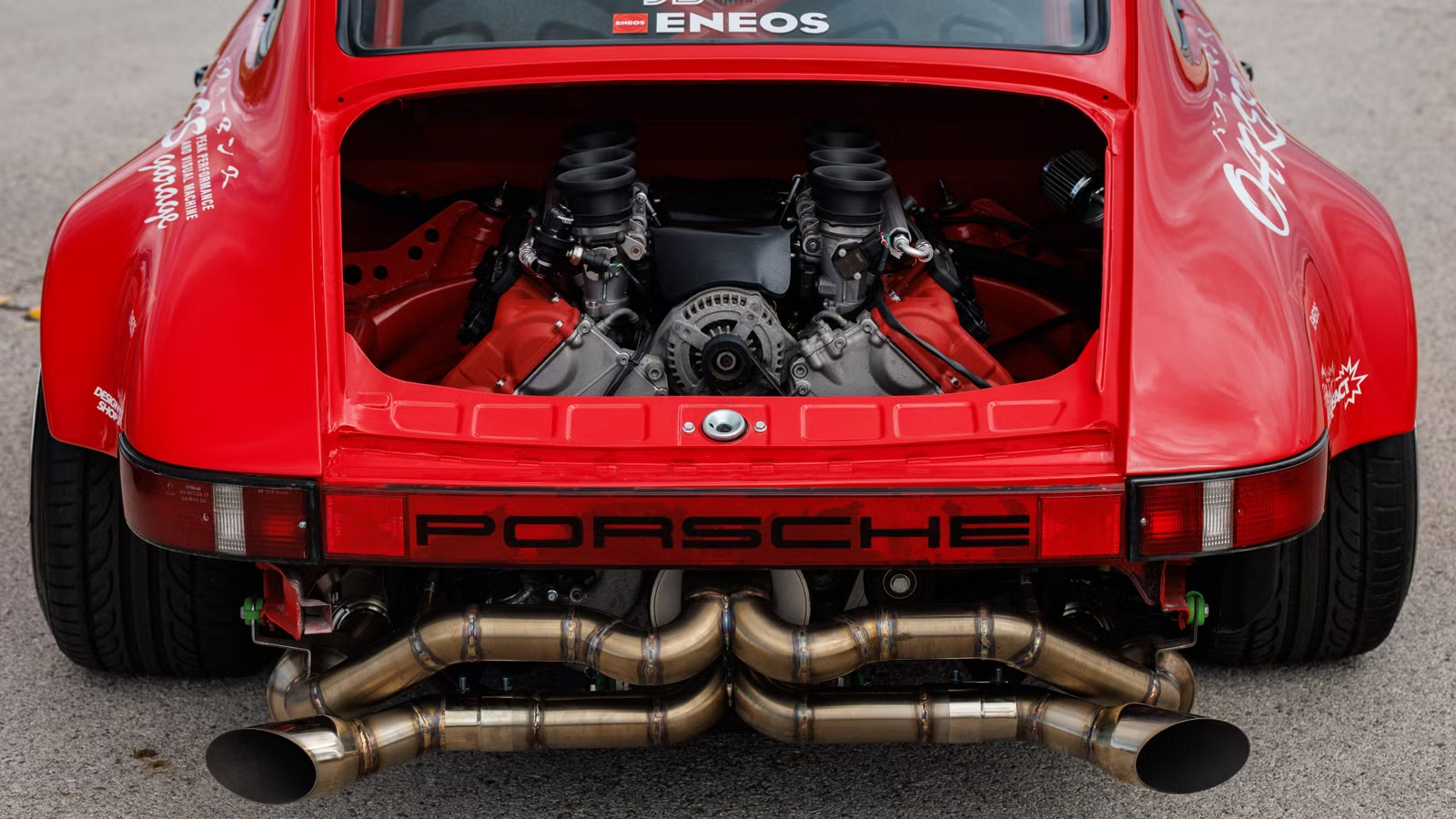
Two Porsche 911s parked at SEMA 2026 this week with engines Porsche never put anywhere near that chassis. Jimmy Oakes’s 1978 911 SC now runs a 4.3-liter Ferrari/Maserati F136, the flat-plane-crank V8 that once lived in a 2007 Quattroporte sedan. A few booths over, Faruk Kugay’s 2007 997 GT3 carries a dry-sump 6.0-liter LS2 with LS3 heads, swapped in for drift duty after the car had already spent time running a Subaru STI EJ25 flat-four.

Both builds are on display through November 6 at the Las Vegas Convention Center, presented through Eneos Oil. Neither one is chasing the same goal. Oakes went for an exotic, high-revving Italian engine that nobody has ever shoehorned into an air-cooled 911 before. Kugay built a GT3 that can get sideways and survive it, swapping one unconventional engine for another. Together they make the same point from opposite directions: the 911’s engine bay is more adaptable than Porsche’s own lineup lets on.
Why A Ferrari V8 Ended Up In An Air-Cooled 911
Maserati and Ferrari shared engineering resources for years before that arrangement ended in 2023, which is how the F136 ended up badged as a Maserati engine despite being built by Ferrari. That history is what makes Oakes’s swap more than a random parts-bin stunt. It’s a Ferrari engine, wearing a Maserati label, sitting where a 3.0-liter flat-six used to live in a 1978 SC.

Getting it there took real fabrication. The F136 mates to a Porsche 996 transmission through a Kennedy Engineered Products bellhousing, a custom clutch and flywheel, and a fabricated engine cradle built specifically for this combination. A Link ECU G5 Voodoo Neo 6 handles engine management, paired with custom Stainless Bros headers. The individual throttle bodies came off a BMW E90/E92 M3’s S65 engine, adapted to work with the F136. That combination reportedly lets the Italian V8 spin to an 8,000-rpm redline, a number that owes as much to the throttle-body swap as to the engine’s own architecture. The SC also picked up upgraded brakes, coilovers, and a roll cage to handle what the old chassis never had to deal with.
The GT3 That Already Had One Unusual Swap Before This One
Kugay’s 997 GT3 didn’t start this build cycle with a flat-six either. The car previously ran a Subaru STI EJ25, an oddball swap in its own right, before it was rebuilt around the dry-sump LS2 and LS3 heads specifically for drifting. That’s two non-factory engines in one GT3’s life, which is rare even in a platform that’s seen plenty of race-built conversions over the years.
The LS2 is a budget-friendly, well-documented engine with a deep aftermarket, the opposite end of the spectrum from a flat-plane Ferrari V8 that needs custom everything. For a car meant to get thrown sideways repeatedly, that practicality matters more than exotic lineage.
Porsche Has Never Put A V8 In A Production 911
Porsche has built V8-powered cars before: the 928, the Cayenne, the 918 Spyder. The 911 has never gotten that treatment from the factory, flat-six only, generation after generation. These two builds don’t pretend to improve on that formula. Oakes’s Porrari sat in the Eneos booth during the Rays Wheels Silver Lot takeover, while Kugay’s LS2 GT3 got its first big public outing during the Optima driving experience in SEMA’s Bronze Lot. Same sponsor, same show, completely different answers to the question of what else fits in a 911’s engine bay.

Related posts
Latest Post


No Comments