
Mercedes-AMG One finally driven: How F1-based hypercar shaped brand’s new era
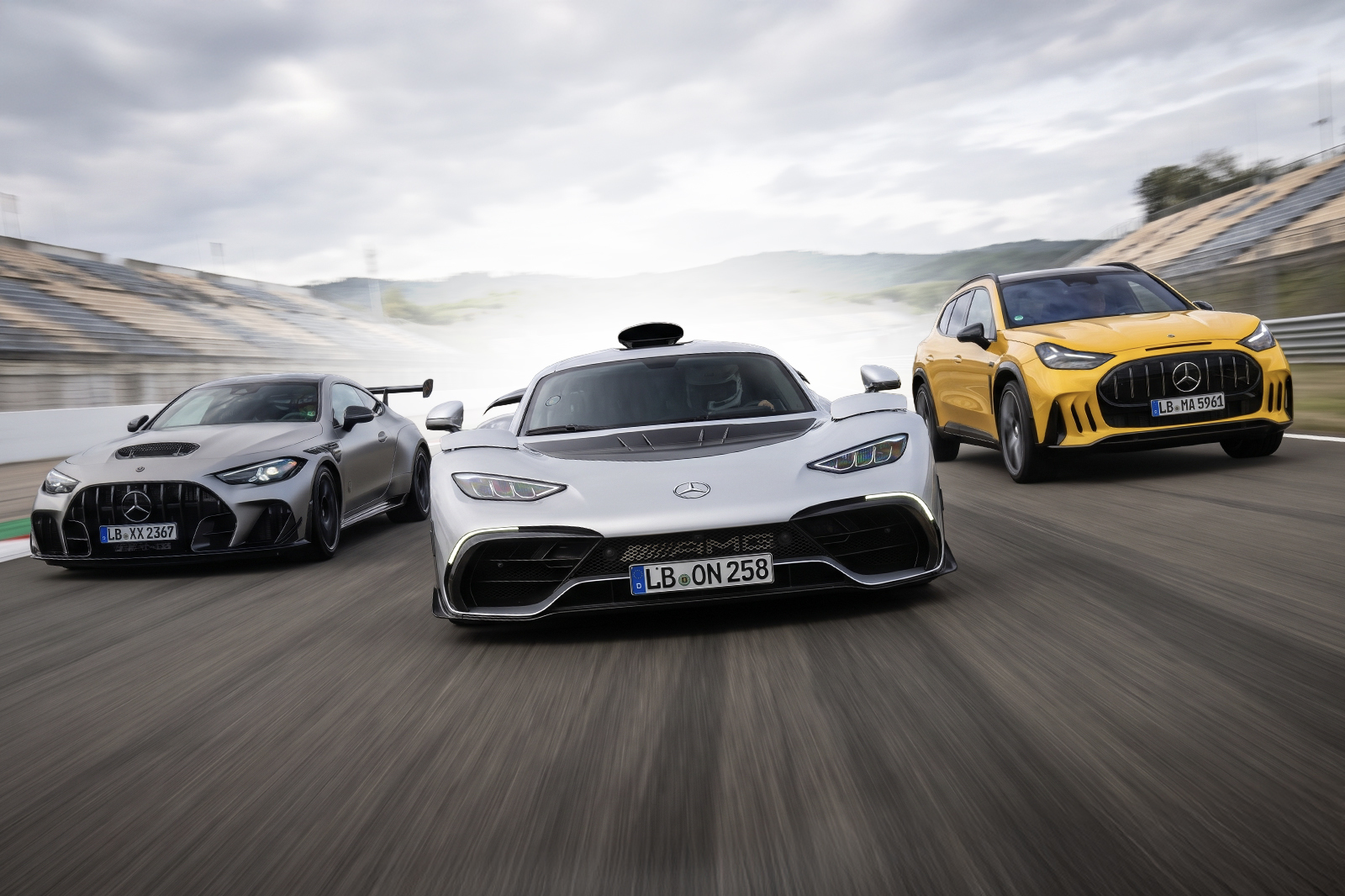
From mega-powered electric SUV to savage V6 hypercar, we drive the cars that define modern AMG

The last time I remember Autocar running a story reporting the experience of doing doughnuts from the unenviable vantage point of the passenger seat of one of the most powerful cars on sale, it was 1989, the car a Ferrari F40 and its intrepid pilot none other than a flat-capped, moustachioed Nigel Mansell.
It was not me in the passenger seat that day but the rightly famed and now sadly long departed sports writer Frank Keating. It was one of the greatest pieces of motoring journalism I can recall appearing between these covers and I’d urge anyone to read it, which you can do for free here this month.
Today, I’m afraid, you have me but, like Frank was, I am at least in one of the most powerful cars on sale.

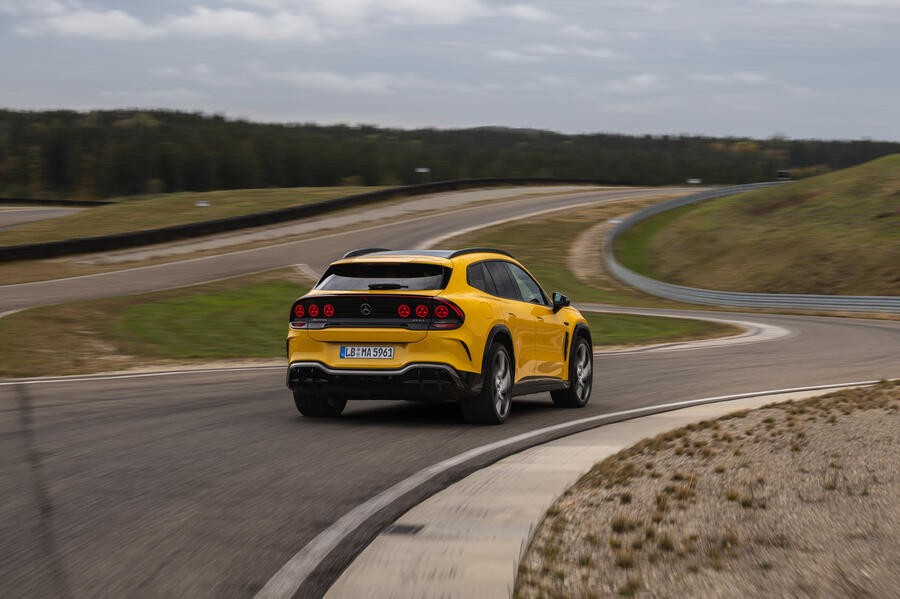
Sadly, it’s not an F40, then and now my favourite road car, but a near 2.7-tonne electric SUV, the latest in a line of bespoke Mercedes-AMG products that began with the gullwinged SLS back in 2009.
We’re going round and round in expensive circles, the 1153bhp at our disposal grinding Michelins to dust while its intrepid test pilot demonstrates how easy or difficult the process of using such a device to describe a mathematically near perfect arc can be, depending on how far you twiddle a knob between the seats. Valuable stuff in a high and heavy five-seat family car, you will agree.
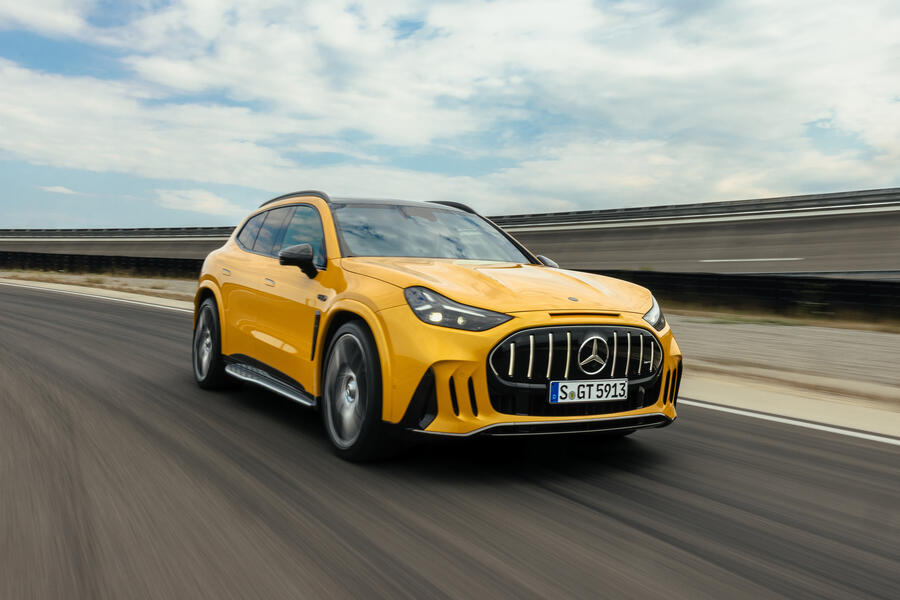
Now, this is not a full road test of the new Mercedes-AMG GT 63 SUV, because while I did drive it, and as fast as I could make it go, it was only for a few minutes within the confines of a vast test track and Autocar requires something a touch more rigorous before designating it a review. For that, you can read my colleague’s fuller verdict here soon.
But my experience was perhaps indicative of where AMG is today as it prepares for 1 June next year – the 60th anniversary of former Mercedes engineers Hans Werner Aufrecht and Erhard Melcher getting together over a stein or two to form a little tuning company, borrowing its third letter from the former’s place of birth in Grossaspach, north-east of Stuttgart.
Unlike some such companies, the chaps enjoyed ever closer working relations with the factory, selling cars in Mercedes dealerships from 1990, launching their first co-developed car in 1993 (the C36 AMG) and selling a controlling interest to Mercedes in 1999, which six years later acquired the company outright.
I wonder what you think of when you think of AMG today. To me an AMG is a saloon or estate making sounds that I’d happily have played as I proceed feet first through the curtains under the big chimney. They’re there courtesy of some monstrous bent-eight motor under bonnet lovingly constructed by a single master craftsman or woman in Affalterbach, where the company has lived these past 50 years.
Except there’s a problem. You can’t buy a V8-powered AMG saloon or estate any more. Indeed, if you want a V8-powered AMG today, you need to buy a convertible SL grand tourer, a GT supercar, a G-Class or GLS off-roader or… well, you may still be able to buy a GLE SUV with the big banger under the bonnet, but on the website it’s claimed to be a bespoke car that can only be made to order with no price next to it. So good luck with that. There is, gloriously, the new CLE 646 coupé to consider, but given that it costs north of £600k and all 30 units have been sold already, it can hardly be called a C63 replacement.
AMGs today are otherwise powered by four- and six-cylinder engines, and they’re some of the best such motors in the world, but these are the string quartets and musical ensembles of the AMG world and sometimes you want the full symphony orchestra. We won’t dwell on the disaster that was the attempt to replace a 4.0-litre V8 in the C63 with a hybridised 2.0-litre four (a car now quietly removed from sale without so much as a tear-stained hankie to send it in its way). And, as we’ve already seen, the EVs are on their way in the form of the GT SUV outlined above and its already-launched GT 4-Door Coupé sibling with its great face for radio.
Now, to be fair, the GT SUV does make V8 noises. Loud V8 noises, a sort of K-tel compilation of AMG’s greatest V8 noises over the years all blended into one stupendous soundtrack if you choose the right mode. And it is unbelievably convincing, right down to the little electric motors in the seats that send shivers up and down your spine in time with every pop and bang on the ‘overrun’. Yes, really. But it’s not quite the same. It’s a battery versus a mechanical watch: both tell the time, the battery-powered one rather better if we’re honest, but there’s nothing like having a chunk of mechanical precision engineering on your wrist.
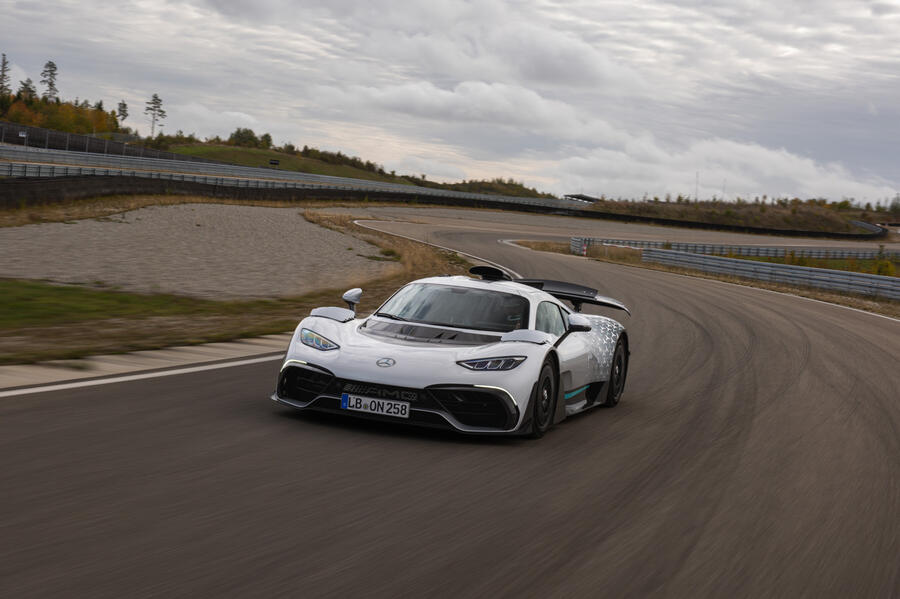
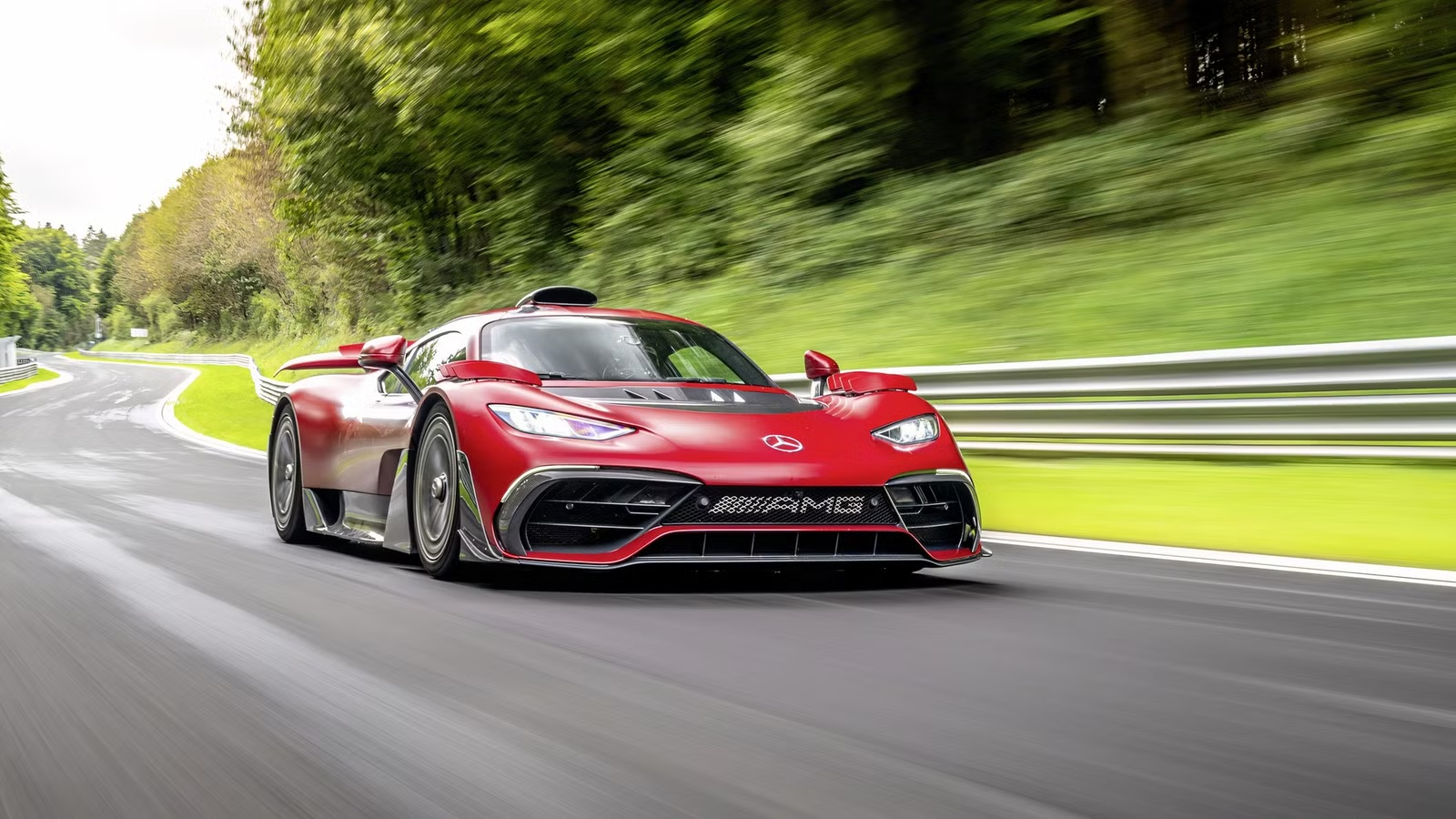
Not that Mercedes has in any way lost the ability to make genuinely extraordinary engines. Another thing I did that day was drive the AMG One, the only road car ever to feature an engine not loosely based upon but directly derived from a Formula 1 power unit. It is an incredible as it sounds. A 1.6-litre V6 developing 566bhp all by its little old self. To save you the maths, that’s 364bhp for every litre of capacity; the Bugatti Chiron Super Sport’s W16 produces around 200bhp per litre.
For an engine designed to last not a few hours but tens of thousands of miles, that’s nuts. It is also unprecedented in the road car arena. And that’s before you’ve added the power from the MGU-H, MGU-K and the front electric motors that give it four wheel drive to provide a total system output of 1063bhp. Did I mention it also revs to 11,000rpm?
Yet despite all this, I thought AMG would drape a veil of civility over this powertrain (designed and developed in Northamptonshire, lest we forget), however gossamer-thin it might be. I thought wrong. If you thought that (A) modern F1 engines don’t make much noise, (B) that small engines don’t make much noise and that (C) small turbo engines make even less noise, you’re in for a shock.
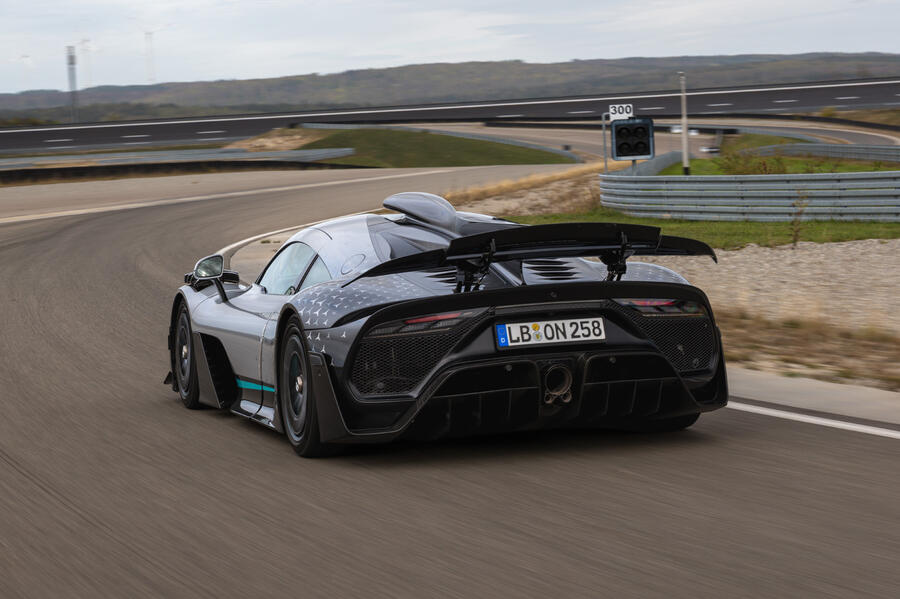
The single-turbo V6 fires up with all the grace of a demolition charge going off behind your head. It’s so loud, so angry and so fabulously raw. Not the slightest attempt to tame it has been made, save that required to get it through homologation which might be its engineers’ greatest achievement of all. You may recall the company went to hell and back trying to get it to work on the road, leading to delays best measured in years and for the former boss of AMG and today chairman and CEO of Mercedes-Benz Ola Källenius to say to some investors at Monaco in 2022: “I will have to go back and check the meeting minutes, but I’m sure we were drunk when we said yes…”
I’m so glad he did. The One is unlike any other road car I’ve driven, because it doesn’t feel like a road car at all, least not in its raciest lower-than-rattler’s-belly mode in which I drove it. You sit bum down, feet up in a driving position more akin to a Le Mans prototype than any kind of normal road car. You then try – and fail – to make sense of the screen in front of you and the one to your right which is telling you the temperatures of myriad components I don’t even recognise. What I do see and understand, however, is that under each one is a little green box with the word ‘go’ at its centre. So I do.
It’s actually quite easy to drive slowly. Pull a paddle, press a pedal and you’re off. I’m following a GT Black Series – far and away the fastest series-production car ever produced by Mercedes, but context is all in such situations and here it is no more than what stands between you, what you know already is going to be a new driving experience and a whole stack of fun. Overtaking is verboten at this event, I guess because they don’t want me trying to find out whether it is car or driver that has the higher personal limit. So I instead I hang back half a lap and then let it do its thing.
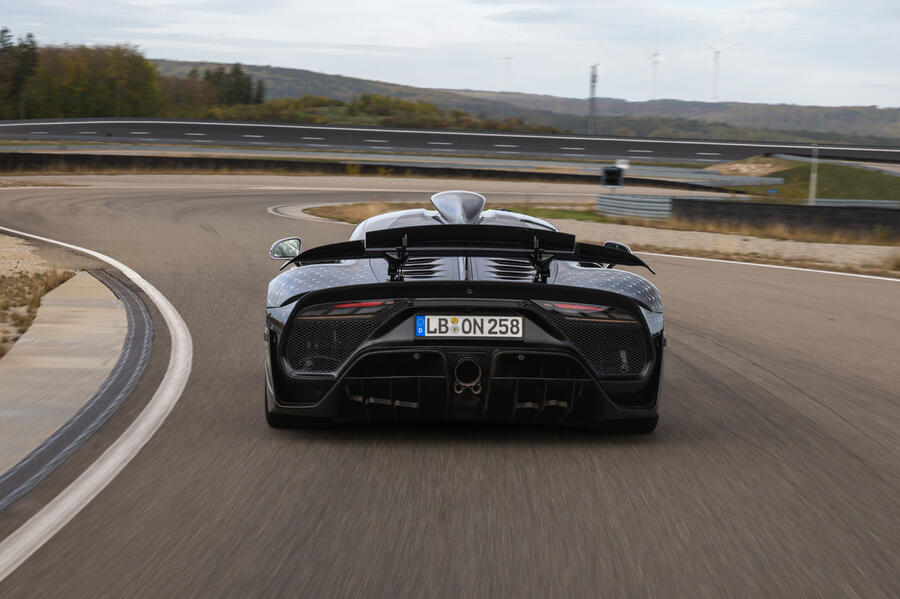
It is the only supercar/hypercar I’ve driven that really does feel closer to a racing car than anything intended for the road. Despite its not-very-racing-car 1695kg kerb weight, the way it is set up combined with the vast amounts of downforce it generates, its bespoke Michelin Pilot Cup 2R tyres and the active torque vectoring across the front axle afforded by those electric motors makes it turn in flatter and faster than anything I’d hitherto have credited with being entitled to wear a numberplate.
Such is the lateral acceleration it can generate, when I call it a breathtaking display, I mean it in the most literal way. It is not just the fastest road car to lap the full Nürburgring Nordschleife, it is the fastest by over 14 seconds, dropping the quickest opposition ever to have tried by more than a second per mile, every mile.
And the good news is that the aroma of coffee is once more flooding the halls of Affalterbach. AMG is rolling out an all-new V8, hybridised to keep its emissions within the right window, and I’ll bet every tooth in my head that it will be reintroduced into all those medium and large saloons and estates that we were once so used to seeing with such power under their bonnets. And you don’t go to that kind of expense if you think your new engine is only going to last a few years.
So, from once fearing that AMG might be losing the V8 for good, it now seems it’s likely to be around for the foreseeable. And if that’s not worth raising a stein or two, I’m not sure what is.
| Specification | Details |
|---|---|
| Price | Circa £2.4 million |
| Engine | V6, 1599cc, petrol plus MGU-H, MGU-K and two electric motors |
| Power | 1063bhp at 9000rpm |
| Torque | na |
| Gearbox | 7-speed single-clutch sequential, 4WD |
| Kerb weight | 1695kg |
| 0–62mph | 2.9sec |
| Top speed | 218mph |
| Electric range | 11 miles (WLTP) |
| Economy | 3.5mpkWh, 28.5 mpg |
| CO₂, tax band | 224g/km, 37% |
| Rivals | Aston Martin Valkyrie, Ferrari F80, McLaren W1 |

Related posts


Latest Post



No Comments