
The First-Ever Twin-Turbocharged Car Is Now A Bargain
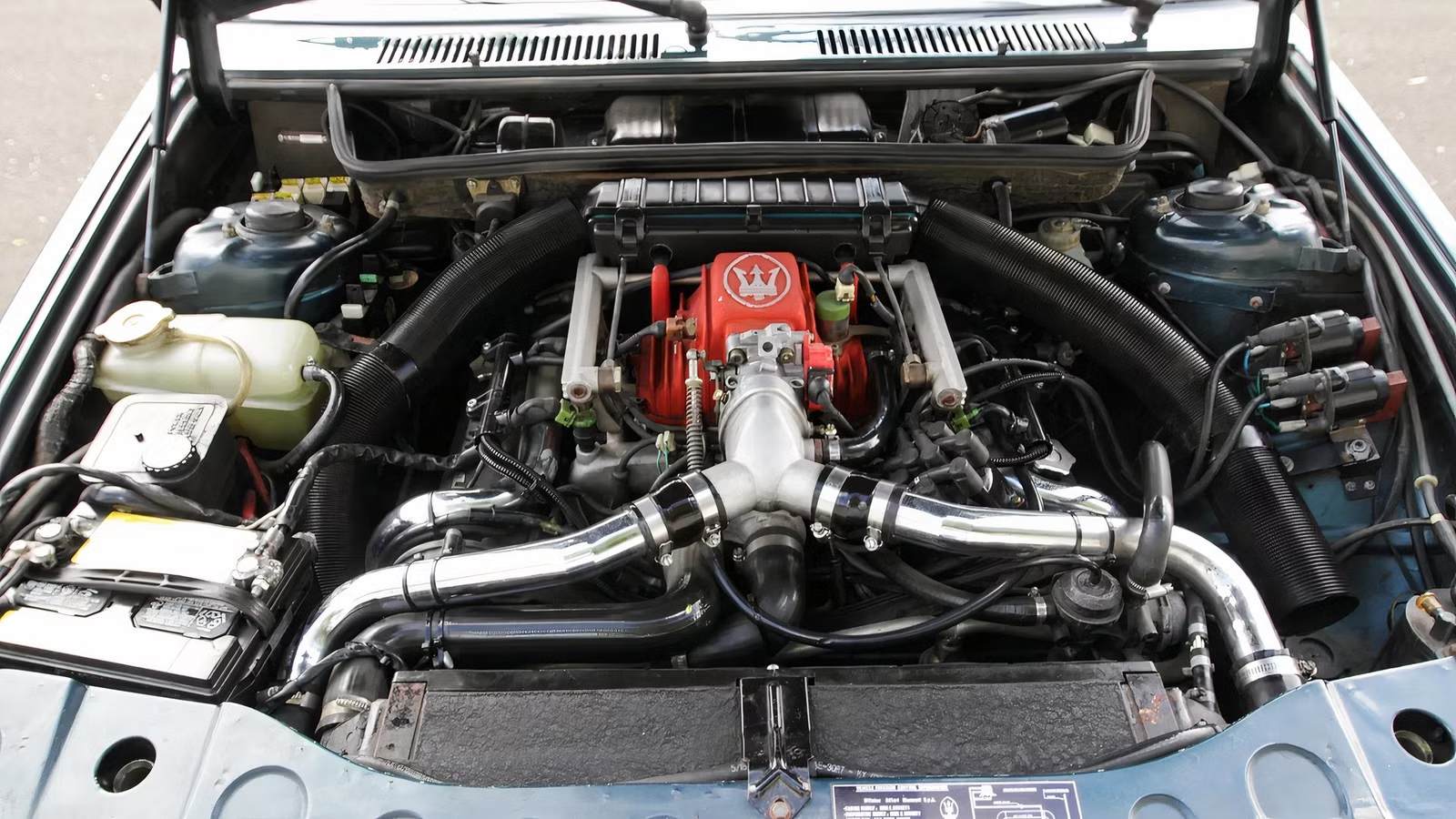
Twin turbochargers are everywhere now — tucked under the hoods of family crossovers, diesel saloons, and six-figure supercars alike. It’s easy to forget that the technology was once genuinely radical, the kind of engineering that made headlines and turned heads at motor shows. Yet the car that introduced twin-turbo power to the production world can still be bought today for less than many used economy cars, and it carries one of the most storied badges in automotive history. Back in the early 1980s, turbocharging itself was still considered exotic, reserved for high-performance models from Audi, Porsche, BMW, and Saab. Twin-turbo setups were virtually nonexistent. One manufacturer defied convention by introducing a twin-turbocharged car in 1981, years before any competitor adopted similar technology.

The brand responsible was obscure to many, and the car paired angular styling with genuine supercar engineering. Today, these pioneering machines sell for remarkably little — often comparable to a used Ford Focus. Ownership, however, demands a tolerance for the challenges that accompany rare and complex vintage machinery.
Why One Turbo Wasn’t Enough Anymore
In the 1970s, tightening emissions regulations and the fallout from the oil crisis forced automakers to find new ways of extracting more power from smaller engines, and turbochargers offered an elegant solution. Early systems, however, came with a frustrating drawback. Large single turbochargers needed time to spool and build boost, creating noticeable turbo lag that made power delivery unpredictable and occasionally dangerous. Engineers soon realized that splitting the workload between two smaller turbochargers allowed each unit to spool faster, sharpening throttle response while preserving the performance enthusiasts demanded.

As with many automotive breakthroughs, racing got there first. Porsche proved the idea was a winner with the 1977 evolution of its 936 endurance racer, and by the close of the 1970s, twin turbos had demonstrated they could offer a better blend of responsiveness and outright speed than many contemporary single-turbo setups. Surprisingly, though, it wouldn’t be Porsche or Ferrari that first brought twin-turbo technology to the showroom. The honor went to a far less obvious name.
The Maserati Biturbo Was The First-Ever Twin-Turbocharged Production Car

Specs
|
Engine |
Horsepower |
0-60 MPH |
Top Speed |
|---|---|---|---|
|
2.0-Liter V-6 |
180 HP |
6.5 Seconds |
134 MPH |
In the ’60s and ’70s, the Italian firm Maserati carefully made its name by producing exquisite sports cars. Thanks to models such as the Merak, Bora, and Ghibli, the brand stood alongside Ferrari and Porsche as a quintessential performance car manufacturer. Some would argue the name ‘Maserati’ sounded even more evocative. It was a name you could mutter down the Casino de Monte-Carlo in between hands of blackjack, and people would know you had discerning taste rather than being one of the nouveau riche.
Maserati Decided It Didn’t Need Its Exotic Reputation In The ’80s

As the 1980s began, Maserati owner Alejandro De Tomaso shifted the company’s direction. Rather than concentrate solely on exotic supercars, he aimed to broaden the customer base with a more accessible model. Designer Pierangelo Andreani, known for the Fiat Ritmo and later the Fiat Chroma wagon, was tasked with creating the Biturbo.

The new car abandoned flowing curves and wedge profiles in favor of a boxy three-box shape. Its angular styling bore some resemblance to the contemporary E30 3 Series, which would eventually produce the celebrated M3. The Biturbo marked a turning point for Maserati and remained central to the lineup in various forms until 1994.
Boxy Styling Meets Pioneering Tech

The boxy body style was very much a product of its era — not unlike Audi Coupes and Lancia Deltas — and while not unattractive, it didn’t really live up to the haute couture supercar image that Maserati’s brand had cultivated for years. That is, until you looked under the bonnet.

Here was an engine as cutting-edge as it was exotic: a compact 1,996cc V6 with not one but two turbochargers, at a time when Audi had just wowed the world with its groundbreaking Quattro, which itself featured only a single turbocharger. The Biturbo’s pioneering powertrain was matched to a luxurious interior to create what Maserati hoped would be an everyday car.
A Closer Look At The Biturbo’s Unique Engine

The Biturbo was launched in December 1981. Its engine was a new, compact 90-degree V6 that drew breath through two small turbochargers — a world first on a production car and well ahead of its time.
The original Biturbo used a 2.0-liter six-cylinder with three valves per cylinder (two intake, one exhaust), a single overhead camshaft, and two turbos. The parallel twin-turbo arrangement meant both units worked together, with each serving its own cylinder bank. The thinking was straightforward: two smaller turbochargers spool up faster than one larger unit, reducing the turbo lag that plagued many early forced-induction cars.
The Biturbo Doesn’t Have Much Power, But It’s Still Quick

At this point, you might assume that — much like today’s downsized turbocharged engines — this was a clever way to generate both power and fuel efficiency. You’d be slightly wrong on both counts. The V6 twin-turbo produced 180 horsepower at 6,000 rpm, but with just 2,394 lbs to haul around, that was enough to reach 60 mph in 6.5 seconds and hit a top speed of 134 mph. Official economy figures are hard to pin down, but when one well-known magazine tested a later 2.5-liter Biturbo, it managed just 11 mpg.
In 1983, the more powerful Biturbo S arrived, featuring twin intercoolers made visible by two NACA air ducts on the hood. By 1986 and 1987, both models gained fuel injection, becoming the 187-horsepower Biturbo i and the 220-horsepower Biturbo Si. Two displacement variants were offered: a 1,996cc version for the domestic Italian market — which sidestepped a VAT surcharge on engines over 2.0 liters — and a 2.5-liter, and later 2.8-liter, version for export.
The Maserati Biturbo Was A Hit

The Biturbo steered Maserati away from exotic grand tourers and toward something closer to BMW’s market segment. Contemporary reviewers flagged handling challenges, yet the model sold well and introduced the brand to an entirely new audience. Its inviting interior appointments helped draw in customers who had never previously considered the marque.
A Spyder variant followed, developed by Zagato on a shortened wheelbase — Maserati’s first convertible since the Ghibli Spyder more than a decade earlier. The platform later evolved into performance-focused derivatives including the Ghibli and Shamal during the 1990s.
Production reached approximately 38,000 units over twelve years, with more than 5,000 sold in the United States. Maserati spent subsequent decades rebuilding its sporting reputation through models including the Coupé, GranTurismo, GranCabrio, and the MC20.
Why The Maserati Biturbo Earned A Bad Reputation

It’s impossible to talk about the Maserati Biturbo without addressing the elephant in the room: its infamous reputation for unreliability. Over the years, the car became almost as well known for mechanical headaches as it was for pioneering twin-turbo technology. In truth, though, it was the earliest cars that earned that stigma. Carbureted models were plagued by hot-start issues caused by their blow-through Weber carburetor, while owners also battled oil coking in the turbochargers if the engine wasn’t allowed to cool properly after hard driving, persistent rust, corroding electrical connectors, and a Salisbury limited-slip differential that could lock abruptly and catch drivers off guard.
Some early teething troubles were perhaps inevitable for the world’s first production twin-turbo car, but Maserati compounded the problem by rushing the Biturbo to market and cutting costs in a bid to rescue the struggling company. The marque responded with continuous improvements, most notably replacing the troublesome carburetor with electronic fuel injection, introducing Nikasil-coated cylinder liners, and swapping the Salisbury differential for a smoother Sensitork limited-slip unit.

Those revisions transformed the Biturbo into a far more dependable car, but the damage had already been done. By the time Maserati had turned the Biturbo into a polished luxury performance machine, many buyers had already moved on — helping explain why these pioneering cars remain such bargains today. The reputational harm was severe enough that Maserati withdrew from the U.S. market after the 1990 model year, remaining absent for more than a decade before returning in 2002.
The Maserati Biturbo Is A Twin-Turbo Bargain Today

Maserati Biturbo Prices In 2025 (Good Condition)
- 1984 Maserati Biturbo Base – $4,900
- 1985 Maserati Biturbo – $4,900
- 1987 Maserati Biturbo – $5,200
- 1989 Maserati Zagato (Spyder) – $13,800
- 1991 Maserati Biturbo – $13,800
- 1992 Maserati Zagato (Spyder) – $15,000
Given its groundbreaking engineering and prestigious badge, it may come as a surprise that the Biturbo is a genuine used-car bargain. Early carbureted models are typically the cheapest. An early 1984 Maserati Biturbo in good condition is valued by Hagerty Valuation Tools at just $4,900 — roughly the same as a well-worn economy car. Later fuel-injected models command a healthy premium, while the stylish Zagato-built Spyders have the highest prices.
A quick glance at Bring a Trailer auction results from the past few years shows that Hagerty’s estimations aren’t far off. Several coupes have sold for well under $10,000 in recent years, including a carbureted 1985 example that sold for $6,000 in December 2025. While some Spyder versions have also sold for less than $10,000, most traded for between $10,000 and $20,000, with pristine units fetching more than that. The most expensive Biturbo sold on the platform is a Swan White 1990 Maserati Biturbo Spyder i with just 9,000 miles on the odometer, which sold for $30,500 in 2022.
History hasn’t always been kind to the Biturbo, but time has a way of changing perspectives. Considering its status as the world’s first production twin-turbocharged car, it’s difficult to think of another landmark performance car that offers as much historical significance for so little money.
Sources: Hagerty.com; Hemmings.com; Maserati.com, Bring a Trailer

Related posts



Latest Post


No Comments