
Audi Q4 e-tron review – first drive
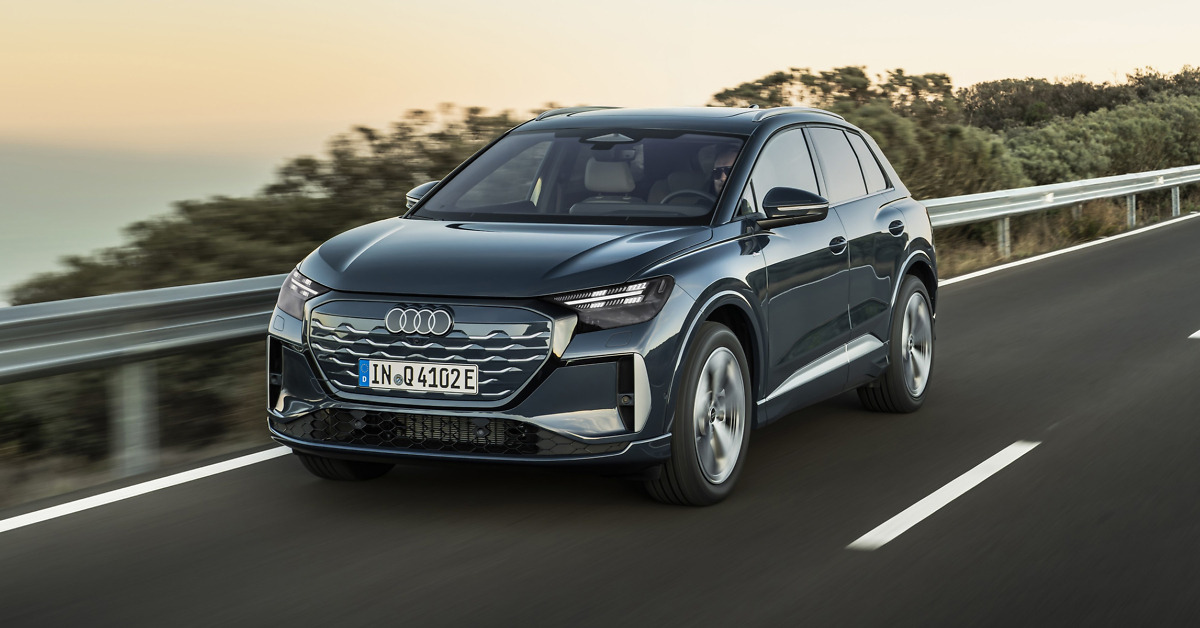
Make and model: Audi Q4 e-tron
Description: Small electric SUV
Price range: from £46,260 to £68,660 (before options)
Summary: There’s a new Audi Q4 e-tron, but should you upgrade? I can’t help but feel that you’d need to be a dedicated Audi buyer to consider it over some of its cheaper opposition.

For a broader ownership picture, see our Audi Q4 e-tron Expert Rating, which combines media reviews, safety data, reliability, running costs and warranty cover.
Launched in 2022, the Audi Q4 e-tron strengthened Audi’s electric SUV range as a compact EV positioned below the Q5. Despite its smaller footprint, it offered impressive interior space and a real-world range close to the official 300-mile figure.
Its blend of practicality, efficiency and premium appeal helped make the Q4 e-tron Audi’s best-selling electric car for the next five years.

The facelifted variant is an improvement, but there are still a few things that require refinement.
Price and equipment
The range kicks off at £47k with the ‘Sport’, where buyers can expect an Audi sound system, fabric seats, dual smartphone charging, high beam assist, air conditioning, and ambient lighting as standard.
Next is the £49k ‘S line’, which adds privacy glass, front sport seats, sportier exterior styling, sport suspension (lowered by 15mm), and stainless-steel pedals.
Spend an extra £3k, and you can have the ‘Black Edition’. In addition to the ‘S line’, buyers get black exterior styling and leatherette sports seats. And finally, there’s the £59k ‘Vorsprung’, adding matrix LED headlights, a panoramic sunroof, a 12-inch front passenger display, upgraded audio, parking assist and a heads-up display.
However, curtain centre, front, and rear side airbags are £350 extra, as is the £1k heat pump. Fully specced, your Q4 e-tron will cost around £74k. That’s a lot.
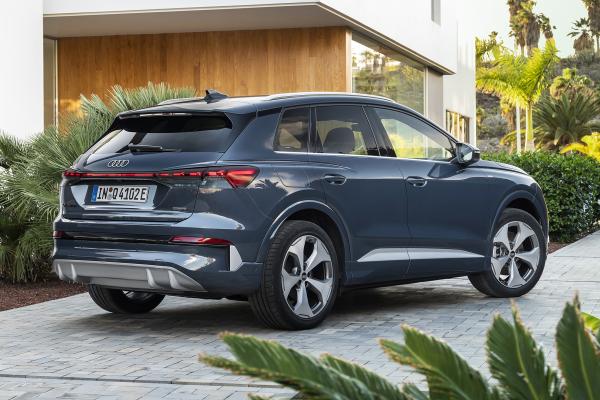
Inside the car
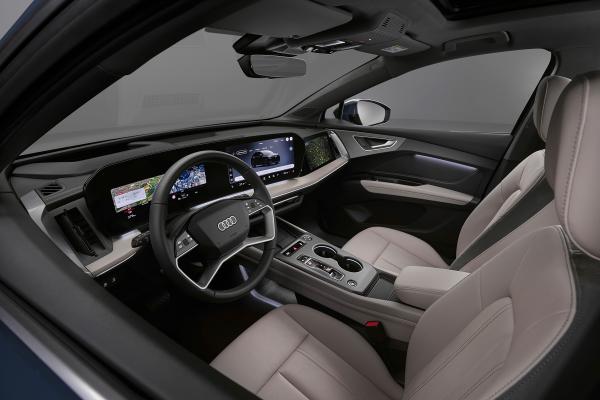
Like many modern Audis, the Q4 e-tron follows the brand’s minimalistic design. The gear selector is a tiny button that’s flicked forwards or backwards, then there’s the iPod-like infotainment controller and the Audi Drive selector, allowing you to switch between the car’s drive modes.
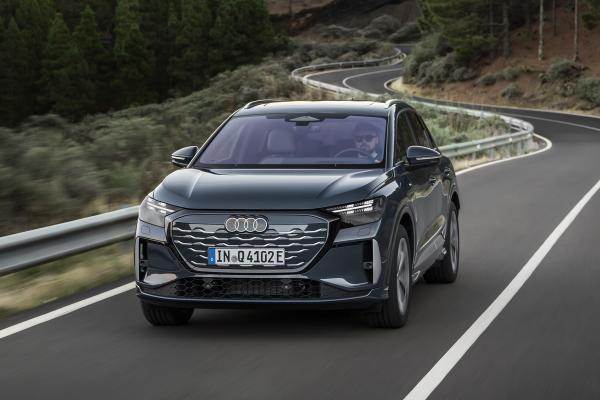
The steering wheel is square, like the Austin Allegro’s, and you’ll be constantly wiping fingerprints off the interior plastics. However, the e-tron’s interior is packed with deep cubbies for storing water bottles and wallets — and the infotainment is better than that found on the previous model.
However, the Audi Q4 e-tron’s steering wheel is plagued with Volkswagen Group’s haptic controls; you’ve no idea what you’re pressing without looking, and they proved problematic during our testing.
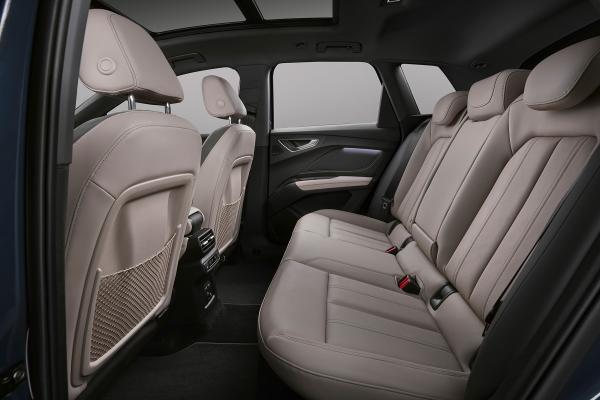
Material quality falls short in places, and you won’t need to look far to find scratchy plastics; some of the plastics in our test car were even mismatched. However, the Audi is roomy, and there’s lots of underfloor storage — ideal for stashing the charging cable.
Driving range and charging
The entry-level model gets a 63kWh battery – Audi claims it will return 273 miles for the SUV and 280 miles for the Sportback coupé-SUV version. Other trims get the 82kWh battery, returning between 336 miles and 367 miles, depending on powertrain and body style.
That said, if you want a balance of performance and range, we’d recommend the RWD ‘performance’. There’s also the ‘quattro’ if four-wheel drive is a must, though you’ll sacrifice some range. As for efficiency, our ‘Sport’ returned about 3.8 mi/kWh.
As for charging, the performance and quattro variants will charge at 165kW, meaning you’ll be waiting around half a hour for a 10% to 80% charge. The range-topping e-tron ‘quattro performance’ charges at 185kW, lopping about two minutes off the charge time. Charging from empty to full via a home 7kW wallbox takes around 13 hours.
Then there’s the bi-directional charging feature. This draws power from your home’s solar panels (if it has any) to charge the car, then feeds any excess power back into your house at night to reduce bills.
On the road
We tested the standard 204hp and the pokier 286hp performance model. Both don’t feel miles apart regarding straight-line punch; the performance model manages 0-62 mph in 6.6 seconds, while the standard car takes 8.1 seconds. Both are equally fun to chuck around a back road.
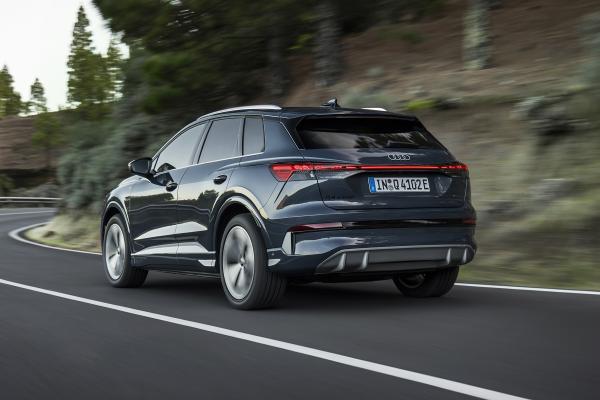
Usually, opting for larger alloy sizes results in a harsher ride, but the Q4 e-tron feels incredibly composed on both the 19- and 20-inch alloys. The car also feels easy to position on the tarmac, thanks to its high driving position and large windows and mirrors. As before, the Sportback’s rear visibility is obstructed by the window-mounted spoiler.
It’s fast enough, comfortable, offers solid range, and charges quickly—but its brakes are a significant weakness. These are soft and spongy, yet another issue plagued by the previous MEB platform VW cars. This alone undermines the car’s driving-dynamics improvements; you shouldn’t need to press the brake pedal that far when slowing from 70mph.
Verdict
The Q4 e-tron faces stiff competition from rivals such as the Hyundai Ioniq 5, Skoda Enyaq, BMW iX2 and Tesla Model Y. In many respects, these alternatives offer better value for money than the Audi.
While the Q4 e-tron improves on its predecessor in several key areas — including a more user-friendly touchscreen, updated colour options, improved interior quality, and a broader choice of trims and powertrains — it still struggles to justify its price against some competitors.
For example, a range-topping Skoda Enyaq ‘SportLine 85X’ costs around £49k and delivers a claimed range of 342 to 360 miles. It also achieves an efficiency of around 3.8 to 4.0 miles per kWh, making it a compelling alternative for buyers seeking both practicality and value.
The Audi Q4 e-tron is far from bad, but I can’t help but feel that you’d need to be a dedicated Audi buyer to consider it over some of its cheaper opposition.
We like:
- Easy to drive
- Physical switches
- Roomy
- All variants are powerful enough
- Decent handling
- Lots of storage
We don’t like:
- Controversial looks
- Spongey brakes
- Touchscreen slow at times
- Questionable material quality in places
- Can become get expensive compared to rivals
Similar cars
BMW iX3 | BYD Atto 3 | Citroën ë-C4 | Ford Mustang Mach-E | Hyundai Ioniq 5 | Kia EV6 | Lexus RZ | Mercedes-Benz EQA | Nissan Ariya | Polestar 2 | Skoda Enyaq | Subaru Solterra | Tesla Model Y | Toyota bZ4X | Volkswagen ID.4 | Volkswagen ID.5 | Volvo XC40 Recharge
Key specifications
Model tested: Audi Q4 e-tron Sport
Price as tested: £46,260
Powertrain: Single electric motor, rear-wheel drive
Gearbox: Automatic
Power: 204 hp
Torque: 310 Nm
Top speed: 99 mph
0-62mph: 8.1 seconds
Battery range (combined): 273 miles
CO2 emissions: 0 g/km
Euro NCAP safety rating: Five stars (September 2025)
TCE Expert rating: A, 75% (June 2026)

Related posts





Latest Post


No Comments