
Suzuki GS1000S: The Superbike That Won Two AMA Titles
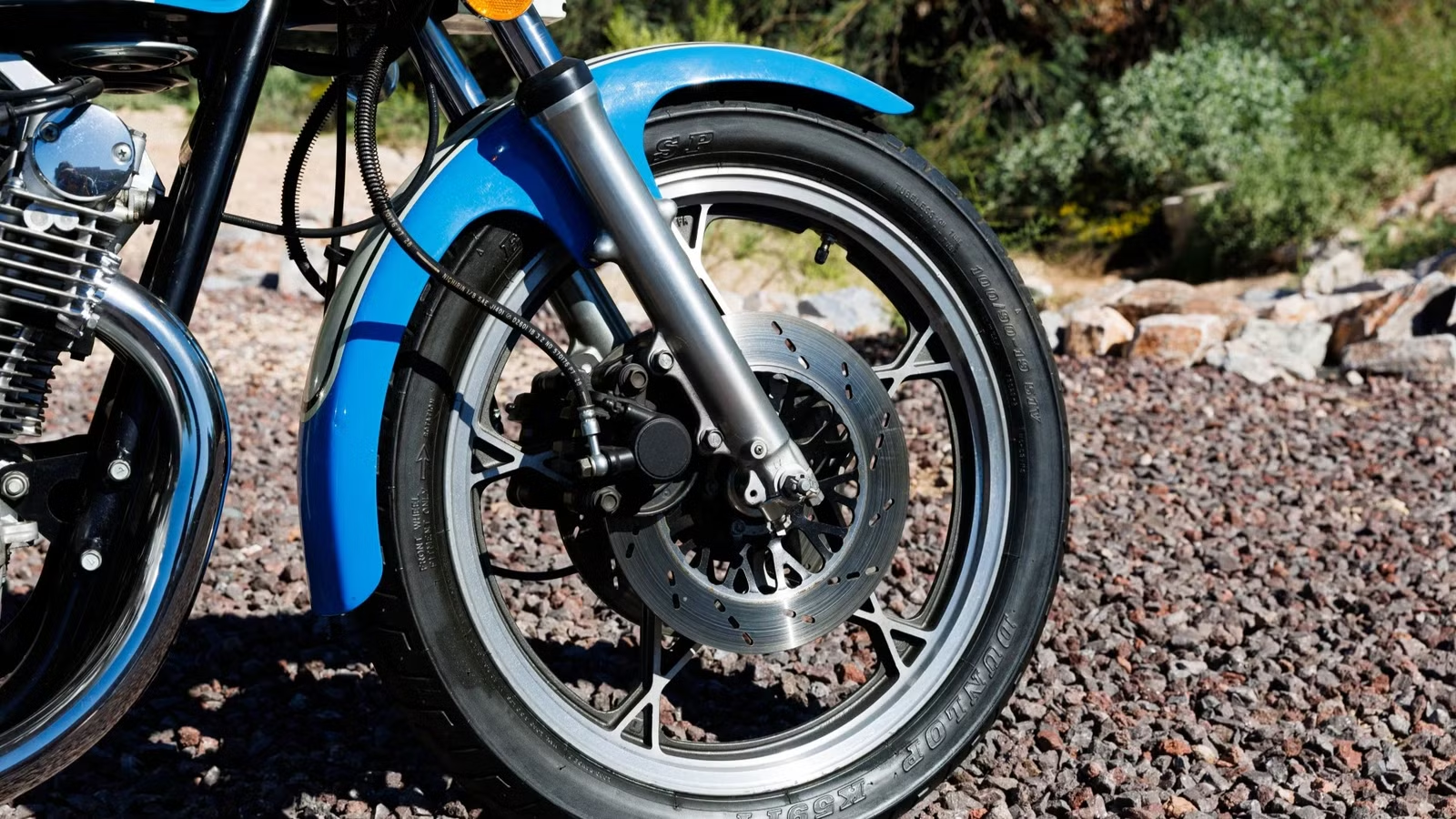
By 1980, Suzuki had been building toward something for three years. A tuner in North Hollywood had taken the company’s platform, figured out what it could do on a circuit, and won in ways that made the factory pay attention. The machine that emerged was already known as the one to beat. What happened at the final AMA Superbike race at Daytona that October tested whether the results would stick.

Three riders had a shot at the title. One won by half a length. Then the protests started, a teammate’s motorcycle entered the record, and an appeal board’s ruling flipped the championship back to where it started. The bike at the center of it has spent four decades in the shadow of a machine that hadn’t been built yet.
The Championship That Nearly Got Stolen in the Paddock
The early AMA Superbike series was a rough draft for what the class would eventually become. Machines were production-based but barely, with rules loose enough that the factory-supported efforts from Yoshimura Suzuki, works Honda, and Kawasaki all pushed well past the sport’s own technical limits. What that environment produced was racing that felt genuinely dangerous and unpredictable, contested by a generation of American riders who had come up through club circuits and had no particular interest in riding smoothly. The style that defined the era was all rear-wheel slides and ragged exits, horsepower overwhelming chassis on every corner, and the fastest men using aggression as a handling solution.

The championship fight of 1980 was the moment the class became something people paid attention to. Lawson, Spencer, and the Yoshimura Suzuki rider were three riders with three different machines and three entirely different approaches to making a motorcycle go fast. The season went the full distance, and the finish produced a controversy that ended up in front of an AMA appeal board before it was settled. What it also produced was a set of racing results that should have guaranteed the winning machine a permanent place in the sport’s origin story. Instead, what followed was five years of diminishing attention, a crash that ended the career of the man most associated with the bike, and the arrival in 1985 of a machine that made everyone forget what had come before it.
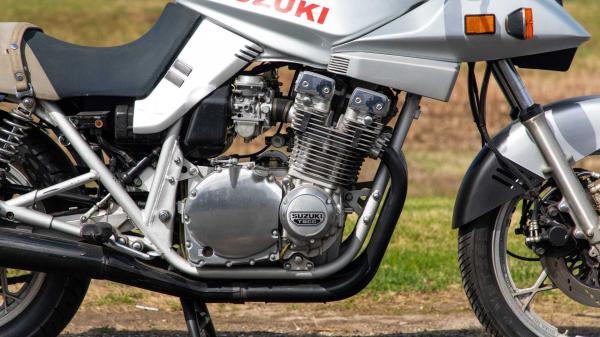
The German-Designed Japanese Superbike That Was Briefly The Fastest Production Bike On Earth
This bike was radical, divisive, and incredibly fast — and for a brief window, no production motorcycle on earth could touch it.
A 500-Unit Street Bike Built to Win Races Its Rivals Could Not Contest

The production machine that underpinned the championship effort had started life as a European market proposition, a sporting variant of a platform that had already proven itself capable enough to embarrass larger-engined rivals in independent tests. American Suzuki dealers saw it at an industry event, recognized immediately what it would mean to the market, and pushed hard enough that a limited allocation was released to the US. The supply was tight by design, roughly one example per dealer in the first year, which meant the bike’s reputation spread faster than the bikes did. Its livery was a direct lift from the race team’s color scheme, which is how a street motorcycle sold to civilians came to carry the identity of a championship effort it was too new to have actually won.
The chassis beneath the livery was the real argument. Yoshimura and rider Wes Cooley had switched from Kawasaki to the Suzuki platform for the 1978 season specifically because the frame was better. The Kawasaki’s handling had been a constant liability, a machine that got faster as you slowed your inputs, which is not a condition most riders find useful at race speeds. The Suzuki gave Cooley something he could push, and what he and Yoshimura built on top of that foundation won at Daytona, won the inaugural Suzuka 8 Hours endurance in Japan, and won back-to-back AMA Superbike championships. The street bike that referenced all of that came with rearset footpegs, superbike-spec handlebars, and a bikini fairing that telegraphed exactly what it was built to do. It was never officially marketed as a race replica. It didn’t need to be.
The Suzuki GS1000S Was the Yoshimura Origin Story American Dealers Almost Never Got

|
Model |
Engine |
Power |
Torque |
0-60 mph |
Top Speed |
|---|---|---|---|---|---|
|
1979 Suzuki GS1000S |
1.0-liter inline-four |
90 hp |
58 lb-ft |
~3.5 sec |
130 mph |
|
1979 Kawasaki KZ1000 |
1.0-liter inline-four |
83 hp |
59 lb-ft |
~3.8 sec |
132 mph |
|
1979 Honda CB900F |
0.9-liter inline-four |
94 hp |
57 lb-ft |
~4.0 sec |
135 mph |
The bike at the center of the 1980 title fight was the Suzuki GS1000S, and Wes Cooley was the rider who won that championship on it. Approximately 500 examples reached the US in 1979, and roughly 700 followed in 1980, one for every Suzuki outlet in the country. Its 997cc air-cooled DOHC inline-four produced 90 horsepower at 9,000 rpm, it weighed 524 pounds dry, and its top speed was estimated at 130 mph. Those numbers placed it in range of its key competitors on paper. What separated it was not what the engine produced but what the chassis allowed the rider to do with that output.
Cooley’s championship titles in 1979 and 1980 on the Yoshimura-tuned version of this platform gave the GS1000S an association with winning that no amount of advertising could have manufactured. Steve McLaughlin had won Daytona in 1978 on the same platform, and the team swept the Daytona Superbike podium one-two-three in 1979. At Suzuka, Cooley and Mike Baldwin won the inaugural 8 Hours endurance race in 1978. Cooley and Graeme Crosby won it again in 1980. What was being sold to American buyers in blue-and-white livery was, as closely as street regulations permitted, the machine behind all of that. Suzuki never called it a Wes Cooley replica. The market made that connection without any help.
The GS1000S Chassis That Put Handling Before Horsepower

The GS1000S arrived with a specification package that prioritized handling over outright performance figures. The rearset footpegs moved the rider’s weight further back and raised the knees into a more aggressive tuck. The superbike-spec handlebars replaced the standard GS1000E’s more upright setup, tightening the riding position for sport use. The bikini fairing offered modest wind protection and gave the bike its visual connection to the race team’s machines. Underneath all of it was a chassis engineered by Suzuki’s Hisashi Morikawa with thin-walled mild steel tubing, a heavily gusseted steering head, and a swingarm that period road tests found beefier than anything fitted to a Japanese big bike of the era. On a circuit, where the Kawasaki KZ1000’s flex and imprecision had driven Cooley and Yoshimura to switch manufacturers, that solidity translated directly into lap times.
The KZ1000 had more displacement and comparable output on paper, but the Kawasaki’s chassis handling deficit was well documented by the time the GS1000S arrived. Cooley had described it plainly: the harder you pushed, the worse it got. The Honda CB900F made more power at the crank and matched the Suzuki’s top speed, but it arrived in the US market in 1981 and 1982, making it a later entrant in the class the GS1000S had already defined. What the numbers in the table don’t capture is the weight of the GS1000S’s racing context. The rivals were fast motorcycles. The Suzuki was a fast motorcycle with a championship embedded in its paint scheme.
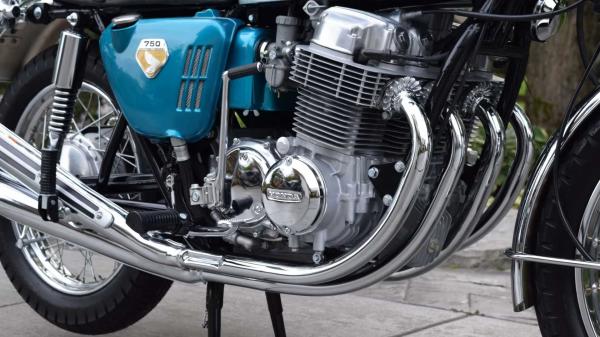
The Honda Motorcycle That Secretly Birthed The Superbike Era
Before superbikes became a category, Honda built the machine that changed everything forever.
Suzuki GS1000S Values: What the Auction Market Pays in 2026

|
Model |
Driver |
Good |
Excellent |
Top Result |
|---|---|---|---|---|
|
1979-80 Suzuki GS1000S |
$5,000–$9,000 |
$13,000 |
$19,500 |
$19,500 |
|
1979 Kawasaki KZ1000 |
$4,000–$7,000 |
$8,000–$12,000 |
$14,000–$18,000 |
$22,000+ |
The GS1000S market reflects exactly the tension between rarity and recognition that tends to define bikes from this era. A 5,000-mile Ohio example sold for $13,000 at auction in July 2025, and a 639-mile modified example reached $19,500 at Mecum in January 2025. Driver-quality and high-mileage examples sit in the $5,000–$9,000 range. The 500-unit US import figure for 1979 means supply is genuinely constrained at the top end, but the bike has not yet attracted the collector premium its significance would imply. That gap is closing.
The comparison with the KZ1000 is worth noting. The Kawasaki was produced in far greater numbers and has a large and active restoration community, which keeps supply higher and prices more accessible at every level. A well-sorted KZ1000 in excellent condition changes hands in the mid-teens; a concours example can push into the low twenties. The GS1000S and the KZ1000 trade in overlapping ranges, which understates the Suzuki’s relative rarity. Clean, unmodified GS1000S examples are becoming harder to find, and the ones that do appear are attracting buyers who understand exactly what they are looking at.
The Suzuka Connection That Proves This Was Never Just an AMA Story

Before the GS1000S had ever appeared on a US dealer floor, the platform it was based on had already won the most prestigious endurance race in Asia. Cooley and Mike Baldwin took the inaugural Suzuka 8 Hours in 1978 on a Yoshimura-tuned GS1000, beating a field that included the best factory efforts from every major Japanese manufacturer. That result established Yoshimura’s GS1000 project as something beyond a domestic racing program. The Suzuka 8 Hours was, and remains, one of the reference events in international motorcycle racing, and winning the first running of it put the platform on a global stage that the AMA Superbike series alone could not have provided.
Cooley returned to Suzuka in 1980 with New Zealand’s Graeme Crosby and won it again, making the GS1000 platform the only machine to win both of the first two runnings of an event that would become a World Endurance Championship round. Crosby had also won at Daytona in 1980, further expanding the platform’s international footprint. The two Suzuka victories, bracketing the back-to-back AMA Superbike championships, produced a four-year record that most motorcycle platforms never approach. The machine behind all of it was fundamentally the same one that Suzuki had sold to American dealers in blue-and-white paint and told them to put in the window.
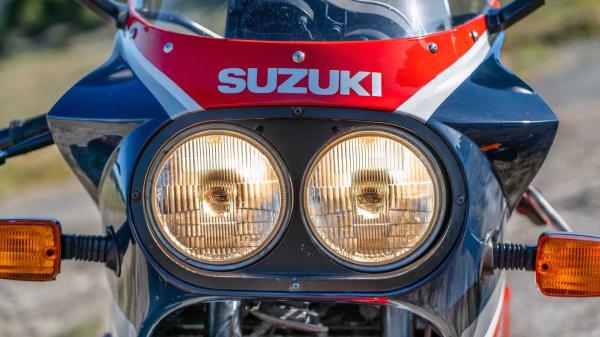
10 Big-Bore Vintage Superbikes Real Riders Worship Forever
These legendary machines from motorcycling’s golden era continue to command massive respect and serious auction money decades later.
The Bike the GSX-R750 Made Everyone Forget

When Suzuki released the GSX-R750 in 1985, it reset every assumption the market had about what a liter-class sport motorcycle should weigh, how it should handle, and what it should look like. The GSX-R was lighter, stiffer, and more visually aggressive than anything that preceded it, and its success was immediate enough that it absorbed all of the institutional memory that might otherwise have attached to the platform it replaced. The GS1000S became a prequel to a story that had already moved on, and the rider most associated with it had been seriously injured at Sears Point in May of that year, ending a career before the new machine arrived to rewrite the narrative.
What that handover obscured is the argument this piece has been building toward: the GS1000S was not the product of Hamamatsu’s engineering department acting alone. It was the product of Pops Yoshimura identifying a platform with the chassis foundation to support serious development, building a tuning program around it, winning with it on two continents, and generating enough commercial pressure that Suzuki had little choice but to put a street version in its catalog. The factory provided the engine and the basic architecture. Yoshimura provided the proof of concept. The GS1000S exists because a private tuner in North Hollywood made the case with race results, not because a product planning committee decided the market needed one. The GSX-R750 is what came after someone else took that lesson and industrialized it. The GS1000S is where the lesson was first written.
Sources: Motorcycle Classics, Classic.com, Mecum.

Related posts
Latest Post


No Comments