
The Forgotten Honda Twin That Made The CB750 Possible Eight Years Early
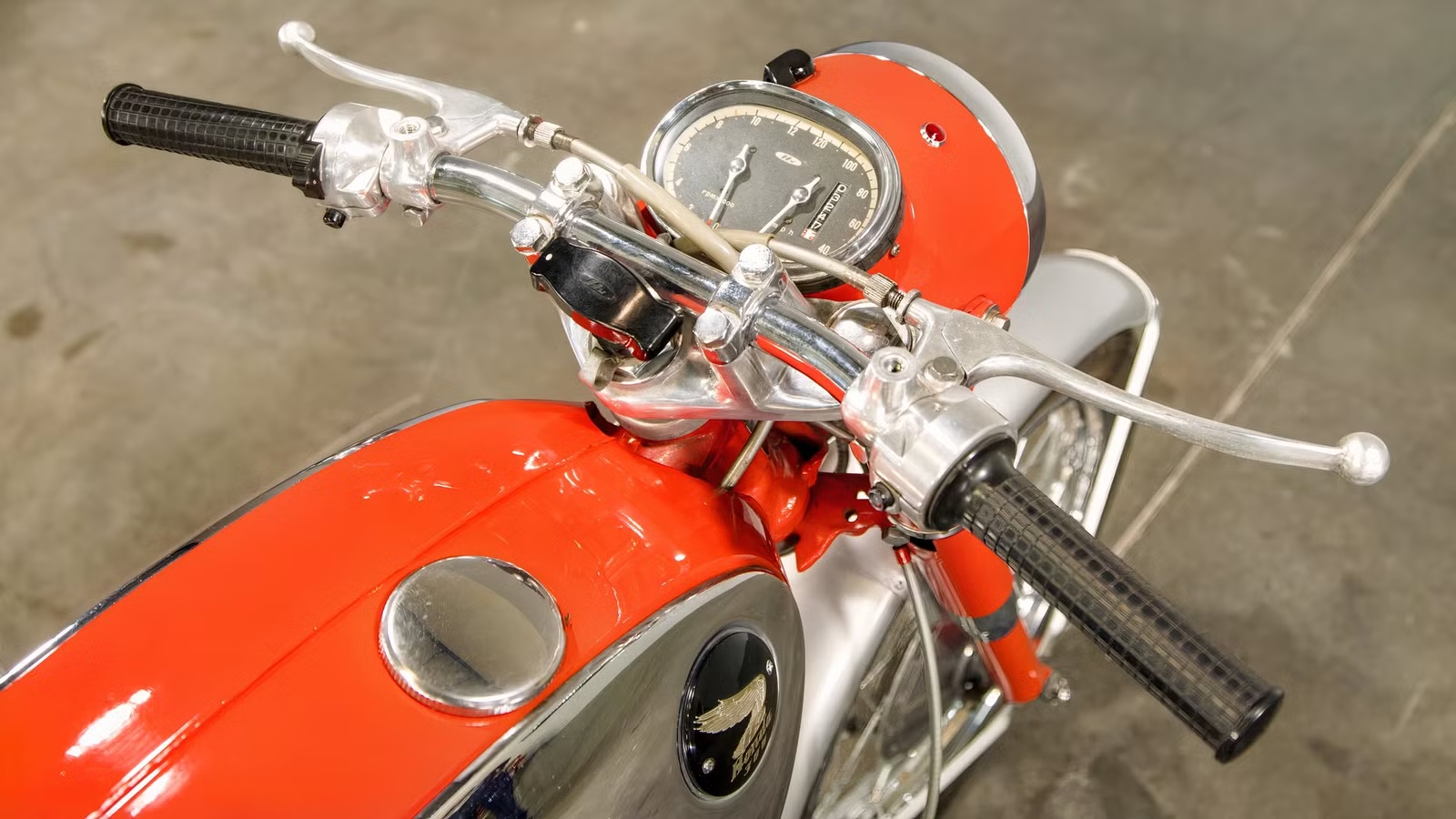
When you think of Honda’s biggest motorcycle legend, what’s involved is four cylinders, sand-cast cases, and the kind of reputation that makes collectors breathe heavily into auction catalogs, which is fair enough. The CB750 earned that treatment. But Honda’s superbike story didn’t start there, and treating it like a sudden miracle skips the smaller machine that quietly built the playbook.

Years earlier, Honda had already figured out the formula: high revs, overhead-cam precision, electric-start convenience, clean engineering, and enough real-world speed to make bigger European bikes look slightly embarrassed.
Honda Was Still Supposed To Build Nice Little Bikes
Think back to the early ’60s; Honda’s image in America was still wrapped around clean, friendly, approachable motorcycles. The company had built its momentum on small machines that started easily, ran neatly, and didn’t leave a little oil signature on the pavement like they were signing the guest book.

That said, Honda wasn’t interested in staying in the polite-commuter corner forever. Behind the friendly face was an engineering company with racing on the brain and revs in its bloodstream. It had already decided that small displacement didn’t have to mean small ambition.
Honda could sell practical machines to new riders, but it also wanted to prove that a Japanese motorcycle could be more than cheap transportation. It wanted road bikes that could chase bigger machines without copying them.
Honda’s Six-Cylinder Motorcycle Vintage Riders Worship
Honda’s wild six-cylinder superbike still stops vintage riders cold.
Bigger European Bikes Suddenly Had A Problem

The old motorcycle hierarchy was simple enough: bigger engine, bigger bragging rights. A 500cc or 650cc European twin carried authority, and a smaller Japanese bike was supposed to, well, know its place. Then Honda began selling a little twin that clearly hadn’t read the room.
The trick was rpm. While many British and German machines still relied on traditional overhead-valve layouts, Honda’s sport twin used an overhead-cam four-stroke parallel-twin engine that loved to spin. Instead of trying to thump its way through the world, it was trying to scythe past it, which is a very Honda answer and, frankly, a lot more fun.
A Shot Of Modernity

It also made daily use feel modern. A 12-volt electrical system, electric start, wet-sump lubrication, and generally oil-tight construction gave it an advantage that didn’t only show up on a spec sheet. Riders got performance without first performing a small religious ceremony involving levers, leaks, and hope.
That combination made the bigger-bike crowd uncomfortable. When a compact Honda twin could run hard, rev high, and keep itself tidy, displacement stopped being the whole story.
The Rare Forgotten Motorcycle That Still Looks The Business
In the 1980s turbo-bike boom, one short-lived Honda mixed wild tech, sharp styling, and a forgotten story that still feels ahead of its time.
The Dream CB72 And CB77 Super Hawk Were The Missing Link

|
Engine |
Power |
Transmission |
Weight |
|
305cc parallel-twin |
28 hp |
4-speed |
345 lbs |
The 250cc Honda Dream CB72 arrived in 1960, and the larger 305cc CB77 Super Hawk followed in 1961. These bikes sit right between Honda’s practical early image and its later superbike reputation. The CB72 lit the idea, but the CB77 gave it the muscle and volume to matter.
The CB77’s numbers still look spicy for the period. Its 305cc parallel twin made 28 hp at 9,000 rpm, and road-test accounts put top speed past 100 mph when given enough room. A 305cc Honda running that hard in 1961 was a proper statement. It beat bigger bikes by beating expectations and refusing to act small.
The U.S. sales split tells the bigger story. Between 1961 and 1966, the 250cc Hawk sold 3,479 examples in America. The 305cc Super Hawk, sold between 1961 and 1969, reached 72,396 units. That makes the CB77 the important one here, because it wasn’t merely an engineering flex. It was the bike that reached riders, funded confidence, and proved Honda’s high-revving road-sport formula had a real audience.
This Twin Already Had Honda’s Superbike Formula

The CB77 Super Hawk’s engine was the heart of the thing, but the rest of the motorcycle wasn’t anything to scoff at. It used a tubular steel frame with the engine as a stressed member, which separated it from the pressed-steel Dream touring models and gave it a sportier, more serious chassis layout.
There were proper sporting details everywhere. The Super Hawk had hydraulic front forks, a swingarm rear suspension setup, large drum brakes, 18-inch wheels, flat bars, adjustable footpegs, and twin carburetors feeding that forward-canted engine. It was compact, and taller riders probably folded themselves onto it like a camping chair, but the intent was obvious.
How The Go-Fast Disease Spreads

The 180-degree crank was another clue. The CB72 and CB77 family offered crankshaft options, and the 180-degree Type I crank was prized for high-rpm use because it produced less vibration at high revs and could deliver more power. That tunability helped make the bikes important in the Japanese racing and aftermarket world, where Hideo ‘Pop’ Yoshimura saw what the platform could become.
Yoshimura’s work with these Hondas helped nurture riders, mechanics, and tuning ideas that fed Japan’s performance culture. Lightened cranks, high-lift cam work, and the search for more power from mass-produced machinery became part of the formula. The Super Hawk was a motorcycle people could buy, race, break, fix, and make faster. That’s basically how the go-fast disease spreads.
The First Mass-Produced Motorcycle To Use A Factory V4 Engine
This engine almost killed the V4 layout entirely, until it was reworked to perfection.
The CB750 Looks Different Once You Know This Bike

The Honda CB750 still deserves its crown. It brought four-cylinder smoothness, big-bike performance, and mass-market sophistication to the end of the 1960s, but it didn’t appear from a vacuum. The CB72 and CB77 had already taught Honda how to sell high-revving road-sport hardware to riders who wanted more than basic transport.
Honda’s middle step makes the connection clearer. The CB77’s popularity helped push Honda toward the 450cc class, where the CB450 arrived with high-revving, high-output technology aimed directly at Europe’s bigger production bikes. American demand then pushed Honda toward an even larger road-sport machine with more relaxed power, and that path led straight to the CB750 Four.
Laying The Path

That’s why the Super Hawk deserves a better seat in Honda history. It didn’t have the CB750’s four-cylinder theater, but it carried the early DNA: overhead-cam thinking, high rpm, modern electrics, real speed, a sport chassis, and the belief that engineering could shrink the gap between classes. Eight years before the superbike label stuck, Honda had already built the little twin that made the big legend possible.
Sources: Honda, Greg Williams, TopSpeed, National Motorcycle Museum, Yoshimura RD.

Related posts

Latest Post



No Comments