
Here’s Why The Cayman Is Called The Poor Man’s Porsche
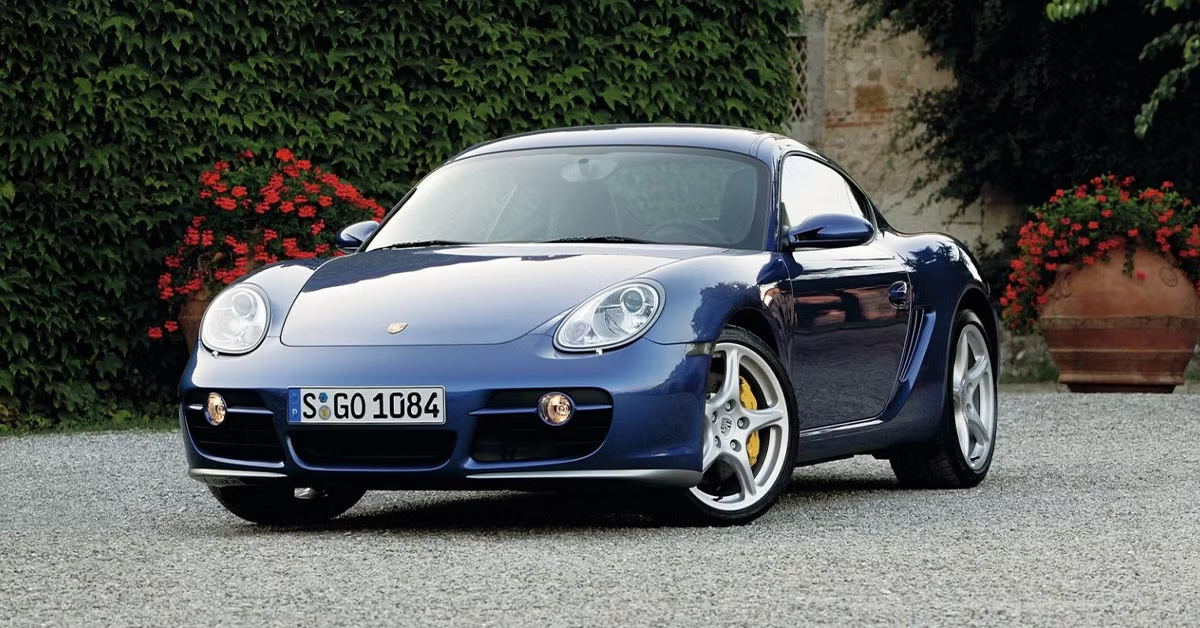
Besides being known for its engineering and automotive heritage, Porsche is also associated with high prices. Historically, there have been several models in the Porsche lineup that are dubbed the “Poor Man’s Porsche” by brand purists because they are considered entry-level models to the brand.

We can talk about the 944, produced between 1982 and 1991, or more recently the Boxster, which in its first-generation reached distributors in 1996 and served as the basis for its “brother”, the Cayman. The Cayman is the fixed-roof sibling of the second-generation Boxster (987). It debuted as the Cayman S at the 2005 Frankfurt Motor Show, with the base model joining the lineup in 2006.

The Origins Of The Cayman
The Porsche Cayman is the coupe version of the third-generation Boxster, the one from 2005, and was presented at the Frankfurt Motor Show that year. It shares most of the elements with the Boxster 987: from the platform to the engine, passing through most of the rest of the mechanics and interior. As with the Boxster, its long body is the work of the Chinese designer Pinky Lai and is inspired by classic Porsche models, such as the 550 from 1953 and the 904 from 1964. These models are perhaps the reason why so many people love Porsche.
Porsche chose the name Cayman for the car’s ease of ‘crawling’ between curves. The assembly of the Cayman was carried out at the Finnish Valmet Automotive plant, where the Boxster was also manufactured.

What Porsche set out to do with the Cayman was to create a more earthy sports car than the flashy and expensive 911 and make the driving experience just as addictive in both models. They achieved such a perfect result that is even called into question the untouchable 911.
To understand why the Cayman is often called the “poor man’s Porsche” we need to put into perspective the price difference between the original Cayman and the 911 of its time. When the base model arrived in 2007, its $49,400 starting MSRP undercut the $72,400 price of a 911 Carrera coupe by nearly $23,000. The Cayman offered a more affordable way into Porsche sports-car ownership without abandoning the brand’s signature flat-six engine and mid-engine layout.
The biggest difference between the 911 and the Cayman is the engine layout. The 911 uses a rear-engine layout while the Cayman adopts a mid-engine layout. In the 911, it is located hanging behind the rear axle while, in the Cayman, the engine is placed in a central position according to the laws of physics that dictate the perfect behavior in a car that is achieved when the heaviest part (the engine) is located within the wheelbase of the vehicle. And this is precisely the main reason the Cayman is dynamically flawless.
The Non-S Cayman

Porsche initially launched the Cayman as an S model in 2006, with the more affordable base version arriving in 2007. Its 2.7-liter flat-six produced 245 horsepower and 201 lb-ft of torque, enough to propel the entry-level coupe from 0 to 60 mph in a factory-claimed 5.8 seconds with the manual transmission. These numbers made this car slower than the S version. Nevertheless, you couldn’t really call it a “slow” car by any means.
There was a considerable price difference between the two versions, which made the Cayman “just plain”, hence the “poor man’s Porsche.” However, in the current second-hand market, they have a very similar value, so it is always more advisable to look for a unit with a 3.4 propeller.
In either of the two variants, the standard equipment is complete: it includes Alcantara and leather upholstery, air conditioning, radio-CD, a retractable spoiler that raises 80 mm if we circulate at over 75 mph.
The Cayman S

The 3.4 six-cylinder boxer engine (M97.21) derives from the 3.2 that equipped the Boxster but with a cylinder diameter greater than 96 mm and the variable valve VarioCam Plus of the 911, which alters the phase and the lift of the valves.
It has dry-sump lubrication with four oil pumps that distribute the lubricant throughout the engine and develops 295 horsepower at 6,250 rpm and 250 pound-feet of torque from 4,400 rpm. Of course, being just behind the seats, it is quite noisy. The six-speed manual gearbox is signed by Getrag. The Cayman S reaches 60 mph in less than 5 seconds.
A Facelift For The Cayman

In 2009, Porsche renewed the image of the Cayman by introducing new bumpers, headlights, taillights. In addition, the 2.7 engine increased its displacement to 2.9-liters, from 245 to 265 horsepower. The 3.4-liter engine gained 25 horsepower to a total output of 320 thanks to the introduction of direct injection.
Another modification brought by the 2009 restyling was the replacement of the outdated optional Tiptronic five-speed gearbox and torque converter with the new seven-speed dual-clutch PDK. The latter is much better for speed and precision and is very suitable for this model; the Tiptronic is slow and penalizes the performance of the engine.
The Original Porsche Cayman Is Still An Affordable Way Into Porsche Ownership

The 987 Cayman deserves a look from collectors seeking an engaging Porsche sports car without spending 911 money. Prices vary between the original 987.1 (2006–2008) and the facelifted 987.2 (2009–2012), with the earlier cars generally offering the cheaper entry point. According to Classic.com, the 987.1 base Cayman with the automatic transmission has a Market Benchmark of $19,823, making it one of the more affordable ways into Porsche ownership. The manual version benchmarks at $24,271, roughly $4,450 more. For those wanting extra performance, the 987.1 Cayman S with a manual transmission carries a $29,650 benchmark.
The facelifted 987.2, built from 2009 to 2012, costs more. Classic.com puts the base automatic at $26,417 and the manual Cayman S at $42,533. Those figures reflect the site’s market benchmarks, not fixed selling prices, so mileage, condition, service records, and specification still matter. Even so, the price spread gives buyers options: the 987.1 offers a more affordable way in, while the 987.2 brings updated hardware for a higher outlay. Either way, the original Cayman remains a tempting way to experience Porsche’s mid-engine magic without paying 911 prices.
The Cayman Evolved From A Poor Man’s 911 Into A Sports Car Icon

The 987-generation Cayman started life in the 911’s shadow, making the “poor man’s Porsche” nickname understandable. Its successor, the 981, began changing that perception when it debuted in 2014 with cleaner styling, improved dynamics, and a stronger lineup of naturally aspirated flat-six engines. Buyers could choose a 275-hp 2.7-liter base model or a 325-hp 3.4-liter Cayman S, while the GTS and GT4 raised the ante to 340 and 385 hp, respectively.
Things took a different turn with the 982 generation, introduced in 2017 as the 718 Cayman. Porsche switched the regular models to turbocharged flat-fours, with the 2.0-liter producing 300 hp and 280 lb-ft and the 2.5-liter Cayman S developing 350 hp and 309 lb-ft. But the 718 range eventually became much more than an exercise in downsizing. At the top sat the GT4 RS, a track-focused weapon packing a naturally aspirated 4.0-liter flat-six rated at 493 hp. Starting at $141,700 for 2022, it cost more than several 911 models, including the Carrera GTS.

That price tag told the story. The Cayman had evolved from the affordable alternative to Porsche’s flagship sports car into a high-performance machine with its own identity, formidable track credentials, and a price that could rival its bigger brother.
Porsche’s Next Cayman Is Going Electric, With 2028 In Sight

The 982-generation 718 Cayman bowed out in October 2025, but Porsche is already preparing its successor alongside a new Boxster. There’s one major catch: Both sports cars are headed toward an all-electric future. Throughout 2026, rumors suggested Porsche might rework the platform to accommodate combustion or hybrid powertrains as EV demand cooled. However, the company has now shut that door, as its newly unveiled strategy lists only electric successors. Porsche Head of Corporate Communications Matthias Rauter also told Motor1 that combustion-powered versions had never been formally confirmed.
Porsche’s newly unveiled Sportwagenschmiede ’35 strategy, announced October 7, 2026, identifies 2028 as the first full production year in which the electric 718 models are expected to contribute to sales, though technical specifications remain unconfirmed. The outgoing 718’s naturally aspirated flat-six flagships may be gone, but their electric successors will carry the Cayman and Boxster names into a radically different era.

Related posts

Latest Post


No Comments