
Tesla’s Flying Roadster Reopens A Question Elon Musk Raised Years Ago: Is This Legal On Public Roads?
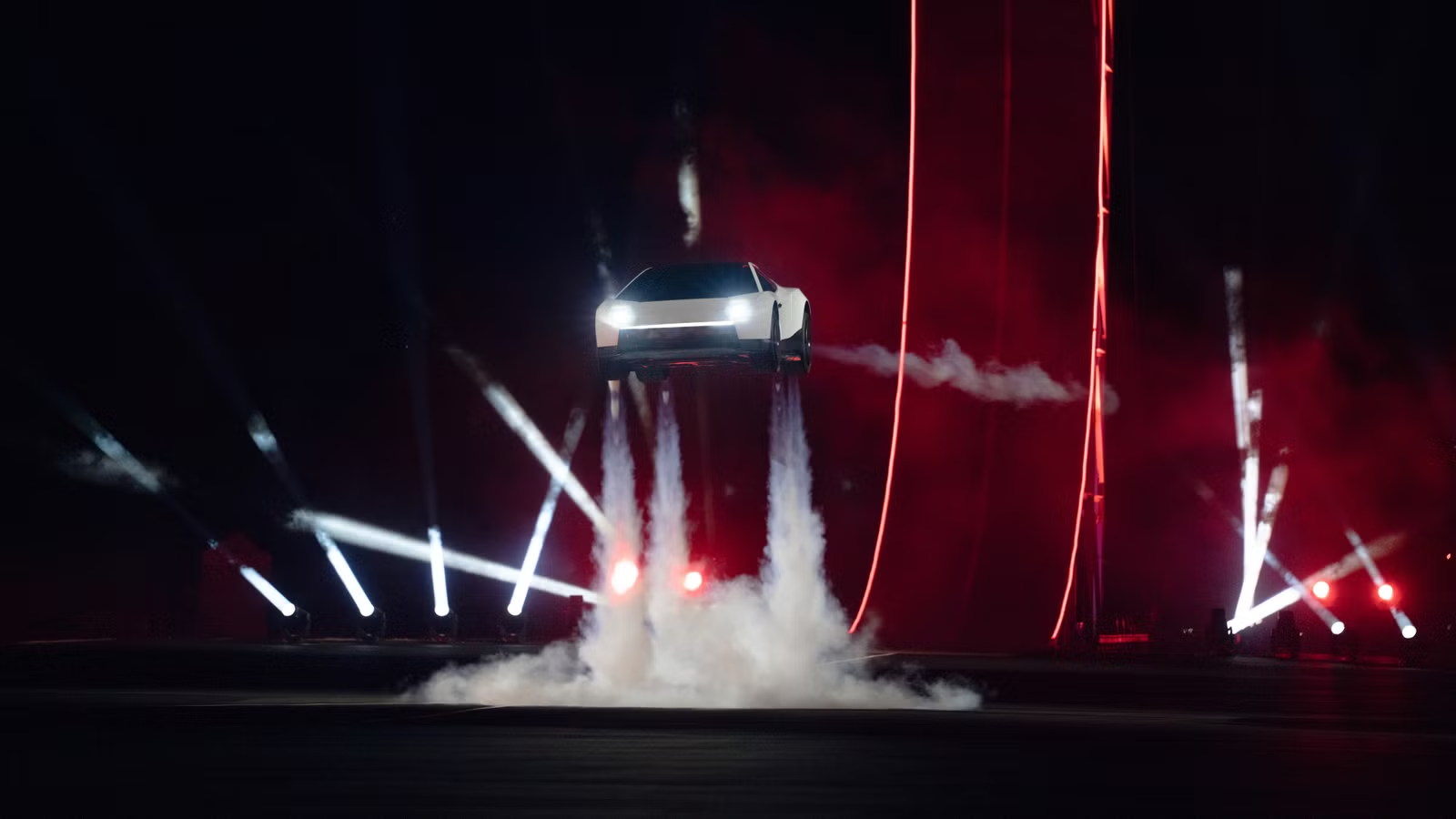
Tesla’s October 16 Roadster reveal at SpaceX’s Waco, Texas facility gave the world something no production car company has shown before: a vehicle that climbs an inverted ramp using suction, launches off the end, flips in midair, and lands under its own thruster power. It cleared a line of parked Teslas, including a semi, on the way down. The demo worked. What nobody at Tesla answered cleanly is whether any of it can ever be legal to drive on a public street.

That gap matters more than the spectacle. Musk himself dodged the question twice during the event, first saying the car would be “an actual car that’s on the roads” before immediately hedging that he wasn’t “necessarily sure it’s legal in all jurisdictions.” When an audience member pressed him directly, he answered, “Depends on your street.” For a company asking buyers to wire up to $250,000 in deposits against a 2028 production date, that’s a strikingly open regulatory question to leave hanging.
Three Trims, Three Very Different Legal Problems
Tesla split the new Roadster into three configurations, and each one carries a different relationship to the law. The Performance trim is described on Tesla’s own site as “road-ready,” seats two, and uses the multi-mode suction fan system without any thrusters at all. That’s the version with the clearest path to a showroom and a VIN.

The Thrust trim adds rear-mounted cold-gas thrusters capable of pushing the car to 60 mph in under a second, but those thrusters are aimed backward for acceleration, not upward for lift. Tesla calls it “race-ready” rather than road-ready, which is itself a tell. The Rocket trim is the one that actually flies: perimeter-mounted thrusters for forward, upward, and lateral rotational movement, a single seat, and a listing on Tesla’s reservation page that says plainly, “Not approved for road use.” It’s invite-only, with no price attached.
Why NHTSA Wasn’t Built For A Car That Leaves The Ground
The National Highway Traffic Safety Administration regulates motor vehicles against Federal Motor Vehicle Safety Standards covering things like crash structure, occupant protection, and lighting. None of that framework anticipates a vehicle designed to briefly become airborne. A car that can perform the kind of lateral rotation Tesla demonstrated in Waco isn’t just an edge case for crash-test protocols; it’s arguably outside the category those protocols were written for.
Tesla’s own event hinted at the tension. Musk told the crowd the Roadster is “not necessarily a safety-optimized car,” a notable admission for a vehicle being pitched, at least in its Performance form, as road-ready. Inside EVs also flagged that the Roadster appears to lack side-view mirrors, a detail that’s already drawing NHTSA scrutiny on Tesla’s Cybercab. A car without mirrors is a federal compliance question on its own, long before thrusters enter the conversation.
The FAA Problem Nobody Mentioned On Stage
If a vehicle can achieve controlled lift and lateral movement off the ground, even briefly, it starts to brush against questions the FAA governs, not NHTSA. Roger Connor, curator for vertical flight at the Smithsonian’s National Air and Space Museum, told CNN ahead of the event that cars and aircraft are fundamentally mismatched engineering problems:
“Aircraft are extremely sensitive to weight, whereas with ground vehicles you want them to have bumpers and crumple zones and all that. Inevitably, something that is a hybrid between the two is going to be a poor-performing aircraft and a poor-performing vehicle.”
Connor was careful to note what the Waco demo actually showed: a hop, not sustained flight. “We’re not talking about sustained flight,” he said. “We are literally talking about hopping.” That distinction may be exactly what keeps the Rocket trim out of FAA airspace jurisdiction for now, but it also means Tesla hasn’t demonstrated anything close to controlled, repeatable flight that a regulator could even begin to certify.
What The Suction System Could Actually Get Approved

Buried inside the spectacle is a piece of hardware with a more plausible street-legal future: the multi-mode suction fan. Tesla’s vehicle engineering chief, Lars Moravy, said the fan system can generate up to 2 g of downforce, strong enough to hold the car to an inverted ramp. On a normal road, that same system is pitched as a traction and cornering aid rather than a stunt mechanism, and it ships standard across all three trims, including Performance.
Unlike the thrusters, a ground-effect fan system doesn’t raise airspace questions or crash-structure conflicts in the same way. It’s a performance accessory, conceptually closer to active aero than to rocketry, and the version of the Roadster built around it alone looks like Tesla’s actual path to a certified production car.
Musk has been saying some version of “excitement guaranteed, success not guaranteed” about this car since 2017, and the Waco event delivered on exactly half that promise. The flips worked. The landing worked. What didn’t happen was any indication that Tesla has started the federal conversations a flying production car would require, or that it’s close to finishing them before 2028. Until NHTSA and the FAA weigh in, the Rocket trim is a demonstration vehicle with an invite-only waiting list, not a car anyone will legally drive to work.

Related posts



Latest Post


No Comments