
The Fastest Car You Can Buy Today For Less Than A New Civic
New cars are expensive, with average prices in the United States hovering around $50,000. Performance cars aren’t escaping the trend, either. Finding a brand-new performance vehicle for $20,000 to $25,000 is increasingly difficult, with something like the Subaru BRZ now requiring a budget in the mid-to-upper $30,000 range.

Inflation isn’t the only factor, as cars have also become more complex. But the used electric vehicle market offers a potential loophole: serious performance for the price of a Honda Civic.
Why Are Performance Cars So Expensive?
Even entry-level new cars now cost more than $20,000, with the Hyundai Venue among the cheapest choices. A Ford Mustang still starts around $32,000, but its range now extends to the $327,000-plus GTD and the $144,000 Dark Horse SC Track Pack.
Performance Cars Demand Serious Premiums

The Toyota GR86 starts at $32,695, below the Subaru BRZ’s $37,055. But other performance models carry much higher premiums. The Honda Civic Type R starts at $48,690, while its Acura counterpart is closer to $55,295. Affordable performance is becoming harder to find.
What $25,000 Gets You In A New Car

We’ve already mentioned what the cheapest car in America is right now. What else does $25,000 get you besides a Honda Civic? From a segment perspective, you’re looking at subcompact SUVs, compact sedans, and entry-level hatchbacks. Right now, these segments include the Chevrolet Trax, the Hyundai Elantra, and the Toyota Corolla. Even so, they’re also edging themselves right on the line of $25,000 and may soon surpass that price. Not a single one of these is priced around acceleration or performance. The Trax comes with a three-cylinder that gets up to 60 MPH in about 9.3 seconds. These are tailored more towards the daily driver that just needs something to get them reliably from A to B.
The Civic Is A Benchmark Car

Since its 1972 debut, the Honda Civic has become a benchmark for affordable, dependable transportation. Its reputation and pricing make it a useful comparison for a used performance car.
In 1996, the Honda Civic had a starting MSRP of $10,350. In today’s money, you’re looking at $22,097. Therefore, if you believe a new Civic is entirely too expensive from a starting price point, it really only got more expensive by $3,000 if you factor inflation into the equation (the 2026 Honda Civic starts at $25,990). For that price, you get a naturally aspirated 1.6-liter inline four-cylinder engine that outputs 106 horsepower and 103 lb-ft of torque. It’s front-wheel drive only and is connected to a continuously variable transmission. Fuel economy is most impressive, with 32 MPG in the city and 41 MPG on the highway. 2026 models also come with an impressive number of features for that price point, including adaptive cruise control, an automatic climate control system, and LED headlights, just to name a few.
New-Car Performance Is Difficult To Find Affordably

Even though the Honda Civic isn’t considered performance, the performance variants are pretty fast. The standard Civic gets to 60 in about 8.9 seconds. Meanwhile, the Hybrid and Si do 6.2 to 6.6, respectively. Both are impressive. This is especially notable compared to the Elantra and Corolla’s 8.1 and 8.4, respectively. The faster of the two, the Sport Hybrid, has a starting MSRP of $30,690 for the sedan. It’s interesting that you have to pay slightly more for the Si, yet get slightly slower 0-to-60 times and even greater efficiency.
The 2018 Tesla Model 3 Performance Is A Wild Card

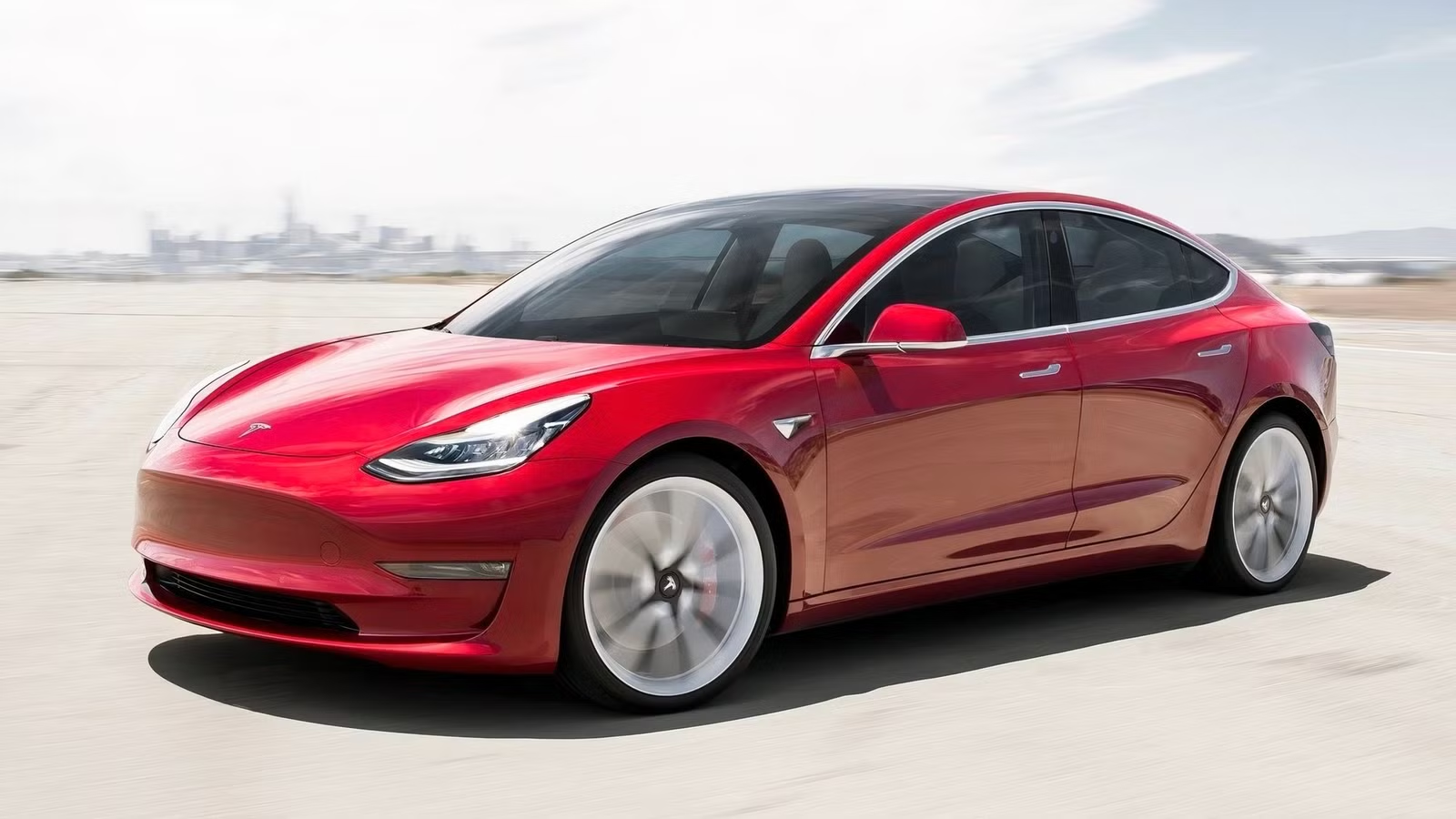
The 2018 Tesla Model 3 is not something that is typically cross-shopped with a Honda Civic. It’s an electric vehicle; it’s considered to be a luxury car, and newer ones have a much higher starting MSRP than the 20-something thousand dollars that you come to expect to pay for a Honda Civic. Not to mention, cross-shoppers who are looking to go fully electric have to decide whether they want to purchase an at-home charger or rely on a charging network instead of going to the pump. Again, it’s not for everyone.
Older Models Fall Well Beneath A New Civic

A brand-new Model 3 Performance easily costs $56,630. This is a far cry, however, from the Tesla Model S Plaid, which is well over the $100,000 mark, but it’s still much more expensive than a Civic. A used one, on the other hand, can easily be found between $18,000 and $20,000. The Kelley Blue Book Fair Purchase price for a 2018 model currently sits right at $20,700. This, however, is dependent on the quality of the vehicle itself and the overall mileage.
0 To 60 MPH In Roughly How Long?
The 2018 Tesla Model 3 Performance can achieve 60 MPH in about 3.5 seconds. The performance is powered by dual electric motors, giving it an all-wheel-drive drivetrain. It has an output of 450 horsepower and a top speed of 155 mph. The Tesla isn’t just “slightly” faster, it’s a supercar compared to the Civic (even though it’s obviously not). When new, it has a range of 310 miles thanks to a 75 kWh battery pack.
What You Give Up For That Speed

Now, we’re not saying drop everything and go buy a close-to-ten-year-old Tesla Model 3 Performance. Everything, especially in the automotive world, comes with its own set of caveats. For starters, even maintenance techs at Tesla wouldn’t suggest buying an EV that has a ten-year-old battery in it. By this point, the 8 year/100,000-mile warranty is coming to a close for these batteries. Therefore, whatever you get, you’ll want an extended warranty, as you’ll probably not want to pay the exceedingly high cost of a brand-new battery. Of course, battery degradation isn’t catastrophic right out the gate.
What You End Up Getting Over The Civic

The battery also loses its ability to charge as efficiently over time, depending on the conditions you live in. Yet, there are a lot of benefits to buying this over, say, a brand-new Civic. You wouldn’t have to pay for nearly as much in terms of maintenance, especially if you have an extended warranty. You also can get a performance car for not nearly as much as, say, a used Corvette or Porsche 911. Even though you’ll have to switch the tires out fairly regularly, brake maintenance won’t be needed as often due to regenerative braking. Again, we recognize this is an odd cross-shop, but it’s one that offers the same in terms of passenger space, cargo space, and overall value. One just has more of a “woo-hoo!” factor than the other.
Sources: Tesla, Honda, KBB

Related posts





Latest Post


No Comments