
The Discontinued Japanese Sports Sedan That Undercuts A BMW M340i By Thousands
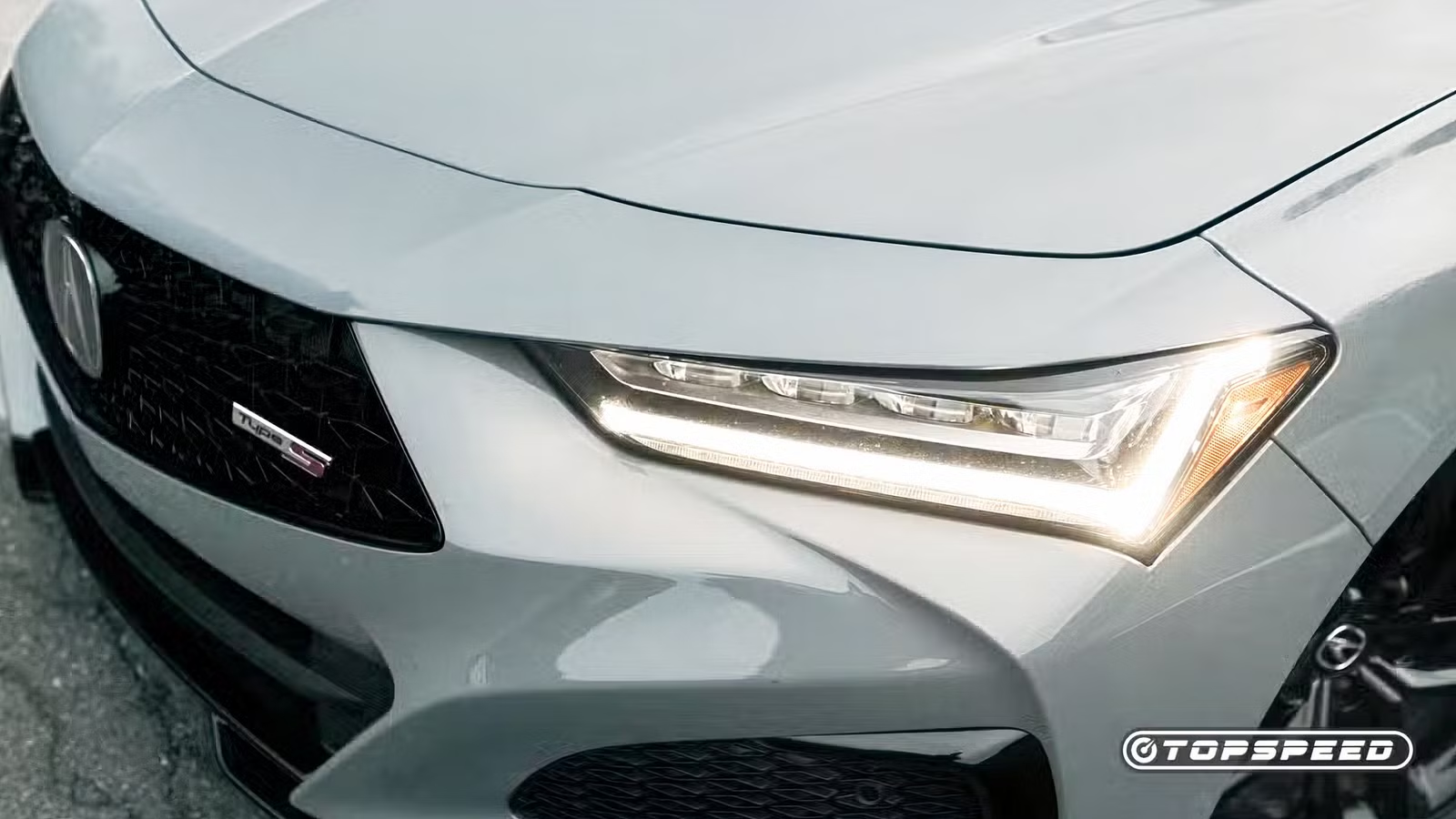
The performance sedan market has never been short on compelling choices, but it has become increasingly expensive. Buyers shopping for a premium all-wheel-drive sports sedan today often find themselves gravitating toward familiar German badges, particularly the BMW M340i and Audi S5. Both deliver blistering acceleration, sophisticated technology, and prestige that remains difficult to replicate. They also come with price tags that continue climbing well beyond what many enthusiasts once considered reasonable.

That reality has created an unusual opportunity in the used and remaining-new inventory markets. One discontinued Japanese sports sedan has quietly emerged as one of the smartest buys available, offering serious performance, premium refinement, and a significantly lower long-term ownership burden than its European rivals. More importantly, its value proposition extends far beyond a lower sticker price.
While many buyers focus on horsepower figures and acceleration times, the real story begins several years into ownership, when warranty coverage expires, and repair costs start to separate seemingly similar vehicles. Suddenly, a few thousand dollars saved at purchase can become many thousands saved over the life of ownership. With production ending in 2025 and inventory becoming increasingly scarce, this overlooked performance sedan may be entering its final chapter just as enthusiasts are beginning to appreciate what made it special in the first place.
The Great Ones Are Never Loved Until They’re Gone

The automotive industry has a habit of recognizing great cars only after they’re gone. For years, enthusiasts largely overlooked Acura’s flagship sports sedan while flocking toward the BMW M340i, Audi S4, and Mercedes-AMG C43. The German trio offered stronger brand cachet and often posted faster acceleration numbers, making them easy recommendations for anyone shopping in the segment.
Circumstances have changed, however. With production ending in July 2025, the car has effectively become a finite resource. Buyers in 2026 are limited to remaining dealer inventory or the used market, creating an unusual situation where one of the most complete sports sedans of the past few years is no longer being actively replaced.

What’s particularly interesting is how the market has begun reassessing its value. When new, it already undercut similarly equipped German competitors by roughly $4,000 to $7,000. Today, depreciation has widened that gap even further, allowing buyers to access premium sports-sedan performance for significantly less money. Yet focusing solely on purchase price misses the bigger picture.
The sedan’s greatest strength has always been its ability to deliver 90 percent of the driving excitement of the Germans while avoiding many of the ownership headaches that inevitably arrive later. That’s a value proposition that becomes increasingly attractive as luxury vehicles become more complex and more expensive to maintain. The result is a sports sedan that feels less like a compromise and more like a calculated decision by enthusiasts who care as much about the ownership experience as they do about lap times and badge prestige.
The Long-Lasting Japanese Luxury SUV That Rarely Needs Repairs
The Acura MDX isn’t just another luxury SUV, it’s proof that sophistication and dependability can coexist.
Brembo Brakes And SH-AWD Poise: Where The TLX Type S Beats The M340i

The Acura TLX Type S enters the conversation with credentials that immediately command respect. Under the hood sits a turbocharged 3.0-liter V6 producing 355 horsepower and 354 pound-feet of torque. On paper, those numbers trail the M340i, which generates 386 horsepower and 398 pound-feet of torque from its turbocharged inline-six. The BMW is unquestionably quicker in a straight line. However, performance sedans are about more than quarter-mile times. One area where the Acura consistently impresses is braking performance. Equipped with substantial Brembo front brakes, the Type S can stop from 70 mph in just 155 feet. That’s reportedly two feet shorter than the M340i, a difference that may seem small on paper but reflects the Acura’s impressive chassis calibration and braking capability.
Then There’s Super Handling All-Wheel Drive

Acura’s SH-AWD system remains one of the most sophisticated torque-vectoring systems available in a mainstream luxury performance sedan. Rather than simply distributing power front-to-rear, it actively sends torque side-to-side across the rear axle, helping rotate the vehicle through corners and reducing understeer. The result is a sedan that feels remarkably poised when roads become challenging.
Reviewers consistently praise the car’s confidence-inspiring nature, noting how effectively it disguises its considerable weight. The steering receives mixed reviews depending on the publication — some praise its precision while others criticize artificial weighting — but there is broad agreement that the chassis itself is exceptionally capable. This is where the Acura differentiates itself. The BMW remains the sharper straight-line performer. The Acura counters with a sense of composure and predictability that makes drivers feel like heroes on real roads rather than racetracks. For many enthusiasts, that’s the more valuable trait.
The Sports Sedan With Honda Reliability And Porsche-Like Precision
This undervalued South Korean premium sedan is a trustworthy performance gem.
The Five-Year Ownership Equation: When German Warranties Expire

Performance comparisons dominate automotive journalism because they’re easy to quantify. Horsepower, acceleration, braking distances, and skidpad numbers create clear winners and losers. Ownership costs tell a more nuanced story. Imagine two buyers purchasing similarly equipped sports sedans and keeping them for seven years. One chooses a German alternative, while the other selects the Acura. During the warranty period, the ownership experiences may feel relatively similar. Modern German luxury cars are generally reliable while under warranty, and most repairs are absorbed by manufacturers. The divergence typically begins after warranty expiration.
Turbocharged engines, advanced electronics, adaptive suspension systems, and increasingly complex driver-assistance technologies create significant repair exposure as vehicles age. A single electronic module failure, turbocharger issue, or suspension repair can quickly generate four-figure service bills. That doesn’t mean every BMW or Audi becomes unreliable. Far from it. The issue is risk.
Acura Has Earned A Reputation For Dependability

That reputation translates into lower repair frequency, more predictable maintenance expenses, and stronger resale values. Consider a realistic ownership scenario. An out-of-warranty German performance sedan may require unexpected repairs involving electronic systems, cooling components, suspension hardware, or turbo-related equipment. Individually, none are catastrophic. Collectively, they can add thousands of dollars over several years.
Meanwhile, Acura ownership has traditionally been characterized by fewer surprise expenses and lower service complexity. The math becomes compelling. Saving $5,000 at purchase is attractive. Saving another several thousand dollars during years five through eight is transformative. That’s why the smartest argument for this car has never been its initial discount. It’s the widening financial gap that appears long after the excitement of delivery day fades. For buyers who actually keep their vehicles rather than leasing them, that distinction matters enormously.
10 Family Sedans That Drive Like Sports Cars
Several automakers have crafted sedans that offer thrilling performance while still providing enough space for family duties.
355 Horses, One Frustrating Touchpad: The TLX Type S Interior Story
No car is perfect, and the TLX Type S provides a textbook example of how strengths and weaknesses can coexist within the same cabin. Let’s start with the positives. The front seats are excellent, offering the kind of support expected in a legitimate sports sedan while remaining comfortable during long-distance travel. Material quality feels appropriately premium, with soft-touch surfaces and attractive design elements throughout the cabin. Then there’s the ELS Studio 3D audio system. Widely regarded as one of the best sound systems available at any price point, it delivers a listening experience that rivals systems found in considerably more expensive luxury vehicles. For many owners, it’s one of the car’s most memorable features. The driving position is equally strong. Acura designed the cockpit around the driver, creating an environment that feels purposeful without becoming intimidating.
Unfortunately, the infotainment system undermines much of that goodwill. Acura’s True Touchpad Interface remains one of the most criticized multimedia systems of the modern era. Rather than using a traditional touchscreen, the system relies on a touchpad positioned on the center console. In theory, it allows drivers to interact with menus without reaching toward the dashboard.
In practice, many users find it frustrating and unintuitive. Review after review reaches the same conclusion: the learning curve is steep, and the system feels outdated compared to the touchscreen solutions employed by competitors.
Packaging Presents Another Challenge

Despite the car’s substantial exterior dimensions, rear-seat space falls short of expectations. Approximately 35 inches of rear legroom leaves passengers with noticeably less space than many rivals offer. Headroom can also become an issue for taller occupants. The irony is that the TLX often feels like a larger car from the driver’s seat, yet passengers don’t enjoy corresponding benefits. Still, these shortcomings feel easier to forgive when viewed through the lens of long-term ownership. A frustrating touchpad may annoy you every day, but it won’t generate a repair bill. The same can’t always be said for some of the highly complex technology found elsewhere in the segment.

The Cleanest Example Of Honda’s VTEC V6 Is A Budget Luxury Sleeper
This sleek sedan boasts a 3.5-liter V6 engine and is a budget luxury sleeper that delivers on all fronts.
Rational Enthusiast Or Consolation Prize?
Why The Sticker Discount Is The Least Compelling Reason To Buy One

It’s tempting to describe the TLX Type S as the budget alternative to an M340i. That would be a mistake. Budget alternatives exist primarily because they’re cheaper. They ask buyers to accept significant compromises in exchange for savings. The Acura doesn’t fit that description. Yes, it gives up some straight-line speed. Yes, the rear seat is tighter than it should be. Yes, the infotainment system remains difficult to defend. Yet none of those factors make it feel like a consolation prize. Instead, it feels like a car designed around a different philosophy.
The German sports sedans continue chasing higher performance ceilings through increasingly sophisticated engineering. The Acura takes a more balanced approach, prioritizing real-world usability, predictable ownership costs, and driver confidence. That distinction becomes even more important now that production has ended. Finite supply tends to reshape perception. Cars once dismissed as merely good suddenly receive greater appreciation when buyers realize there won’t be another generation waiting in the wings.

The TLX Type S may ultimately be remembered as one of the last premium sports sedans that embraced traditional enthusiast values without abandoning common sense. Its biggest advantage isn’t that it costs several thousand dollars less than a comparable BMW M340i. It’s that five years from now, when warranty coverage is gone, and repair bills start arriving, owners are likely to feel just as confident in their purchasing decision as they did on day one. For enthusiasts who view cars as long-term companions rather than short-term leases, that’s arguably the most meaningful performance metric of all.
Sources: Acura, BMW, CarEdge, KBB

Related posts


Latest Post


No Comments