
10 Discontinued V8 Engines We Want Back On The Market
The V8 engine is fighting for its survival. Squeezed by tightening emissions standards, electrification mandates, and the relentless march of turbocharging, the naturally aspirated eight-cylinder is disappearing from showrooms at a rate that would have seemed unthinkable a generation ago. For enthusiasts who grew up on the sound, the feel, and the sheer mechanical honesty of a great V8, that’s a genuine loss worth mourning.

Some of the best sports cars in history were defined by iconic V8s that have since come and gone, leaving behind a legacy that refuses to die. Not all V8s are created equal, but throughout history, certain eight-cylinder engines have stood the test of time, delivered breathtaking power, or earned their place through sheer engineering brilliance. Here are the V8s we wish could come back — if only someone would grant the wish.
Chrysler 426 Hemi
Specs
|
Chrysler 426 Hemi |
|
|---|---|
 65 autotech Engine |
7.0-liter, NA V8 |
|
Dates Produced |
1964-1971 |
|
Block/Head Material |
Iron / Aluminum and iron |
|
Power |
425 hp |
|
Torque |
490 lb-ft |
The name ‘Hemi’ refers to the hemispherical combustion chamber design, which proved exceptionally powerful thanks in part to reduced heat loss and the ability to accommodate larger valves. Chrysler’s use of the Hemi is arguably the most famous, though other manufacturers have employed the same technology.
The Hemi wasn’t without its drawbacks, but it quickly became an icon of muscle car culture in the ’60s and ’70s, particularly after the second-generation Hemi arrived with its big power and torque output. From 1964 to 1971, this engine powered some of the greatest muscle cars, from the Dodge Charger to the Plymouth Superbird and many in between.
The 426 Hemi boasted 425 hp and 490 lb-ft, which was enough to smoke the tires at any drag strip. Today, classic muscle cars equipped with this engine command significant premiums over other variants. There’s no denying that the large-displacement Hemi still deserves a place in today’s flagship performance cars, even if examples grow rarer by the year.
Dodge Hellcat ‘Demon’

Specs
|
2018 Dodge Hellcat Demon Engine |
|
|---|---|
|
Engine |
6.2-liter supercharged V8 |
|
Dates Produced |
2018 |
|
Block/Head Material |
Iron / Aluminum |
|
Power |
808 hp (840 hp 100 octane) |
|
Torque |
770 lb-ft |
Dodge’s Hellcat V8 belongs to the third generation of Hemi engines, a lineage that returned in 2003 with the 5.7-liter version. The iconic 6.2-liter supercharged ‘Hellcat’ variant produced a minimum of 707 hp and 650 lb-ft, powering the Challenger and Charger SRT Hellcats as well as the Durango SRT Hellcat and Jeep Grand Cherokee Trackhawk.
In 2018, the limited-production Challenger SRT Demon appeared with the most powerful version of the Hellcat engine yet, rated at 808 hp on pump gas, with the car receiving a suite of additional upgrades to make it a purpose-built drag strip weapon. It became the most powerful production muscle car thus far and paved the way for the limited-production Demon 170, a car even faster and more powerful, though the engine was substantially modified for that application.
Although Dodge, like many brands, has gradually moved away from the V8, the Hellcat and Demon engines offer more character and soul than today’s sensible turbocharged alternatives.
Pontiac SD-455

Specs
|
Pontiac SD-455 |
|
|---|---|
|
Engine |
7.5-liter, NA V8 |
|
Dates Produced |
1973-1974 |
|
Block/Head Material |
Iron |
|
Power |
290 hp |
|
Torque |
395 lb-ft |
Pontiac’s big blocks, including the 7.5-liter ‘455,’ were powerhouses defined by massive torque. For 1970, the 455 was introduced alongside its H.O. (high output) variant.
The original 455 was rated at 360 hp and 500 lb-ft, though later ratings fell as emissions regulations tightened and the industry shifted to SAE net figures. In 1973, the mighty SD-455 arrived: a strengthened block with 4-bolt main bearings, forged rods and pistons, and round-port cylinder heads. Despite its modest official output figures, it was one of the last great muscle car engines at a time when most competitors were hemorrhaging power. Due to engineering complications in bringing it to market, the SD-455 appeared only in the 1973–1974 Firebird Trans Am and Firebird Formula.
Chevrolet 454 Big Block

Specs
|
Chevrolet 454 Big Block |
|
|---|---|
|
Engine |
7.4-liter, NA V8 |
|
Dates Produced |
1970-1976 |
|
Block/Head Material |
Iron |
|
Power |
275-450 hp |
|
Torque |
468-575 lb-ft |
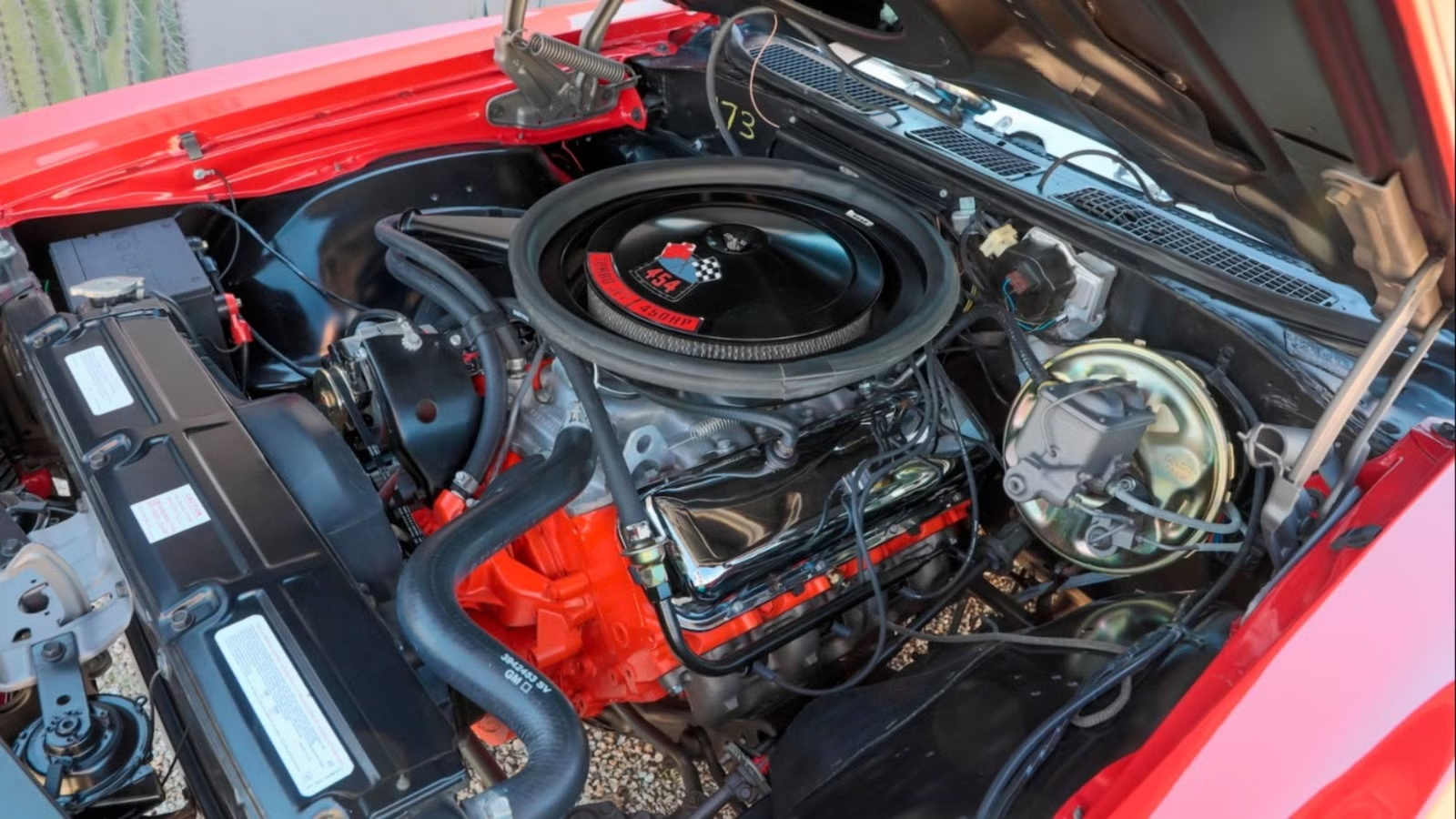
Another GM big block, the ‘454’ was an evolution of the Mk IV big blocks that succeeded the iconic 427, as well as the 396 and 366. Introduced in 1970, the engine produced up to 450 hp and 500 lb-ft in LS-6 configuration.
Legendary cars such as the Chevrolet Chevelle, El Camino, and Corvette offered the 454 as an option, generally sorted into three categories — the LS-5, LS-6, and the special-order LS-7. After the fuel crisis and increasingly stringent emissions regulations forced a push toward fuel efficiency, the 7.4-liter 454 was effectively retired from passenger cars after 1976, though it soldiered on in trucks and buses into the 1990s.
Today, like the Chrysler second-generation Hemi, it remains an icon and a sought-after engine swap for classic car builds.
Mercedes-Benz M156

Specs
|
Mercedes-Benz M156 |
|
|---|---|
|
Engine |
6.2-liter, NA V8 |
|
Dates Produced |
2006-2014 |
|
Block/Head Material |
Aluminum alloy |
|
Power |
451-518 hp |
|
Torque |
465 lb-ft |
The 6.2-liter M156 V8 was designed and built by AMG from the ground up as a racing engine, incorporating motorsport-derived components throughout.
The V8 — which Mercedes-Benz markets as a 6.3-liter despite its actual displacement — was the first engine developed entirely in-house by AMG. It featured a high-strength silicon-aluminum alloy block and incorporated a forged steel alloy camshaft, valvetrain, and intake and exhaust ports adapted directly from AMG’s racing program.
The M156 appeared across a wide range of Mercedes-AMG 63 models during its production run. Today, large-displacement naturally aspirated engines like the M156 have been replaced by downsized turbocharged units — and while those units are efficient and capable, the power delivery and raw character of the M156 are qualities that modern AMG models simply can’t replicate.
BMW S65

Specs
|
BMW S65 |
|
|---|---|
|
Engine |
4.0, 4.4-liter, NA V8 |
|
Dates Produced |
2007-2013 |
|
Block/Head Material |
Aluminum |
|
Power |
414-450 hp |
|
Torque |
295-325 lb-ft |
This engine was fitted to very few models, but it earned its place in history for several reasons. Destined primarily for the E90-generation BMW M3, it broke the mold in 2007 with its eight-cylinder layout in place of the expected inline-six, while its silky power delivery and high-revving character were perfectly suited to the sports sedan, coupe, and convertible body styles.
The German Morgan-esque brand Wiesmann also used the engine. In 2010, the limited-production track-focused M3 GTS used an enlarged 4.4-liter version with an incredible 450 hp and 325 lb-ft, an engine also shared with the even rarer M3 CRT. It did not return for the subsequent M3 generation. While the inline-six is synonymous with the M3 name, the S65 could have found a home in other models — and in a world increasingly dominated by small-displacement turbocharged engines, it represents exactly the kind of V8 we miss.
Ford 429 Cobra Jet

Specs
|
Ford 429 Cobra / Super Cobra Jet |
|
|---|---|
|
Engine |
7.0-liter, NA V8 |
|
Dates Produced |
1969-1971 |
|
Block/Head Material |
Iron |
|
Power |
370-375 |
|
Torque |
450 lb-ft |
Ford’s ‘385’ series of big blocks gave birth to the 7.0-liter 429 and the special Cobra Jet and Super Cobra Jet variants. It is a separate lineage from the ‘FE’ family of engines that produced the 428 Cobra Jet and Super Cobra Jet. The iconic Ford Mustang Boss 429 used this engine. For the Cobra Jet version, which appeared in various models including the Torino and Mustang, key components — cylinder heads, carburetors, camshafts, and valves — were all modified, and the compression ratio was raised.
The Super Cobra Jet added forged rods and pistons, a revised carburetor, and new camshaft and crankshaft profiles, though the advertised power increase was a modest 5 hp. This great engine is now a distant memory, though Ford’s current truck lineup does benefit from the large-displacement 7.3-liter ‘Godzilla.’ Even so, it’s the 429 Cobra Jet that would make the ultimate modern Mustang Boss 429.
Toyota/Lexus UZ

Specs
|
Toyota/Lexus UZ |
|
|---|---|
|
Engine |
4.0, 4.3, 4.7-liter, NA V8 |
|
Dates Produced |
1989-2013 |
|
Block/Head Material |
Aluminum alloy / Iron and aluminum alloy |
|
Power |
230-300 hp |
|
Torque |
258-325 lb-ft |
Toyota’s ‘UZ’ family of engines is celebrated for its reliability and refinement, along with a solid foundation for modification. The UZ was a series of V8s in varying displacements that appeared in everything from the Lexus LS 400 luxury sedan to the SC 430 sports convertible, and even the Toyota Land Cruiser SUV and Tundra pickup. Power and torque outputs were modest by performance standards, but these engines compensated with a durable, proven platform that was also impressively refined.
The case for a UZ comeback is straightforward: they simply don’t make them like this anymore. Many models have since moved to Toyota’s newer V35A turbocharged engines, which don’t offer the same relaxed power delivery or long-term reliability reputation. The UZ’s successor — the ‘UR’ family of V8s — can still be found in Lexus’s current high-performance lineup, keeping the spirit alive if not the letter.
TVR AJP8 ‘Speed Eight’

Specs
|
TVR AJP8 ‘Speed Eight’ |
|
|---|---|
|
Engine |
4.2, 4.5-liter, NA V8 |
|
Dates Produced |
1996-2003 |
|
Block/Head Material |
Aluminum alloy |
|
Power |
360-420 hp (standard) |
|
Torque |
320-380 lb-ft (standard) |
This is another engine that was given a very limited window in which to prove itself — from 1996 to 2003, in just one road-going production model from British boutique brand TVR. It was designed from the ground up by TVR as a replacement for the Rover V8 used in the two previous models, the Griffith and Chimaera, but ended up being used exclusively in the Cerbera coupe.
This flat-plane V8, produced in two displacements with an optional upgrade pushing power to 440 hp, was essentially conceived as a racing engine: relatively lightweight and delivering a high specific output for a naturally aspirated design. The Cerbera was later also offered with TVR’s own ‘Speed Six’ inline-six. The Speed Eight is a simple, punchy, and charismatic engine that embodies the kind of character conspicuously absent from today’s roadsters.
Ferrari F136

Specs
|
Maserati-Ferrari F136 |
|
|---|---|
|
Engine |
4.2, 4.3, 4.5, 4.7-liter, NA V8 |
|
Dates Produced |
2001-2020 |
|
Block/Head Material |
Aluminum |
|
Power |
385-597 hp |
|
Torque |
333-397 lb-ft |
The F136 is a family of 90-degree V8 engines co-developed by Ferrari and Maserati, though built exclusively by Ferrari. It appeared in numerous models for both automakers, with the specification differing between brands — Ferrari applications used a flat-plane crankshaft while Maserati versions employed a cross-plane layout.
Produced from 2001 until 2020, the F136 powered Maserati models including the Coupe, Spyder, Quattroporte, and GranTurismo, while Ferrari’s versions appeared in the 430, 458, and California derivatives. Its successor, the twin-turbocharged and modestly downsized F154, is a capable unit — but it makes the larger, naturally aspirated F136 feel all the more like a traditional supercar engine in the purest sense. That’s precisely why it deserves a second life: in an ideal world, performance cars would use large, free-breathing V8s with nothing to dilute the experience.
Sources: Hagerty, Ferrari, Hemmings, Stellantis, MotorReviewer, ClassicAndSportsCar, Mercedes-Benz, BMW

Related posts

Latest Post



No Comments