
Shelby’s One-Off 427 Cobra Prototype Reveals How Close The Big-Block Idea Came To Dying
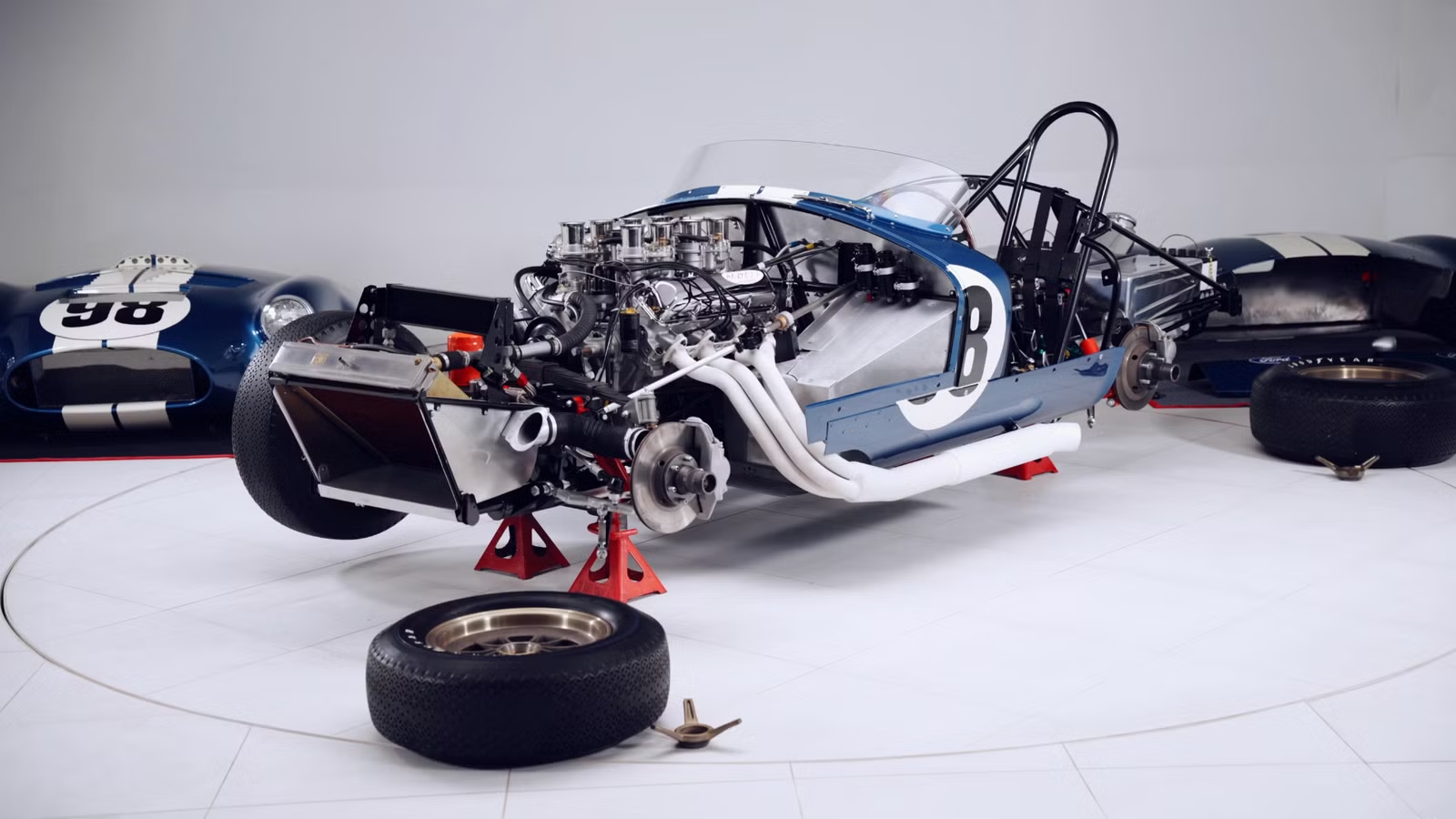
Shelby American built exactly one car like this, and it never built another. CSX2196, listed in The World Registry of Cobras and GT40s as the only 427 Cobra prototype, started life as a stock small-block 289 roadster before Shelby’s crew tore it apart and shoved a big-block 427 under the hood. A detailed YouTube breakdown from Peter Klutt and Legendary Motorcar just gave Cobra historians the clearest look yet at what that experiment actually involved, and the car’s guts tell a story that production figures never would.

The nickname stuck for a reason. Crew members called it “the Flip-Top” because the entire body lifts off in one piece, held down by a handful of Dzus fasteners instead of a permanent mount. Pop those loose, and you’re staring straight down at a chassis Shelby’s mechanics kept revising on the fly, long after the car had already crashed, burned a clutch, and cracked an engine block at Sebring in 1964.
Why Shelby’s Team Even Tried A Big-Block Swap
The idea didn’t come from Carroll Shelby’s office. It came from the shop floor. Ted Sutton, the mechanic who built CSX2196 at Ken Miles’ suggestion, is quoted in the Registry admitting the whole thing was a hard sell internally: “Lots of skepticism went along with this… Making a big snake out of a little one wasn’t the ideal way to go racing. But the concept needed a beginning and you had to start somewhere.” That’s not a marketing line. That’s a mechanic describing a project nobody was sure would work.

Once the 427 went in, CSX2196 became Shelby’s rolling test mule for whether a big-block Cobra could survive real competition, not just a drag strip. The team kept modifying it between races rather than building a second car, which tells you how far from production-ready the concept actually was.
What The Flip-Top Body Reveals About Shelby’s Process
Pull the body off CSX2196 and the sports car looks improvised because it was. The chassis carries a revised frame and extra bracing, plus adjustable lower control arms Ken Miles fabricated himself, not parts pulled from a catalog. Aircraft-grade hardware shows up throughout, and several brake calipers are still stamped with production dates from the early 1960s, leftover stock pressed into service on a car built to answer one question rather than roll off a line.
At roughly 1,800 pounds, the roadster paired that lightweight package with an experimental 390-cubic-inch FE motor. At Nassau Speed Week in late 1964, it ran hard enough to take a lead over the Corvette Grand Sports before the engine let go, the same kind of mechanical failure that had already ended the car’s Sebring outing earlier that year.
Why Shelby Never Built A Second One

CSX2196 proved a big-block Cobra could be fast. It never proved one could finish. Between the Sebring crash, a cracked block, and the Nassau engine failure, every outing ended in mechanical trouble rather than a result Shelby could point to and greenlight a production run. With Ford’s money and attention locked onto the Daytona Coupe and the looming GT40 program, there was no business case for chasing a second big-block prototype that kept breaking.
That’s why CSX2196 stayed a one-off. It wasn’t abandoned because the idea was bad. Production 427 Cobras eventually arrived years later, vindicating the concept. But this specific car, with its experimental control arms and cannibalized brake parts, was never meant to be replicated. It was meant to answer a question, and once Shelby had the answer, the Flip-Top went back in a corner of the shop.
Cobra history is full of cars that won races and cars that made headlines. CSX2196 did neither. It’s preserved today as proof of a dead end Shelby’s own crew had to drive straight into before anyone could build the Cobras that came after it.

Related posts

Latest Post


No Comments