
The British Bike That Guaranteed Its Top Speed Before The Ninja
When you buy a new motorcycle, what are you actually paying for? Early manufacturers wrongly thought buyers were just forking over cash for some steel, rubber, and copper shaped into a bike. In 1924, one British enthusiast realized that riders are paying for the promise of speed.

While other manufacturers were chasing aesthetics or marketing buzz, the ” Rolls-Royce of motorcycles” took a completely different strategy. Its founder revolutionized the industry with a signed warranty guaranteeing that he’d personally tested every motorcycle he sold to exceed a previously unheard of speed. Speed marketing was born half a century early, and the motorcycle market has never been the same.
The Superbike Top Speed Arms Race
Superbike fans are familiar with the top speed arms race between Japanese manufacturers that led to the 1989 Kawasaki Ninja ZX-11, 1996 Honda CBR1100XX Super Blackbird, and 1999 Suzuki Hayabusa. But the first bike sold with a top speed guarantee hit the streets 65 years earlier.

In 1989, Kawasaki rolled out the Ninja ZX-11. In period tests, it hit 175-176 mph and easily claimed the top speed record through 1995. Not to be outdone, Honda engineered a bike just to beat the Ninja.

The 1996 CBR1100XX Super Blackbird had to beat 175 mph to outdo the Ninja. Sure enough, Sport Rider tested it at 178.5 mph. Coincidence? Probably not. Honda had even chosen the bike’s name to call out the SR-71 Blackbird, the world’s fastest aircraft. Honda’s victory was short-lived. In 1999, Suzuki debuted the Hayabusa. The name is Japanese for peregrine falcon, and many suspect it was a jab at the Blackbird, as falcons hunt blackbirds. It raced into the 21st century with a top speed of 194 mph.
By 1999, motorcycle manufacturers agreed the top speed arms race had gone on too long, and manufacturers voluntarily capped their top speeds at 186 mph. But this race hadn’t started with the Ninja. In fact, it started 65 years earlier on a racetrack in England.
England’s First Family Of Motorcycles

William Edward Brough built motorcycles in Nottingham and expected his son George to take over the family factory. George wanted to evolve their people-mover business into high-performance motorcycles, and his father disagreed. So George set up his own factory—Brough Superior—just down the street.
George’s company name was cheeky to say the least. But he had the technical know-how to back up all his trash talk. The younger Brough set to work building his first SS80, a Super Sports bike engineered to hit 80 mph.

George Brough made a splash when he arrived at Brooklands racetrack in 1922 on one of his early machines. He laid down an unofficial 100 mph lap. That was absurdly fast for the day. How fast? That same year, Kenelm Lee Guinness set an official World Land Speed Record in his 350-horsepower Sunbeam at the Brooklands Easter Meeting. His top speed—not his top lap average—was 133.75 mph.
Brough’s legendary lap inspired a now-legendary model.
These Are The Most Awesome British Motorcycles Of All Time
Britain has a rich history of motorcycle development, dating from the dawn of the 20th century until the present. Here are 10 of the best.
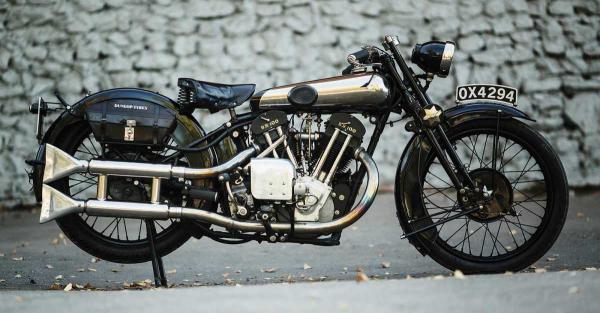
The 1924 Brough SS100
The Superbike With A Personally Guaranteed Top Speed

|
Model |
1924 Brough Superior SS100 |
|---|---|
|
Engine |
Air-cooled OHV V-twin |
|
Displacement |
998 cc |
|
Output |
50 horsepower |
|
Transmission |
Sturmey-Archer three-speed, chain drive |
|
Top speed |
100 mph |
George Brough introduced his SS100 in 1924 with an interesting twist. Every motorcycle was delivered with a hand-signed certificate guaranteeing that George Brough had personally tested its top speed at Brooklands. It was not a gimmick but a form of genuine quality control. When he tested bikes that couldn’t hit 100 mph, he sent them back to the factory for further refinement.
To consistently turn out 100 mph superbikes, Brough bought 998 cc air-cooled OHV V-twin engines from J.A. Prestwich. They made 50 horsepower. He mated these to a three-speed gearbox from Sturmey-Archer, which spun the rear wheel with a chain drive. He designed his own front forks for better handling, then commissioned Castle Fork and Accessory Company to assemble them.

Every SS100 was custom-ordered. Even the handlebars were custom-built to the rider’s measurements. Brough solicited feedback from his customers, improving the motorcycle over its model run. He upgraded to a “super heavyweight” transmission in 1929, introduced rear suspension in 1934, a foot gear-change lever in 1935, a Matchless engine in 1936, and a four-speed Norton gearbox in 1936.
The Brough Superior lineup didn’t stop with the 100 mph top speed guarantee. George Brough eventually introduced a “Pendine” variant with a 100 mph guarantee. The name honored Sir Malcolm Campbell’s multiple 1920s World Land Speed Records at Pendine Sands in Wales.
In 1927, Brough set a 130.6 mph Brooklands top speed record on one of his motorcycles. In 1939, another driver would set a record lap time of 124.51 on an SS100. Bert le Vack, who worked on development at Brough, set seven world records.
The Rolls-Royce Of Motorcycles

Brough Superior’s exacting build quality earned it an unofficial nickname: “the Rolls-Royce of motorcycles.” Then Rolls-Royce caught wind of the phrase and showed up at the factory. The automaker wasn’t leveling a lawsuit. It was genuinely curious about the bikes’ build quality. After a factory tour, it gave Brough Superior official permission to use the phrase “Rolls-Royce of motorcycles” in marketing.
Unsurprisingly, this brand positioning attracted a wealthy and celebrity clientele. Brough Superior’s most famous customer may be T.E. Lawrence (a.k.a. Lawrence of Arabia). The famous WWI veteran bought one of the first SS100s built in 1925. He owned multiple Brough Superior bikes over the years. Sources place the number at between six and eight. In 1935, he was riding an SS100 on a narrow road and crashed after swerving to avoid two boys on bicycles. He died after six days in a coma. His doctor, Sir Hugh Cairns, was inspired by the incident to develop the modern crash helmet.
The First Production Bike To Run A 10-Second Quarter Mile
It was a benchmark that manufacturers were vying to hit, but who actually hit it first?
A Superior Legacy

George Brough converted his factory to build airplane engine parts during WWII, and ceased all motorcycle development. The Brough Superior’s high-end reputation has outlasted the company by decades.
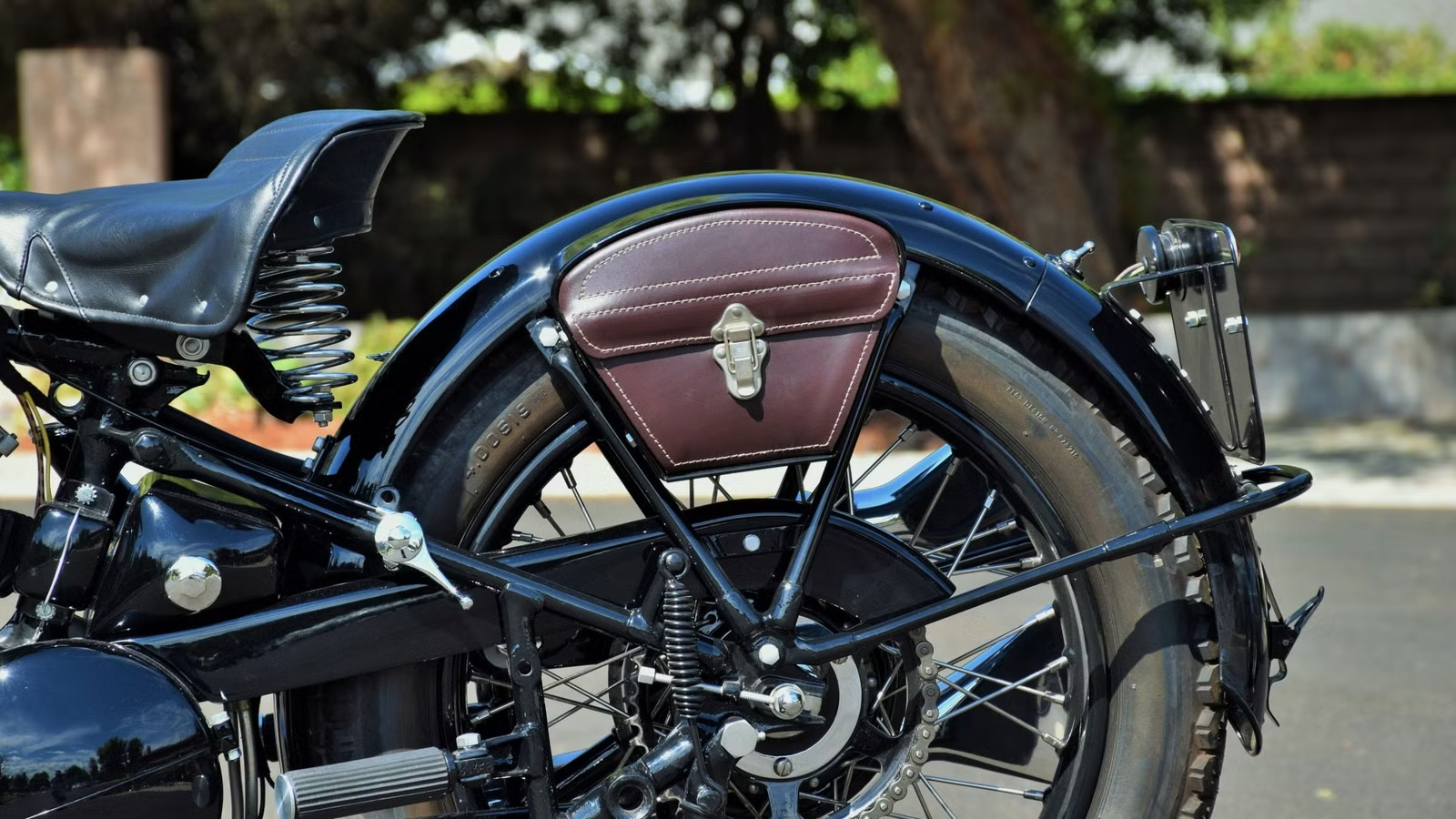
In 2008, an SS100 sold at a Bonhams auction for $219,097.35, breaking the record for a British motorcycle. In 2010, a 1929 SS100 sold at Haynes International Motor Museum for $376,303.41, breaking the record for any motorcycle. SS100 frame number 8/1496 (pictured) sold through Mecum Auctions in 2022 for $236,500.

In 2013, a revived Brough Superior company unveiled a retro-styled SS100 with a modern 120-horsepower engine set in a magnesium, titanium, and aluminum chassis. It even came with carbon-fiber wheels and the first four-disc front brakes on any production motorcycle.
Sources: National Motorcycle Museum, Audrain Auto Museum

Related posts
Latest Post



No Comments