
The Tourer That Gives You Harley-Davidson Comfort Without Harley-Davidson Prices
Harley-Davidson has made the jump from bagger to full-dress touring motorcycle an expensive one. Consider the Street Glide or the Road Glide, which are priced in the mid-$20,000 range, but once the factory adds the equipment needed for serious two-up, long-distance travel, the price moves beyond $30,000. That is a big ask if the priority leans more toward comfort rather than just having the Bar and Shield on the tank.

The good news is that Harley-Davidson does not have this part of the market entirely to itself. There is a European heavyweight with the same low-slung presence, relaxed highway character, proper passenger accommodations, and enough luggage capacity for long trips. Better still, it costs about the same as a regular Harley bagger rather than one of Milwaukee’s fully dressed touring flagships.
Full-Dress Touring Comfort Has Become A $30,000 Conversation
A standard bagger and a full-dress tourer can look closely related on the face, but the difference becomes obvious once a passenger and their luggage are taken into account. Now you need substantially more space alongside a supportive pillion seat with a backrest, as well as cold-weather equipment to turn a stylish, minimal highway cruiser into something capable of keeping two people comfortable for several hundred miles a day.

Harley-Davidson’s pricing shows what that extra touring ability costs to be put on a bagger. The 2025 Street Glide Ultra started at $30,749, but the new 2026 Street Glide Limited has moved the full-dress price to $32,999. It brings a Grand Tour-Pak, heated rider and passenger seating, heated grips, a tall windshield, lower fairing, premium audio, and the 12.3-inch Skyline OS display.

The regular 2026 Street Glide and Road Glide are priced much lower and those are important reference points because they prove that buying a Harley tourer does not automatically mean spending over $30,000. They are baggers, however, rather than direct substitutes for a factory-equipped, two-up dresser. Once a trunk, passenger backrest, heated seating, and extra weather protection become part of the package, the comparison moves into a whole different price bracket despite some similarities.
So the real value question is not whether another motorcycle can undercut a basic Street Glide. It is whether it can deliver the equipment and passenger accommodations of the Limited for something much closer to standard-bagger money. It’s a difficult task considering all the extra equipment that does cost money, but BMW seems to have cracked that problem with a solution that is in equal parts characterful and cost-effective.
The BMW R 18 Transcontinental Offers Full-Dress Touring For $24,395

BMW’s solution is the R 18 Transcontinental, the full-dress member of its Big Boxer cruiser family and a machine developed specifically for relaxed, two-up touring. It joined the R 18 range for 2022 alongside the bagger-style R 18 B, then received an emissions update and another four pound-feet of torque for 2025.
BMW still lists the 2025 model at $24,395, although the R 18 family was absent from BMW Motorrad USA’s 2026 model-year update. At that price, the Transcontinental sits much closer to a standard Street Glide than a Street Glide Limited, despite equipping itself from the factory with the top case, tall windshield, heated seat, lower fairing, passenger backrest, and broader touring focus expected of the latter.
The Big Boxer Is Tuned For The Job

The centerpiece of the R 18 Transcontinental is, of course, BMW’s 1,802cc air and oil-cooled boxer twin, which produces 91 horsepower at 4,750 rpm and 120 pound-feet of torque at 3,000 rpm. More tellingly, BMW says that at least 110 pound-feet is present from 2,000 to 4,000 rpm.
That broad, low-speed power delivery range suits a motorcycle intended to settle into top gear with the additional load and respond without demanding frequent downshifts. Peak torque arriving so early also lets the rider short-shift through the six-speed gearbox and use the engine’s midrange better. An exposed shaft drive completes a powertrain designed around steady mileage.

There is plenty of motorcycle for that engine to move. At 954.6 pounds road-ready, the R 18 Transcontinental is a hefty motorcycle. But thankfully, the chassis is built around stability and load carrying. Both ends provide 4.7 inches of suspension travel, while the rear suspension uses automatic load compensation to maintain the intended ride height as weight changes.
BMW Did Not Treat Passenger Comfort As An Afterthought

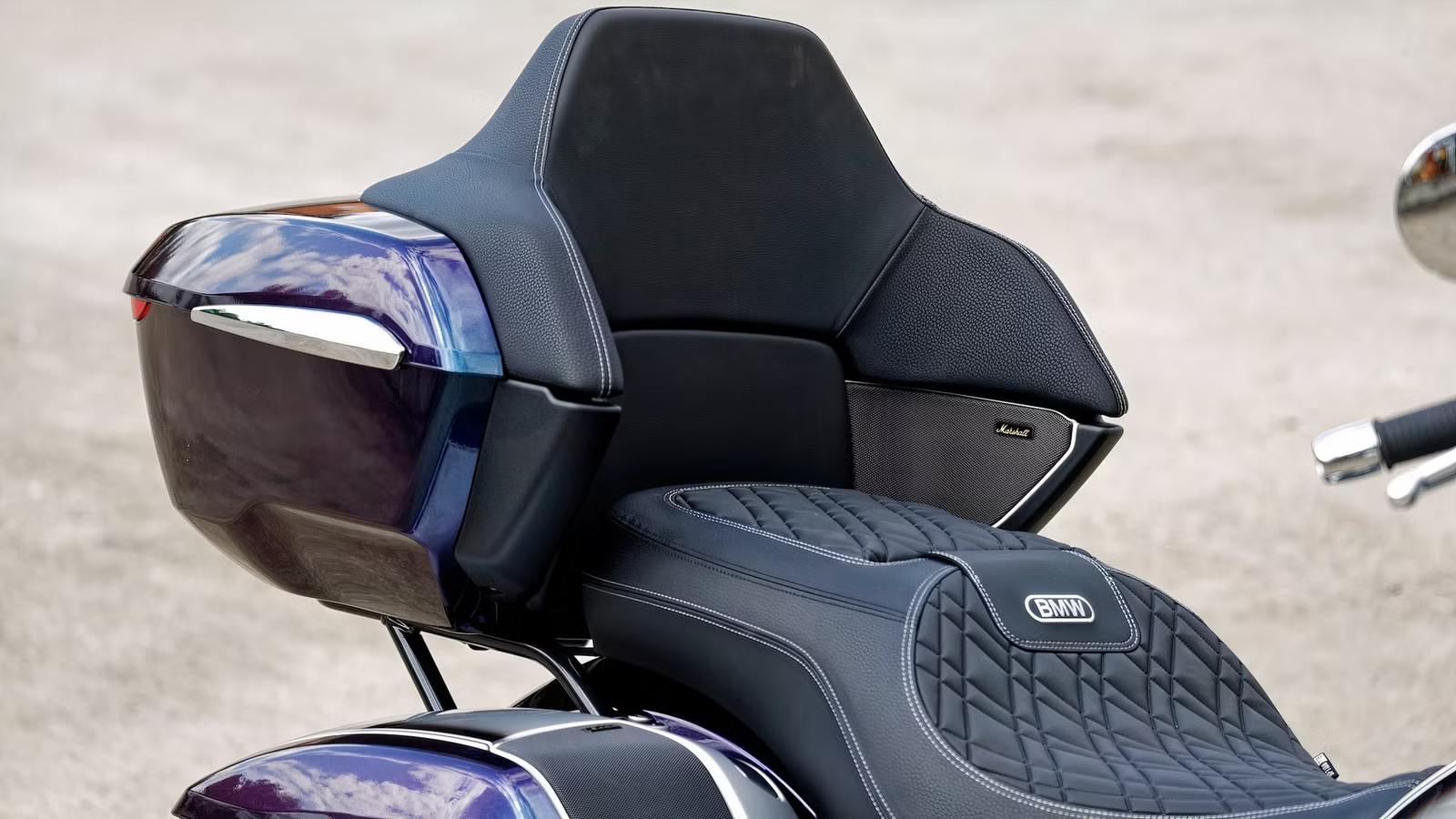
A 29.1-inch seat height places the rider low in the motorcycle, while both rider and passenger floorboards create a relaxed but relatively neutral lower-body position. The heated seat is paired with a broad passenger perch and an integrated backrest built into the body-color top case. A tall windshield, fairing lowers, adjustable cockpit vents, and fixed wind deflectors around the engine guards handle the other major source of long-distance fatigue that wind blast presents to any motorcycle.
Each side case holds roughly 7.1 gallons, while the top case adds about 12.7 gallons, giving the standard setup almost 27 gallons of hard storage. A separate compartment in the fuel tank also provides phone storage and charging, while fuel capacity is 6.3 gallons.

Four analog instruments sit above a 10.25-inch TFT display with connectivity and app-based navigation, while heated grips, cruise control, keyless operation, three riding modes, full integral ABS, and full LED lighting are standard. BMW does, however, charge extra for Active Cruise Control, central locking, tire-pressure monitoring, Hill Start Assist, upgraded Marshall Gold Series Stage 2 audio, and the anti-theft alarm.
Automatic Load Compensation Is The Silent Luxury Feature

Heated seats and large screens are the obvious selling points for any touring motorcycle, but suspension behavior matters more after the bags are packed. The Transcontinental’s rear shock uses a height sensor and an electrohydraulic preload adjustment system to compensate automatically for changes in load. Add a passenger and luggage, and the system works to restore the designed ride height.
That has two benefits for a heavyweight tourer. It preserves useful suspension travel and keeps the chassis geometry closer to where BMW intended it, without the need for calculating preload settings every time the load changes. The system, of course, cannot make 954.6 pounds disappear, and the fork remains a conventional non-adjustable unit, but it addresses a problem a full-dress motorcycle encounters far more often.
Harley Still Has Its Advantages, But BMW Makes The Price Gap Hard To Ignore

The same model-year comparison with a 2025 Street Glide Ultra at $30,749 puts it $6,354 above the 2025 R 18 Transcontinental. The Harley has more power, a larger 12.3-inch interface, strong factory audio integration, and a touring platform refined over generations. The 2026 Street Glide Limited further improves performance with 106 horsepower, 131 pound-feet, improved aerodynamics, and a lower 893-pound running weight, but it also widens the gap to $8,604 against the BMW.

The BMW is not without its flaws, either. It is heavier, the boxer cylinders restrict leg movement, and several convenience features remain optional. Yet the expensive pieces of the full-dress experience are there as standard, including weather protection, heated seats, a passenger backrest, substantial hard luggage, floorboards, infotainment, and load-compensating rear suspension. So, for riders who want Harley-style cross-country comfort without paying Harley full-dresser money, the R 18 Transcontinental is a solid value proposition.
Source: BMW Motorrad

Related posts




Latest Post


No Comments