
This Cheap Plymouth Made Hemi Owners Look Like Fools
If you ask a novice car enthusiast what they think the quintessential Mopar V8 of the ‘60s was, they’ll tell you loudly and with pride in their chests that it was the 426-cubic-inch Hemi. On the face of it, they wouldn’t be wrong at all. Yet, the real faithful, the people who’ve categorized every V8 in the lineup by heart for decades by now, know the Hemi was far from the be-all and end-all of Mopar performance. If anything, you could get pretty darn close without spending nearly as much money at the dealership. Today, we show you how the blue-collar working man could option a Hemi killer in the middle of 1969.
The Hemi: An Iconic V8, But With a Price

So, what is it exactly that made the 426-cubic-inch Hemi such an absolute barn burner? Well, its core design principles weren’t exactly new. Chrysler Group had been manufacturing big-block V8s with hemispherical combustion chambers since 1951. Instead, the bespoke second-generation Hemi engine had a lethal combination of free-flowing internals, high rev-range screaming power, and high-displacement brute force that made it the most desirable Mopar/Chrysler motor of its era.
In cars like the Dodge Charger and Challenger, plus the Plymouth Road Runner and Hemi ‘Cuda, the 426 Hemi was a means to flex on your friends as much as it was an all-time great engine. It was a race-bred homologation monster with its roots in the crucible of NASCAR Cup competition; a 426 Hemi churned out 425 hp way up in the rev range at 5,000 RPM. Of course, knowing how American automakers used to fudge the numbers back in the day, the true number was probably closer to 475 or even 500 horsepower. The difference between gross horsepower and net horsepower skewed numbers even further, but the Gen-II Hemi was an iconic engine regardless of the specifics.

Given the notoriety, you won’t be shocked to learn the price to equip your Charger, Challenger, or ‘Cuda with a Hemi spiked the price of the car considerably. For some context, a Charger equipped with a 383-cubic-inch V8 sold for around $3,100 in 1969, or just under $28,295 in modern money. Upgrading to the 426 Hemi added a whopping $650 in 1969 money to the price. In modern money, that’s the equivalent of nearly $6,000 extra just for the fancy engine. For the working man of the day, that was just a little bit too much for most to stomach. With that said, there was at least one viable workaround.

The 440 Super Commando V8: A Very Different Beast

If you weren’t quite prepared to gut your bank account for the Hemi with racing credentials, Mopar had other means of squeezing your wallet, but far less aggressively this time around. Enter the 440 V8, also known as the Super Commando in the Plymouth lineup and the Magnum in Dodge land. While both the 440 and 426 Hemi belonged to Chrysler’s raised block (RB) big-block family and packed the same bore spacing as well as deck height, the two used entirely different castings and radically different hardware.
The Hemi’s head bolts were positioned differently to accommodate the free-breathing heads. As a result, the 440 used conventional wedge-shaped heads, hydraulic lifters, and a simplified valvetrain. Where the Hemi used clever physics and peak combustion efficiency to make big power high in the rev range, an RB 440 used pure cubic displacement and maximum machismo to make low-end torque at a biblical scale. While official ratings pegged horsepower at 375 hp, good old-fashioned underrating meant the number was closer to 400-plus.

As for torque, that was a stump-pulling 480 lb-ft, peaking in the middle of the rev band at 3,200 RPM. Considering a 440 could only rev to 5,000 RPM before the lifters started to float, the 440 offered a radically different operating experience compared to the more famous, well-celebrated Hemi. Overall, the 440 bridged the gap between lower-tiered V8s and the Mopar flagship with remarkable skill, and in the case of Plymouth specifically, did so at an astonishing fraction of the price.
The 1969½ A12 440 Six Barrel Package: Hemi-Challenging Performance, Cheaper Price

The Road Runner — we all know it, we all love it, and it had a character about it the likes of which we’ll probably never see from a production car ever again. Midway through the 1969 model year, the Road Runner developed another interesting quirk as a budget Hemi killer. Enter the A12 option code. For $462.80, or roughly $4,200 and change in today’s money, Plymouth could upgrade your Road Runner 383 into a bona fide street brawler with that very same 440 we just profiled.
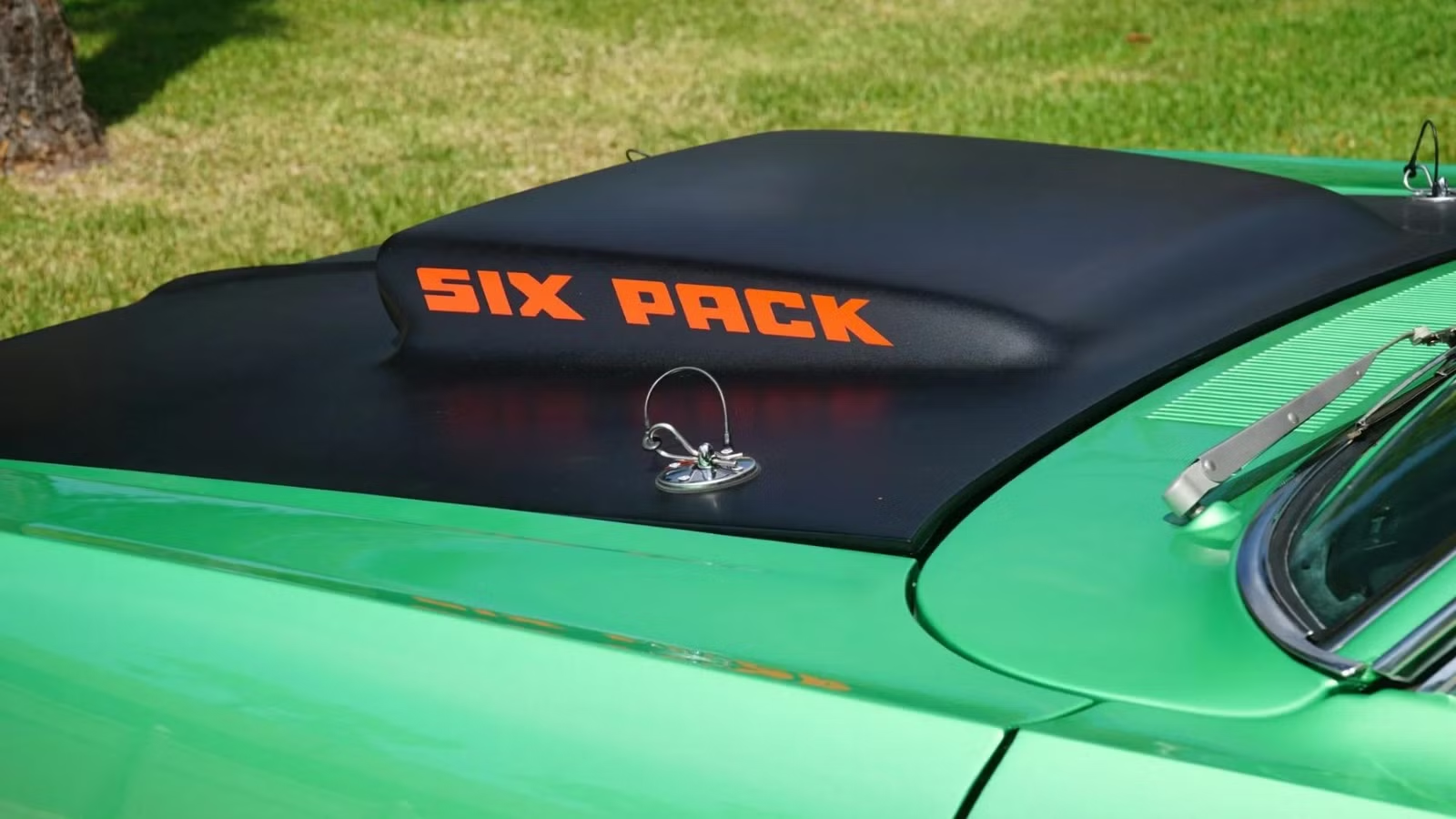
Its hood, made of matte-black fiberglass, was secured only by four pin clips and not even hinged to the car. The 15×6 “H-Code” black steel wheels weren’t topped by chrome hubcaps, giving the car an absolutely vicious look, and the Dana 60 rear axle with 4.10 gears let you know right away this wasn’t your average 440. The A12-packaged Road Runner needed that extra beef under the skin because when you peeled away that removable hood, a 1969-only Edelbrock aluminum intake manifold and three two-barrel Holley carburetors were staring right back at you. In later years, Chrysler group forced the Road Runner back onto a cast-iron intake to cut costs, but with this setup, 375 officially jumped up to 390.

Torque figures were even more impressive at an astounding 490 lb-ft. When the NHRA, America’s premier sanctioned drag racing operator, decided to test the engine on its own dynos, it was found the “Six-Barrel” 440 actually made closer to 410 hp. That was good enough for a 12.91-second quarter-mile sprint and a zero-to-60 blitz in the mid-5s. For some modern context, that’s about as fast as a 2026 Subaru WRX or a Golf GTI, but with ten times the character. When Plymouth handed the keys to the very first A12 Road Runner over to drag racing icon Ronnie Sox, he hit a blistering 111 mph over open throttle. While the official production run count is a little muddy, various sources claim anywhere from 797 to around 1,400 A12 Road Runners were built, with roughly 400 being four-speed manual hard-tops.
Big Power, Big Rarity, Huge Value

Today, an A12 Road Runner is an absolute must-see at any classic car auction it attends. In recent years, examples have sold for between $145,000 and $165,000 for Concours-grade originals, around $100,000 for well-preserved examples with a few flaws, and A12 tribute cars can easily run you in the mid-50s, but don’t mistake them for the real thing.
For most of us, the tribute cars are as close as we’ll ever get to the right to drive the real thing.In short, the A12 is one of those rare cars that serious collectors battle over at the auction block, while the rest of us can only watch in amazement as a genuine Hemi destroyer makes an appearance. Such is the way things go with classic Mopars — they’re worth their weight in gold nowadays. Well, not quite, but it might very well get there one day.
Source: Bring a Trailer, Mecum

Related posts




Latest Post



No Comments