
Suzuki’s Mid-1980s Cruiser Design Outclasses Harley’s $15,999 Sportster On Price And Repair Costs
Cruiser Motorcycles have always sold a little fantasy alongside the hardware. In America, that fantasy can get expensive pretty quickly when a famous badge adds thousands of dollars before fuel, maintenance, or repairs enter the equation.

Look beyond the obvious American cruiser choices, though, and some far cheaper motorcycles make a compelling ownership case. One especially simple Japanese design turns old-school engineering into a financial advantage that gets harder to ignore with every passing mile.
Harley’s Cheapest Sportster Still Carries A Serious Brand Tax
Harley-Davidson occupies a position in American motorcycle culture that few manufacturers can touch. The name carries history, image, and the sort of instant recognition that makes a motorcycle feel like part machine and also a bit of a membership card. No doubt, that emotional appeal has value, but the $15,999 Sportster price point also places Harley’s entry-level cruiser in a completely different financial bracket from several affordable cruiser motorcycles sold in the USA.

Consider the gap before a rider even starts thinking about motorcycle maintenance costs. Against a Suzuki priced at $5,799, the Harley asks for another $10,200 upfront. Put it beside the $8,699 Honda Shadow Phantom and the difference is still $7,300. That’s enough money to change the entire economics of long-term motorcycle ownership, particularly for riders shopping for a dependable cruiser rather than a lifestyle purchase with two wheels attached.
Serious Questions

Needless to say, sticker price also determines how much financial breathing room an owner has later. A cheaper motorcycle leaves far more cash available for tires, routine servicing, replacement parts, and the occasional repair that comes with keeping any machine on the road. That equation matters enormously in the used motorcycle market, where a low purchase price combined with simple mechanicals can make ownership far less intimidating.
Harley can still justify its premium to someone who wants the sound, heritage, and American identity wrapped around the Sportster name. Yet riders focused on affordable cruiser motorcycles have another question to ask: how much of that $15,999 price is going toward engineering they’ll actually use, and how much is being paid for the badge sitting on the fuel tank?
Simple Cruisers Keep Winning After The Purchase

Japanese cruiser motorcycles have traditionally approached the problem from the opposite direction. Their appeal often comes from proven engines and straightforward servicing rather than trying to turn every ride to the grocery store into a reenactment of an outlaw motorcycle movie. That philosophy can look decidedly sensible once the odometer starts adding miles.
The Yamaha V Star 250 takes that simplicity almost to its logical extreme. At a price of $4,799, it uses a 249cc V-twin rated at 21 horsepower and carries a 324-pound wet weight. Its 27-inch seat height also makes it approachable for newer riders, while inexpensive maintenance and broad aftermarket support strengthen its case as an affordable used cruiser motorcycle in America.
The Larger Lesson

Performance is modest, obviously. Twenty-one horsepower won’t turn the V Star 250 into an interstate missile, and riders expecting effortless high-speed passing power should look elsewhere. What it offers instead is a mechanically uncomplicated platform with easy-to-find replacement parts, which can matter far more to someone commuting around town or spending weekends on local back roads.
At the risk of sounding a tad preachy, there’s a larger lesson here for anyone comparing cheap cruiser motorcycles with a Harley-Davidson Sportster. Total ownership cost isn’t determined by MSRP alone. Simpler motorcycles can keep repair costs under control because there’s less complexity to diagnose and fewer expensive systems standing between an owner and an afternoon ride.
Suzuki’s Boulevard S40 Turns Old-School Engineering Into An Advantage

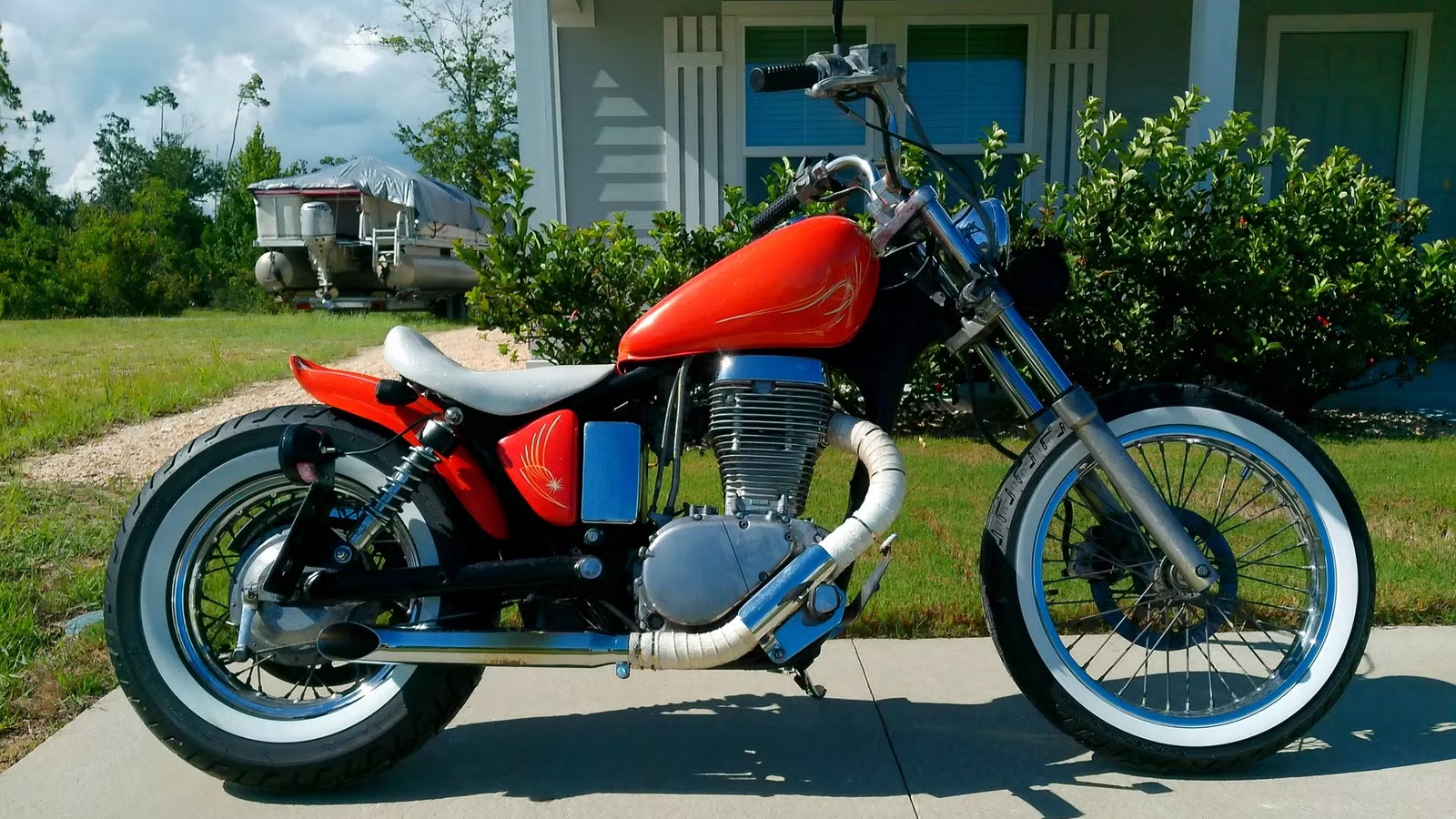
The Suzuki Boulevard S40 takes that argument and gives it a 652cc single-cylinder engine. Its basic design traces back to the mid-1980s LS650 Savage, making it something of a mechanical time capsule in the coolest possible sense. The later Boulevard S40 sticks with a straightforward formula rated at 31 horsepower and paired with a five-speed transmission, all for a $5,799 price (when new. Used prices up the value even further).
It’s easy to see how that number changes the comparison immediately. Against a $15,999 Harley-Davidson Sportster, the Suzuki Boulevard S40 comes in $10,200 cheaper before the first service appointment. For someone searching the used motorcycle market in the USA, that difference gets even more interesting because the S40’s appeal has always centered on simplicity rather than expensive tech.
Its physical dimensions help, too. The Suzuki weighs 380 pounds wet and has a 27.6-inch seat height, making it relatively manageable for a cruiser motorcycle. More important for long-term ownership, the S40 has a reputation for inexpensive maintenance, strong parts support, and the broader reliability associated with simple Suzuki motorcycle engineering. There’s nothing particularly exotic hiding under the tank, which becomes increasingly attractive once a bike has spent several years accumulating miles.
Mechanical simplicity also affects motorcycle repair costs in ways a spec sheet can’t capture. Shop labor can become expensive when technicians have to spend hours diagnosing complicated systems or removing layers of hardware just to reach a failed component. A basic single-cylinder cruiser has fewer opportunities to turn a small problem into a large invoice. For people looking for a reliable used cruiser in North America, that kind of old-school engineering can age brilliantly well.
Honda’s Shadow Phantom Makes Harley’s Premium Even Harder To Defend

To add to things, the Honda Shadow Phantom offers a stronger answer for riders who want something closer to the traditional American cruiser recipe. Its 745cc liquid-cooled V-twin gives it the engine layout many cruiser fans expect, while its $8,699 MSRP keeps it thousands of dollars below the $15,999 Sportster benchmark.
That $7,300 gap is important because the Honda doesn’t feel like the budget option in the usual sense. The Shadow name’s been around for decades, and the Phantom combines familiar V-twin character with the reliability reputation that helped Japanese motorcycles become such a force in the American market. Riders wanting a substantial cruiser without Harley-Davidson pricing have a very straightforward alternative.
Compelling Proposition

If you think about it, the comparison also highlights how broad the affordable cruiser market has become. The Suzuki Boulevard S40 appeals through simplicity and low repair costs, while the Honda Shadow Phantom brings more engine capacity and a more conventional V-twin layout. Neither requires a rider to spend Sportster money just to park a cruiser in the garage.
For long-term ownership, Honda’s formula may be the easier sell for someone who regularly covers more miles or wants more capability than the smallest entry-level cruisers can offer. The Shadow Phantom keeps the traditional cruiser experience intact while leaving a sizeable chunk of the budget untouched, which is a compelling proposition for American riders who’d rather spend their money riding than servicing a loan.
A Decade Of Ownership Is Where Cheap Cruisers Really Win

Royal Enfield’s Meteor 350 adds useful real-world context to the low-cost cruiser motorcycle argument. When it entered the United States for the 2021 model year, the base Fireball version carried a $4,399 price. Fuel economy hovered around 67 mpg, while outright speed stayed modest, with roughly 75 mph achieved on a downhill run.
That makes the Meteor 350 way better suited to city riding and relaxed secondary highways than sustained high-speed interstate travel. In much of the USA, where freeway traffic can comfortably run above 70 mph, that’s a limitation that’s hard to ignore. The Meteor’s appeal comes from low running costs and accessible performance rather than pretending a 350cc cruiser can cover every kind of American riding.
The Value Quotient

There’s some pretty convincing long-term ownership data that strengthens the argument. One owner covered roughly 37,000 miles while spending the equivalent of around $540 on servicing and maintenance. That figure comes from Indian-market experience rather than a United States dealership, so it shouldn’t be treated as a prediction of what an American rider will pay. Still, it gives useful perspective on what a simple, modestly powered motorcycle can cost to keep moving over substantial mileage.
Put all of these motorcycles together and the Suzuki Boulevard S40 stands out because its design attacks ownership cost from both directions. Its $5,799 price dramatically undercuts the $15,999 Harley-Davidson Sportster, while straightforward mechanicals help support the case for lower repair costs later. The Honda Shadow Phantom adds more traditional V-twin substance, while the Meteor 350 and Yamaha V Star 250 push affordability even further. Granted, Harley sells one of the strongest motorcycle identities in America, but there’s no denying the value you get when the engineering stays simple and the logo doesn’t set the price.
Sources: Monimoto, Cycle World, Bikewale, Harley-Davidson, Suzuki, Honda, Yamaha

Related posts

Latest Post


No Comments